
Euspermophagus seed beetle
Euspermophagus
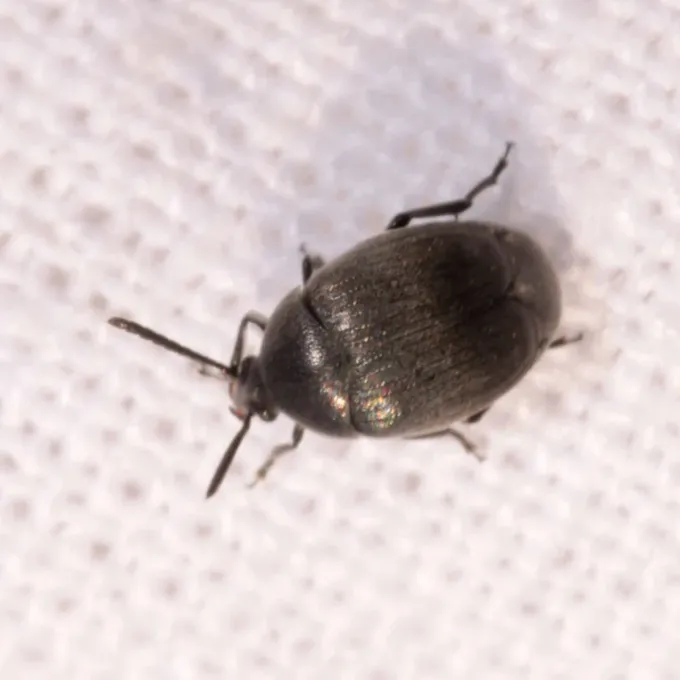
Description
How to identify
Beetles of the genus Euspermophagus belong to the family Bruchidae (seed beetles) within the order Coleoptera. These are small insects, typically 3–5 millimeters long, featuring an oval body shape and often a dark, sometimes spotted, coloration.
The head is noticeably retracted into the pronotum, and the antennae are serrated or pectinate, which serves as an important diagnostic feature. The larvae are pale, equipped with well-developed mouthparts, and live a concealed life inside the seeds of host plants.
Adults are capable of flight, allowing them to actively disperse to fields during the flowering and pod formation stages. Identification can be made through close inspection of seeds or by observing specific exit holes created when the adult beetle emerges.
Precise identification is difficult due to the morphological similarity between many seed beetle species, often requiring laboratory examination of the genitalia. In the field, agronomists should focus on the presence of beetles on flower clusters during morning hours.
Eggs are typically laid singly on the surface of developing pods, making visual detection of egg-laying sites extremely challenging without the aid of magnification tools.
What it damages
The primary crops attacked by Euspermophagus seed beetles are members of the legume family. Damage occurs both in the field and during post-harvest storage, where these insects can destroy a significant portion of the seed stock.
The larva penetrates the seed and consumes the embryo and endosperm tissues, leading to a complete loss of germination potential. Seeds damaged by the pest are unsuitable for sowing and lose their nutritional value for human and animal consumption.
Beyond direct physical damage, the presence of larvae inside seeds promotes the development of secondary fungal infections and mold. This results in the spoilage of entire batches of produce if stored improperly in warehouses and silos.
The greatest damage occurs in warm, dry years when the pest's life cycle accelerates, allowing the population to reach high densities within a single season. Some species may also infest seeds of wild plants, which serve as reservoirs for future infestation of cultivated crops.
Yield losses can range from 10 to 50 percent, depending on the severity of the infestation and the effectiveness of storage conditions after harvesting.
When it appears
The activity of adult Euspermophagus begins in the spring and summer when air temperatures reach optimal levels for emergence from overwintering sites. This process usually coincides with the budding or flowering phase of legume crops.
Multiple generations of the pest can develop throughout the summer if climatic conditions remain favorable. The rate of development is directly proportional to the accumulation of active temperatures in the growing region.
Larvae develop actively inside seeds as they mature in the field. With the onset of autumn and falling temperatures, development may slow down, but if infested seeds are moved into storage, the life cycle often continues due to stable indoor temperatures.
Overwintering of adults or late-stage larvae typically occurs within seeds left in the field or in facilities where infested grain is stored. This makes warehouses the primary source for population renewal in the following season.
Understanding the phenology of the pest enables agronomists to correctly time insecticide applications by focusing on periods of peak beetle activity prior to egg-laying.
Signs of infestation
The key sign of infestation is the presence of small, nearly circular holes on the seed surface, through which adult beetles emerge. When inspected with a magnifying glass, one can identify "windows" — places where the larva thinned the seed coat before pupation.
Microscopic egg-laying marks are often visible on the surface of legume pods, appearing as tiny light-colored spots. Detecting these marks during early maturation stages is a signal to initiate protection measures immediately.
- Presence of emergence holes on the seed surface.
- Empty, hollowed-out seeds upon dissection.
- Presence of adult beetles on pod surfaces or inside grain bags.
- Reduced seed weight (infested seeds become very light).
- Presence of dust-like debris (excrement and seed particles) inside containers or silos.
Control measures
Protection against Euspermophagus requires a holistic approach, combining agronomic, biological, and chemical control methods. The primary requirement is crop rotation, which prevents legumes from returning to the same field for at least 3–4 years.
An important preventive measure is early harvesting to minimize the time available for beetles to re-infest pods in the field. Drying seeds to a moisture level below 14 percent makes them significantly less suitable for larval development.
In grain storage facilities, effective control methods include fumigation of warehouses and produce using authorized specialized chemicals. It is also recommended to clean grain to remove damaged seeds, as these are where the pest tends to concentrate.
Chemical control in the field involves spraying crops with contact-stomach insecticides during peak flowering when pests are most vulnerable. The selection of products must consider the safety of pollinators.
Biological control involves the use of entomophages — natural enemies of seed beetles — which can limit pest population numbers in natural conditions without the use of toxic chemicals.
Taxonomy
- Latin name
- Euspermophagus
- Order
- Coleoptera (beetles)
- Family
- Bruchidae
- EPPO code
- EUSMSP
Discussion
No discussions yet — be the first.