
Honey locust beetle
Caryobruchus gleditsiae
Description
How to identify
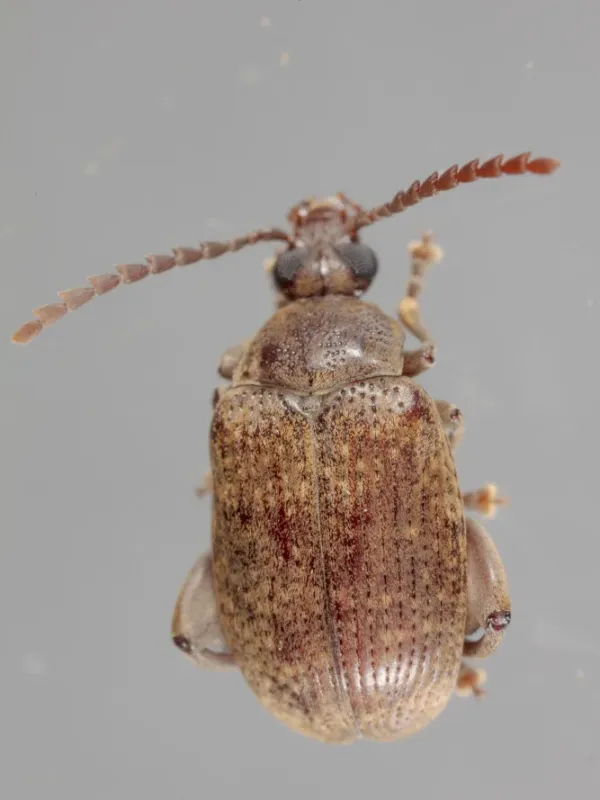
The honey locust beetle (Caryobruchus gleditsiae) is a member of the Bruchidae family within the Coleoptera order. Adult beetles are small, typically ranging from 4 to 5 mm in length, with a brownish, oval-shaped body and distinct patterns on their elytra.
The larvae are whitish, legless, and have a curved, fleshy appearance. They are specifically adapted to thrive within the hard seeds of legume plants, completing their entire larval stage inside the seed pod.
The eggs are minute and oval, often deposited on the surface of developing seed pods. Females secure them with a sticky secretion that provides protection against environmental stress and predation.
The development rate of this beetle is highly temperature-dependent. Warm weather significantly accelerates their life cycle, leading to rapid population growth in infested stands of honey locust trees.
Adult beetles are capable of flight, which allows them to disperse effectively across landscapes during the summer season to locate new seed pods for egg-laying.
What it damages
This beetle primarily infests the pods and seeds of the honey locust tree (Gleditsia triacanthos). It is considered a specialized seed pest that can significantly affect the viability of the seeds.
Larvae bore into the seeds upon hatching, feeding on the endosperm and destroying the embryo. This activity renders the seeds completely non-viable for future planting or natural forest regeneration.
Severe infestations can result in the destruction of the vast majority of seeds within a single crop. This poses a major threat to both nursery production and the reforestation of affected regions.
Beyond direct feeding damage, the tunnels bored by the larvae create entry points for secondary fungal and bacterial pathogens, which contribute to the premature decay of the seed pods on the trees.
The presence of this pest imposes significant trade restrictions, as infested seeds cannot be legally transported between different jurisdictions due to strict phytosanitary regulations.
When it appears
The active life cycle begins during the summer when adult beetles emerge from their overwintering sites. They immediately begin seeking host trees to begin the reproductive process.
Egg-laying coincides with the development of the seed pods. As soon as the pods are available, the females deposit their eggs, starting the infestation cycle for the next generation.
The larval stage occurs throughout the autumn, with intense feeding taking place inside the seed. The beetle larvae are essentially hidden within the seeds during this period, making them difficult to detect.
Adult beetles of the new generation typically emerge in late autumn or the following spring. In controlled environments like storage facilities, the life cycle may continue year-round if temperatures remain favorable.
The pest overwinters primarily in the adult or mature larval stage, protected inside seeds that may be hanging on the trees or lying on the ground among leaf litter.
Signs of infestation
The most visible sign of an infestation is the presence of small, circular exit holes on the surface of the seeds, which are created by the adult beetles when they emerge.
Close inspection of the pods often reveals the tiny, whitish egg clusters left by the females. These are usually concentrated on the outer skin of the seed pod.
Dissecting an infested seed typically reveals a hollowed-out interior filled with frass (larval waste). One may also find the larvae or pupae still residing within the cavity.
Deformed or unusually lightweight seeds are another indicator of damage. When the embryo is consumed, the seed loses its density and structural integrity, appearing shriveled or discolored.
Finding live adult beetles in stored seed lots is a clear indication that the seeds were infested in the field before the harvest took place, requiring immediate treatment.
Control measures
The primary control measure is the early harvest of seed pods. Collecting seeds before the beetles complete their development and emerge is essential for preventing the spread of the pest.
Fumigation of seeds in sealed storage facilities using approved insecticides is necessary to eradicate hidden populations of larvae and adults within the seed lots.
Thermal treatment is an effective, chemical-free method. Heating the seeds to temperatures between 50 and 60 degrees Celsius for several hours kills the larvae without significantly impacting seed viability.
Sanitation is critical; cleaning up fallen pods from under trees in the autumn reduces the availability of overwintering sites for the next year's population.
- Monitor beetle populations using pheromone traps placed in seed orchards.
- Maintain spatial isolation between new nurseries and existing infested stands.
- Strictly adhere to phytosanitary certificates when sourcing seeds for forestry.
Taxonomy
- Latin name
- Caryobruchus gleditsiae
- Order
- Coleoptera (beetles)
- Family
- Bruchidae
- EPPO code
- CRBRGL
Discussion
No discussions yet — be the first.