
Groundnut seed beetle
Caryedon serratus
Description
How to identify
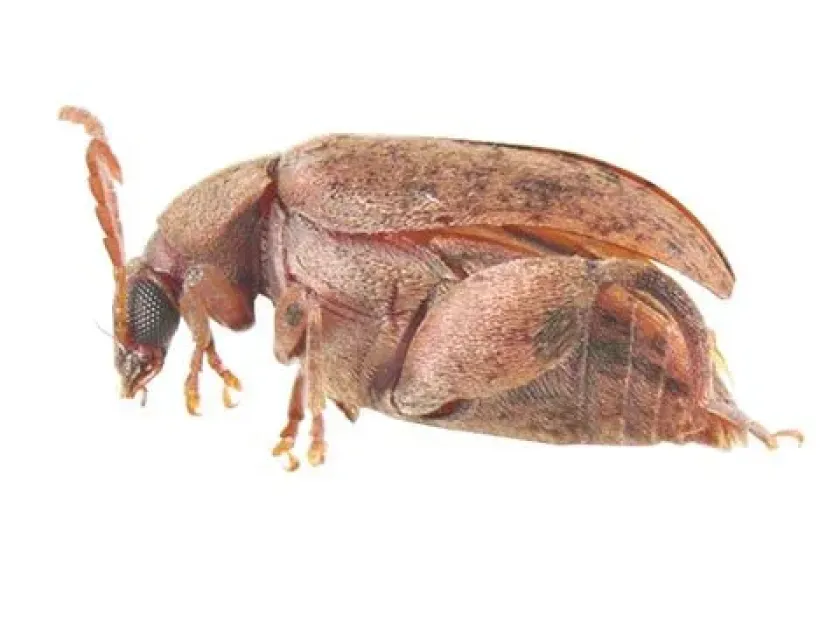
The groundnut seed beetle (Caryedon serratus) belongs to the Bruchinae subfamily of the leaf beetle family (Chrysomelidae). Adult beetles measure 4–7 mm in length and possess a characteristic elongated reddish-brown body with prominent teeth on their hind femora.
The larvae are whitish and develop inside the seeds, making early detection challenging. Eggs are oval and smooth, typically glued by the female onto the surface of the pods or seeds, both in field conditions and in storage facilities.
Adults are strong fliers, which facilitates the rapid spread of the infestation from storage foci to new lots of produce. The optimal temperature for their life cycle is between +25°C and +30°C, provided there is adequate humidity.
The life cycle is closely linked to the availability of leguminous hosts. Under optimal conditions, a generation can be completed in 4–6 weeks, allowing for multiple generations per year within storage environments.
Adult beetles prefer dark, secluded areas and are most active in warm conditions, which helps them infest entire storage lots if preventive measures are not taken.
What it damages
While the primary host is the groundnut (Arachis hypogaea), the beetle also attacks seeds of various species like Acacia, Tamarind, and pulses including beans, peas, and chickpeas.
This species is considered a quarantine pest globally due to its potential to completely destroy the seed embryo. The larva burrows into the pod and consumes the cotyledons, leaving behind a hollow cavity filled with frass.
Economic losses include not only physical weight reduction of the grain but also a significant decrease in germination rates. Infested seeds often become susceptible to secondary infections by various fungi, rendering them unfit for food processing.
Infestation can initiate in the field during the ripening stage and continue post-harvest. In storage, mass multiplication can lead to the total loss of the batch within a very short timeframe.
The metabolic activity of the larvae increases the moisture content within the grain mass, which can trigger heating and encourage the growth of micro-fungi, further degrading the quality of the stored harvest.
Signs of infestation
The primary symptom of infestation is the presence of small circular holes on the seed coat or pod surface, through which the adult beetles have emerged. Individual, translucent eggs may also be visible on the surface of the pods.
A distinctive sign of established infestation is the presence of «windows» or exit holes left by the larvae after pupation. Often, fine silken threads or webbing produced by larvae can be seen on the surface of the infested produce.
In storehouses, infestations are marked by a characteristic odor and the accumulation of a fine powdery substance resulting from larval feeding. Upon cutting open a damaged pod, one can often find larvae at various stages of development or empty cocoons.
High moisture levels around the feeding sites often result in rotting. During inspection of samples, active adult beetles may emerge from the grain mass, indicating a high level of population density.
A reduction in the weight of a thousand grains is a reliable indicator of heavy infestation, which can be easily confirmed through standard laboratory sampling and analysis.
Control measures
Strict phytosanitary control is the cornerstone of managing this pest. Preventive fumigation of storage facilities and disinfestation of containers before harvest intake are essential procedures.
- Regular cleaning of storage areas to remove grain debris and dust.
- Use of hermetically sealed containers to exclude beetles.
- Maintenance of low-temperature storage (below +15°C) to inhibit larval development.
- Fumigation using registered pesticides within specialized gas-tight chambers.
- Maintaining grain moisture levels below 12% to make the environment less favorable for beetle reproduction.
In field conditions, early harvesting is highly effective as it minimizes the window for primary infestation by the beetle before storage. Timely sorting and cleaning of the harvested produce are critical steps.
For industrial-scale infestations, fumigation with phosphine-based treatments is standard. This process ensures the mortality of all life stages, including those hidden within the seeds, providing a comprehensive solution to the infestation.
Taxonomy
- Latin name
- Caryedon serratus
- Order
- Coleoptera (beetles)
- Family
- Bruchidae
- EPPO code
- CARESE
Discussion
No discussions yet — be the first.