
Groundnut seed beetle
Caryedon pallidus
Description
How to identify
The groundnut seed beetle (Caryedon pallidus) is a coleopteran pest belonging to the family Bruchidae. Adults are small, measuring approximately 4–7 mm in length, with a brownish-gray coloration that provides camouflage on seeds.
The larvae are C-shaped, creamy-white in color, and possess a well-developed head with strong mandibles adapted for boring into hard legume seeds. They reside entirely within the host seed during their development.
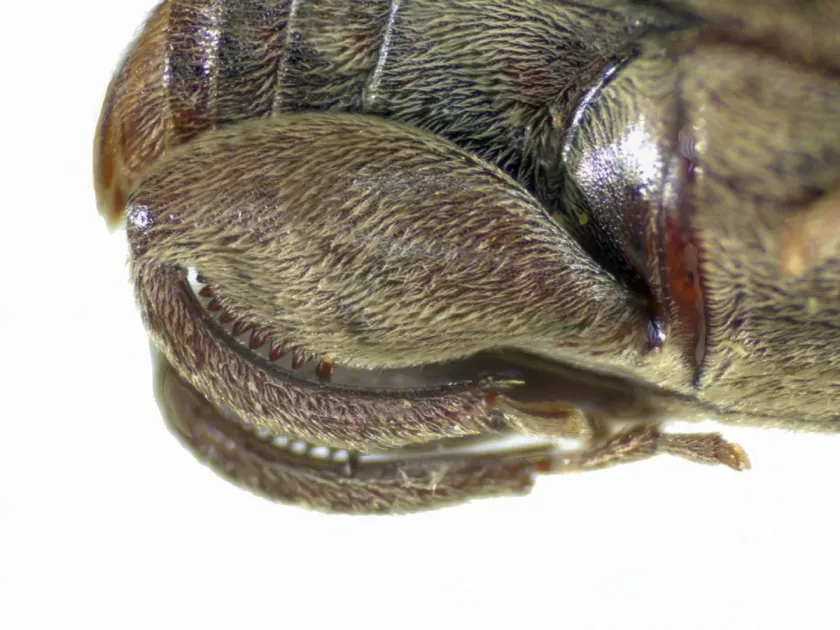
A key diagnostic feature for experts is the presence of distinct teeth on the femur of the hind legs. This anatomical detail helps distinguish C. pallidus from other similar species of stored product insects.
The life cycle is temperature-dependent, with optimal growth occurring at temperatures between 25°C and 30°C. In such environments, the pest can complete its entire development inside the host seed.
Adults are nocturnal and tend to remain stationary during daylight hours, which often leads to the underestimation of infestation levels during visual inspections of warehouses.
What it damages
This pest primarily infests peanuts (groundnuts), causing significant economic losses in both stored products and, occasionally, in the field. It is a major quarantine concern globally.
While peanuts are the preferred host, the beetle can also infest various other legumes, including tamarind seeds and different species of the Fabaceae family. This dietary flexibility allows it to persist in mixed-commodity storage facilities.
Larvae feed on the interior of the seed, consuming the embryo and endosperm. This activity destroys the seed's viability and drastically reduces its quality, rendering it unsuitable for planting or human consumption.
Infested seeds become highly susceptible to secondary contamination by fungi and bacteria. These pathogens enter through the exit holes created by emerging beetles, leading to rapid deterioration of the entire batch.
Economic damage includes direct weight loss, the need for costly fumigation, and the devaluation of products due to insect fragments and contamination in the final processed goods.
When it appears
In temperature-controlled storage facilities, the groundnut seed beetle can breed continuously throughout the year. There is no natural dormancy unless external temperatures drop below their survival threshold.
The development time from egg to adult ranges from 30 to 50 days under ideal conditions. High humidity significantly enhances the reproductive rate and the survival of larvae.
In tropical and subtropical field conditions, infestation begins as the pods mature. Once the crop is harvested and moved into storage, the infestation cycle continues uninterrupted.
Even in cooler regions, warehouse environments provide a buffer against extreme cold, allowing the pest to survive through winter months, provided the storage temperature remains moderate.
Infestation rates typically peak during periods of warm weather when the internal warehouse climate favors the emergence of new adult generations and their rapid dispersal across stored batches.
Signs of infestation
The most noticeable sign of infestation is the appearance of small, circular holes on the surface of the peanut shell or the kernel itself. These indicate where adults have emerged.
White, oval-shaped eggs can often be found attached to the surface of the pods, particularly near the ridges or cracks in the shell. They are small but visible under close inspection.
Infested seeds exhibit significant weight loss. Often, they appear hollow or powdery inside. When handled, heavily infested batches produce a distinct, unpleasant "musty" odor typical of stored product pests.
The presence of fine dust, larval excrement (frass), and cast skins near the storage containers or sacks is a clear indicator of active infestation and larval feeding activity.
- Circular exit holes (1-2 mm in diameter) on seeds.
- Reduced seed weight and hollowed-out kernels.
- Visible white eggs on pod surfaces.
- Accumulation of powdery frass in storage containers.
- Poor germination rates in seed lots.
Control measures
Strict phytosanitary inspections of incoming shipments are the primary defense against the introduction of Caryedon pallidus into new regions or clean storage facilities.
Storage areas must be kept clean, cool, and dry. Regular sanitation practices, including the removal of residual debris from previous harvests, are essential to minimize breeding sites.
Fumigation with registered chemical agents, such as phosphine, is the most effective method for eradicating existing infestations, as the gas penetrates the seeds to kill larvae and pupae.
Monitoring with pheromone-based traps is highly recommended to detect the presence of adults early. Early detection allows for targeted interventions before a major outbreak occurs.
Proper inventory management, including the use of airtight containers or sealed storage units, can prevent adult beetles from moving between different batches of stored products.
Taxonomy
- Latin name
- Caryedon pallidus
- Order
- Coleoptera (beetles)
- Family
- Bruchidae
- EPPO code
- CAREPA
Discussion
No discussions yet — be the first.