
Tamarind bruchid
Caryedon gonagra
Description
How to identify
The tamarind bruchid (Caryedon gonagra) is a beetle belonging to the family Bruchidae within the order Coleoptera. Adult beetles are typically 4–7 mm long, exhibiting a brownish to reddish-brown coloration with dark, irregular patches on their elytra.
The adults are robust, capable of sustained flight, which facilitates their movement across warehouses and grain storage facilities. They possess a specialized rostrum and chewing mouthparts, allowing them to penetrate the tough outer layers of various leguminous seeds.
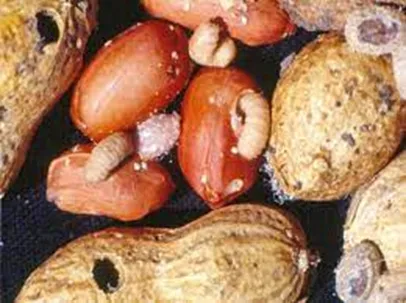
The larvae are white or creamy-colored with a distinct head and a C-shaped, fleshy body, characteristic of the family. They are highly specialized for feeding within plant seeds, where they consume the internal tissues, including the germ and the cotyledons.
As a holometabolous insect, the tamarind bruchid goes through four distinct life stages: egg, larva, pupa, and adult. The entire development process, except for the adult flight stage, usually occurs within a single host seed.
Identification in a storage setting is often aided by the presence of circular exit holes on the surface of infested seeds, left behind by adults emerging after pupation.
What it damages
The tamarind bruchid primarily targets seeds of the tamarind tree, but it is a significant pest of a wide array of stored legumes, including peanuts (groundnuts), cassia species, and various other tropical pulses.
Damage is caused primarily by the larvae, which burrow into the seeds and consume the interior. This causes severe weight loss in stored commodities and renders the seeds entirely useless for planting as the embryo is systematically destroyed.
In addition to physical consumption, the larvae cause contamination through the accumulation of frass and webbing within the seeds. This lowers the market quality of the produce and makes it unfit for human consumption.
Infested produce is prone to secondary colonization by fungi and bacteria, which exploit the damaged seed coats. This leads to rapid deterioration of the entire storage batch, resulting in significant economic losses.
Because the beetle can produce multiple generations per year under warm conditions, an infestation can escalate quickly, causing catastrophic losses in bulk storage facilities if not intercepted early.
When it appears
In tropical and subtropical climates, the tamarind bruchid is active throughout the year. It does not require a dormant period, allowing for continuous reproduction whenever food and temperature conditions are suitable.
Within warehouse environments, the pest remains active year-round due to the stability of indoor climates. Optimum temperatures for rapid development range between 25°C and 30°C, which accelerate the life cycle considerably.
A single generation from egg to adult takes approximately 30 to 50 days under ideal conditions. This rapid turnover rate allows for exponential population growth, particularly in large, poorly managed warehouses.
While their activity slows down in cooler temperatures, they remain viable and can survive in a state of suspended development, resuming activity as soon as the environment warms up again.
The transition between generations is continuous in stored grain piles, leading to overlapping life stages, which makes it challenging to pinpoint a specific "season" for management actions.
Signs of infestation
The initial signs of infestation include tiny, oval-shaped eggs glued to the surface of host seeds or pods. These are often difficult to spot without magnification but are critical for early detection.
The most recognizable sign is the emergence of round holes on the seed coat. These holes appear once the adult beetle successfully bores its way out of the seed after completing its transformation.
The physical presence of adult beetles crawling on surfaces or in samples of the stored grain confirms the active spread of the infestation throughout the storage facility.
Frass, which looks like fine powder or waste material inside the packaging, is a definitive indicator of internal larval activity and consumption of the seed material.
A musty or offensive odor emanating from stored commodities is often a sign of high levels of infestation, accompanied by secondary rot and microbial growth resulting from the beetle's activity.
Control measures
Phytosanitary inspection is the first line of defense. All incoming shipments, especially those from tropical regions, must be thoroughly inspected for signs of eggs or exit holes to prevent the introduction of the pest into storage facilities.
Fumigation with professional-grade gases is the most effective way to eliminate existing infestations. This process is necessary to kill all life stages, including larvae deeply embedded within the seeds.
Temperature management is a key non-chemical control measure. Maintaining storage areas at low temperatures inhibits the beetle's metabolic processes and significantly slows down the reproductive rate.
Good warehouse hygiene, including the complete removal of spilled grain and old residues, is essential. Furthermore, storing products in airtight, pest-resistant packaging prevents adult beetles from migrating between different batches.
- Use pheromone-based monitoring traps to detect early activity.
- Ensure thorough cleaning of storage bins between uses.
- Maintain low humidity levels to reduce mold-related secondary damage.
- Perform regular visual inspections of high-risk seed stocks.
- Use heat or cold treatments for small-scale eradication.
Taxonomy
- Latin name
- Caryedon gonagra
- Order
- Coleoptera (beetles)
- Family
- Bruchidae
- EPPO code
- CAREGO
Discussion
No discussions yet — be the first.