
Caryedon
Caryedon
Description
How to identify
Caryedon is a genus of beetles belonging to the family Bruchidae (seed beetles). Adults typically have an oval body shape, with lengths generally ranging from 3 to 7 millimeters.
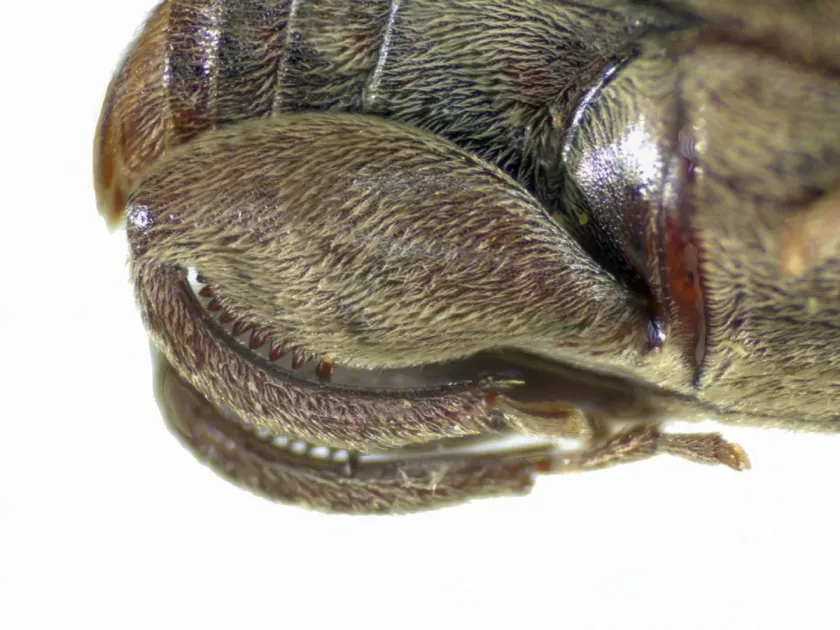
The coloration of these insects varies from light brown to dark brownish, often featuring dark spots on the elytra. They possess well-developed hind legs with distinct teeth on the femurs, a feature that distinguishes them from many other bruchid species.
The head is relatively small, often retracted under the pronotum, featuring well-developed chewing mouthparts. The antennae are serrate, consisting of 11 segments, which helps them efficiently locate substrates for oviposition.
The larvae are white or cream-colored, with a curved body covered in sparse hairs. Larval development occurs entirely inside the seeds, making early detection of the pest quite challenging.
The pupa is free and usually housed within a cradle that the larva constructs prior to pupation, either inside or on the surface of the seed, often forming a dense, parchment-like cocoon.
What it damages
The primary hosts for Caryedon include seeds of various leguminous plants, such as peanuts, tamarind, and acacia. In storage facilities, these pests can quickly infest stockpiles of pulses.
The larvae bore into the seed, consuming the internal content, which results in a total loss of nutritional value. A single seed may host one or more larvae, depending on the size of the seed.
Infested seeds lose their viability, which is critical for seed stocks. Furthermore, the pest's activity causes the accumulation of waste products (frass), rendering the produce unsuitable for human or animal consumption.
Massive reproduction in storage bins can lead to rapid increases in temperature and humidity within the grain bulk. This creates a perfect environment for the development of secondary fungal pathogens.
Economic losses are not limited to the direct weight reduction of the grain but also include significant market value depreciation due to poor appearance and quality, making the produce susceptible to rotting.
When it appears
The development of Caryedon is highly dependent on temperature and relative humidity within storage environments. The optimal temperature for rapid reproduction ranges from 25 to 30 degrees Celsius.
In warm tropical climates, the life cycle of one generation can be completed in as little as 30 to 45 days. In warehouses where stable temperatures are maintained, Caryedon can produce several overlapping generations annually.
Adult beetles are highly capable of migration in search of fresh food sources. They can fly from fields into storage facilities if climatic conditions support their flight activity.
Overwintering in temperate climates is difficult for many Caryedon species, thus their activity is often restricted to heated warehouses. However, given enough food, they can remain active throughout the year.
Reproduction rates drop significantly when temperatures fall below 15 degrees Celsius. Nevertheless, the insect can survive short-term cold spells by remaining in a dormant state inside the seed.
Signs of infestation
The first sign of infestation is the presence of small, circular exit holes on the surface of the seeds, created by emerging adults. Often, dust and flour particles can be seen around these holes.
Another characteristic sign is the presence of parchment-like cocoons attached to the surface of the seeds or the inner walls of storage containers. This is a clear indicator that the pest has completed its life cycle.
A specific, musty odor is often detected in infested grain batches, caused by the accumulation of larval waste. Additionally, the grain loses its density and becomes noticeably lighter when weighed.
Opening infested seeds reveals internal cavities filled with endosperm remnants, frass, and larval exuviae. If the seed is heavily infested, it tends to crumble upon the slightest pressure.
The observation of adult beetles moving on the surface of the grain mass or flying within the storage area is a definitive confirmation that the infestation has reached a critical level requiring urgent intervention.
Control measures
Strict sanitation in storage areas is the cornerstone of control. Regular cleaning of warehouses to remove dust, grain debris, and plant material significantly reduces the likelihood of pest population buildup.
Cooling or thermal treatment of grain are effective methods if the technology allows. However, fumigation with specialized gases in airtight enclosures is the most common professional approach.
- Using pheromone traps for population monitoring.
- Applying contact insecticides to storage surface areas.
- Maintaining grain moisture content below 12% to inhibit larval development.
- Using inert dusts or diatomaceous earth to protect grain from damage.
Monitoring incoming products is a vital step. Every batch placed into storage must be thoroughly inspected for signs of infestation and, if necessary, undergo a mandatory fumigation process.
Biological control methods, such as the use of entomophagous insects or entomopathogenic fungi, are currently under active research, though chemical treatment remains the standard method for protecting stored pulse commodities.
Taxonomy
- Latin name
- Caryedon
- Order
- Coleoptera (beetles)
- Family
- Bruchidae
- EPPO code
- CARESP
Discussion
No discussions yet — be the first.