
Rhodesian bean weevil
Callosobruchus rhodesianus
Description
How to identify
The Rhodesian bean weevil (Callosobruchus rhodesianus) is a member of the Coleoptera order and the Bruchidae family. It is a well-known stored-product pest that specifically targets legume seeds, often causing significant economic losses in tropical and subtropical regions.
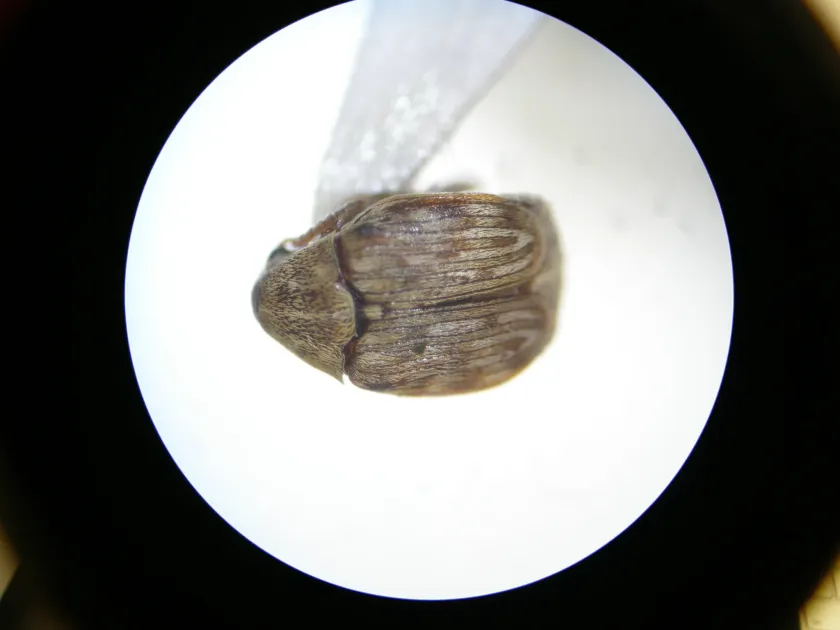
Adult beetles are small, typically measuring 2.5 to 4 mm in length. Their body is oval-shaped, with a brownish coloration and a specific pattern of darker spots on the elytra. The antennae are serrated in males and somewhat serrated or dentate in females, serving as a key diagnostic feature.
The larvae are typically C-shaped, legless, and whitish in color, perfectly adapted to live inside the seeds. They possess strong mandibles capable of consuming the starchy interior of various bean and pulse varieties.
Identification of C. rhodesianus can be complicated due to its high similarity to other members of the Callosobruchus genus, such as C. maculatus. Taxonomic verification often requires the examination of male genitalia under magnification.
This pest is highly adaptable to warehouse environments, where it can thrive independently of field conditions, provided that the ambient temperature and humidity remain within its optimal growth range.
What it damages
The Rhodesian bean weevil primarily attacks various grain legumes, including common beans, cowpeas, and mung beans. The damage starts when larvae burrow into the seed, consuming the endosperm and embryo.
The resulting damage renders the grain useless for both human consumption and planting. Seeds are left as hollowed-out shells, which reduces their weight and destroys their nutritional value, making them unsuitable for any commercial use.
Beyond direct feeding damage, the presence of the weevil contaminates the grain supply with metabolic waste, molted skins, and dust. This reduces the quality of the product and often leads to the rejection of entire shipments during international trade inspections.
Infestation often originates in the field as the crop matures. Once harvested and moved into storage, the weevil completes its life cycle within the stored grain, leading to a rapid buildup of the pest population if no management steps are taken.
Economic losses caused by this weevil are substantial, particularly in rural communities where stored pulses are a vital source of protein. Without control, a clean grain supply can become heavily infested within just a few months.
When it appears
The Rhodesian bean weevil is highly sensitive to climate, thriving in warm and humid environments. Optimal development occurs between 25°C and 30°C with relative humidity above 60%.
Under favorable conditions, the insect is capable of continuous breeding throughout the year in storage facilities. It does not undergo diapause in the same way as pests in temperate climates, meaning every generation proceeds rapidly if the food source and warmth are present.
The life cycle is relatively short, usually lasting about 3 to 5 weeks depending on the temperature. A single pair of beetles can produce numerous offspring, leading to an exponential increase in population size in a short period.
Females attach their eggs firmly to the surface of the legume pods or seeds. After hatching, the larvae immediately bore into the interior of the seed, where they are protected from external environment and contact pesticides until the adult stage.
Development in colder climates is significantly slowed or halted, making this pest primarily a concern for tropical storage facilities or imported goods that have been kept in climate-controlled environments during transit.
Signs of infestation
The presence of tiny, oval-shaped white eggs glued to the outer surface of the beans is the earliest indicator of infestation. These eggs are often visible upon careful inspection of the seed batch.
The emergence of adults creates distinct, clean, circular holes in the seeds. These holes are the most visible evidence of damage, showing where the fully developed beetle exited the grain after completing its transformation.
A powdery, dust-like substance inside the storage container or at the bottom of the grain sack is a sign of extensive larval feeding. This dust is composed of larval excrement and seed debris.
Infested seeds are noticeably lighter and often have a duller appearance compared to healthy seeds. When squeezed, infested beans easily crumble, exposing the internal damage caused by the developing larvae.
Observation of adult beetles crawling on the surface of grain bags is a definitive sign of an active infestation. Since beetles are often attracted to light, their presence near windows or lighting fixtures in a warehouse is a common symptom.
Control measures
Effective management of the Rhodesian bean weevil relies heavily on preventative measures and hygiene within storage areas. Keeping warehouses clean and removing spilled grain is essential to break the pest cycle.
- Fumigation of grain with approved agents like phosphine to eliminate all life stages.
- Drying grain to a moisture content below 12% to inhibit larval development.
- Using airtight storage bags or containers to prevent further contamination.
- Monitoring pest populations using pheromone-baited traps to detect early outbreaks.
- Aerating grain bulks to reduce temperature and humidity levels inside the storage.
Chemical control must be applied in accordance with regional safety regulations. While fumigation is the most effective method for killing larvae inside the grain, it must be performed by trained personnel to ensure safety and effectiveness.
Integrated pest management (IPM) strategies, which combine physical cleaning, moisture control, and targeted chemical treatments, provide the most reliable protection against this destructive stored-product pest.
Taxonomy
- Latin name
- Callosobruchus rhodesianus
- Order
- Coleoptera (beetles)
- Family
- Bruchidae
- EPPO code
- CALSRH
Discussion
No discussions yet — be the first.