
Four-spotted bean weevil
Callosobruchus ornatus
Description
How to identify
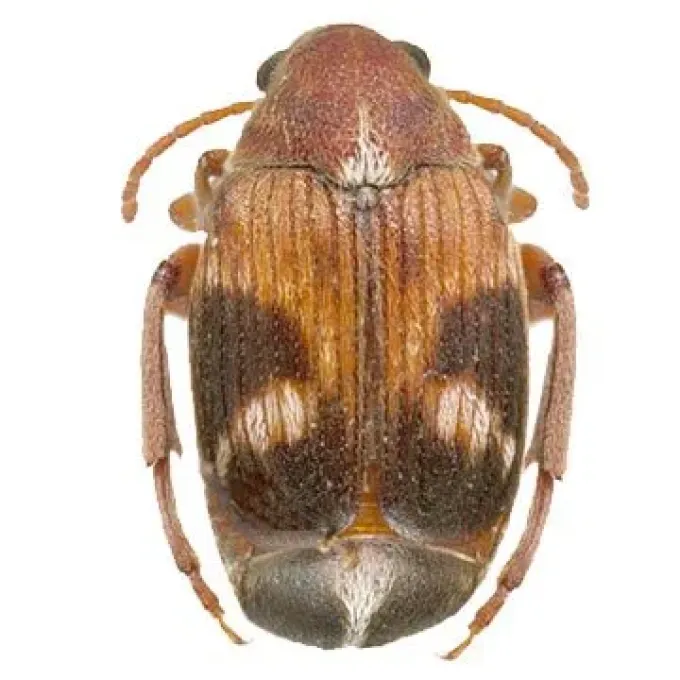
The Four-spotted bean weevil (Callosobruchus ornatus) is a destructive member of the Bruchidae family. The adult beetle is small, typically measuring 3–4 mm in length, with a distinct oval-shaped body.
The color of the insect ranges from reddish-brown to black. The common name arises from the four visible spots located on the elytra, which serve as a primary identifying characteristic for this specific species.
Larvae are white, legless grubs with a robust chewing mouthpart. They are perfectly adapted to live and feed within the interior of pulses, where they undergo development until reaching the pupal stage.
These insects thrive in indoor environments such as warehouses, barns, and silos. They are highly dependent on warm, humid conditions to maintain a rapid reproductive cycle.
Under optimal conditions, the life cycle of the Four-spotted bean weevil can be completed in as little as 3–4 weeks, allowing for rapid population growth in infested grain stocks.
What it damages
This pest is a major threat to stored legumes, including mung beans, cowpeas, chickpeas, and various types of beans. It can cause significant economic losses in the agricultural supply chain.
The larvae bore into the seeds, consuming the nutrient-rich interior of the grain. This internal damage often goes unnoticed until the adults emerge, leaving behind visible exit holes.
Seed germination is severely impacted because the larvae often consume the embryo of the seed. This makes the affected grain useless for planting purposes and degrades its commercial quality.
Infested grain becomes contaminated with insect excrement and debris, which can trigger fungal growth and further spoil the quality of the product for human consumption.
High levels of infestation lead to substantial weight loss in grain stocks, as the internal content is completely hollowed out by the feeding larvae.
Signs of infestation
The most recognizable sign of infestation is the presence of small, perfectly circular emergence holes on the surface of the beans, created by the adults as they leave the seed.
Before emergence, eggs can be seen as tiny, off-white, oval-shaped structures attached to the surface of the beans. These eggs are often placed in groups by the female beetles.
Grain stocks may exhibit an increase in temperature, known as hot spots, which indicates high metabolic activity and pest proliferation within the stored heap.
A musty or unpleasant odor often accompanies heavy infestations, combined with the presence of fine dust and broken seed coats found at the bottom of storage containers.
Infested beans may appear lighter in color or slightly shriveled, and they often lack the structural integrity of healthy, uninfested seeds when handled or pressed.
Control measures
Temperature control is one of the most effective preventive measures. Storing grain at low temperatures significantly slows down the development and reproduction of the weevil.
Sanitation of storage facilities is crucial. Before new grain is brought in, all areas must be thoroughly cleaned and treated with approved insecticides to eliminate dormant insects.
Fumigation with phosphine-based products is the standard industry method for controlling deep-seated infestations, as these gases penetrate effectively into the kernels.
- Regular screening and aeration of grain to remove infested seeds.
- Utilizing sealed storage containers to prevent cross-infestation.
- Monitoring population levels using species-specific pheromone traps.
- Drying grain to a moisture content below 12-14% to inhibit larval survival.
An integrated pest management (IPM) approach, combining physical, chemical, and biological controls, is essential to protect high-value pulse stocks from significant degradation.
Taxonomy
- Latin name
- Callosobruchus ornatus
- Order
- Coleoptera (beetles)
- Family
- Bruchidae
- EPPO code
- CALSOR
Discussion
No discussions yet — be the first.