
Smooth bean weevil
Callosobruchus glaber
Description
How to identify
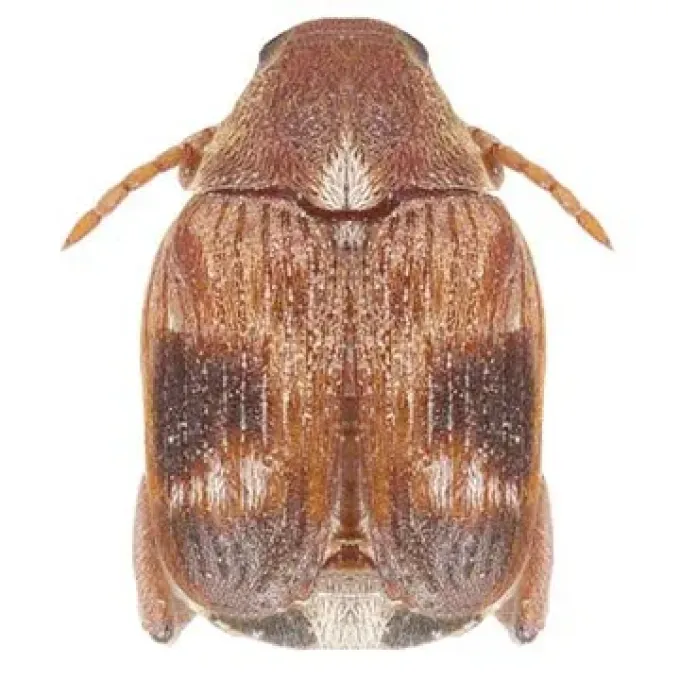
The Smooth bean weevil (Callosobruchus glaber) is a member of the Bruchidae family within the order Coleoptera, known for its ability to infest stored leguminous seeds.
The adult beetle is small, typically oval-shaped, and dark in color with a smooth, shiny appearance on its elytra, which distinguishes it from other species.
These insects are highly adapted to indoor environments and can complete their life cycle rapidly when temperatures and humidity levels are favorable for breeding.
The female weevil deposits individual eggs directly onto the surface of the bean seeds, attaching them firmly so the emerging larva can immediately bore into the seed.
As a storage pest, it can maintain its population as long as there is an available food supply, with several generations produced annually in heated facilities.
What it damages
Smooth bean weevils primarily infest pulse crops, with a strong preference for dried seeds like mung beans, chickpeas, and various types of beans.
The larvae feed internally on the seeds, destroying the embryo and starch reserves, which ultimately leaves behind hollowed-out husks.
Infested seeds suffer significant weight loss and are rendered useless for planting, as the damage to the embryo prevents successful germination.
Beyond the loss of quantity, the quality of the product is severely degraded by the accumulation of insect debris and frass, making it unfit for commercial use.
In large-scale storage, the metabolic activity of the weevil infestation can cause localized heating, which often leads to mold growth and total spoilage of the batch.
Signs of infestation
The presence of minute, whitish eggs on the exterior surface of the beans is the earliest indicator that a storage batch has been infested.
As the insects mature, they bore perfectly circular exit holes through the seed coat, which are clearly visible once the adult beetles have emerged.
An accumulation of fine, powdery residue (frass) at the bottom of containers or sacks is a reliable sign of active feeding by the weevil population.
Infected batches may also emit a distinct, musty odor that differs from the natural smell of clean, stored leguminous grains.
- Circular holes in individual beans.
- Presence of live or dead beetles on container surfaces.
- Visible dust accumulation around storage areas.
Control measures
Preventive management focuses on maintaining low temperature and dry conditions in storage facilities to create an environment unsuitable for insect development.
Prior to loading, it is essential to sanitize all storage bins and warehouses using appropriate insecticides to eliminate any remaining insect populations.
If an infestation is detected, fumigation is the most effective method, utilizing phosphine gas to treat the affected grain mass in sealed enclosures.
Routine inspection of stored goods using pheromone traps can help detect the presence of the Smooth bean weevil before the population reaches an uncontrollable level.
The use of properly sealed, airtight packaging can protect smaller quantities of pulses from cross-contamination with the pest in a domestic or warehouse setting.
Taxonomy
- Latin name
- Callosobruchus glaber
- Order
- Coleoptera (beetles)
- Family
- Bruchidae
- EPPO code
- CALSGL
Discussion
No discussions yet — be the first.