
Four-spotted bean weevil
Callosobruchus dorsalis
Description
How to identify
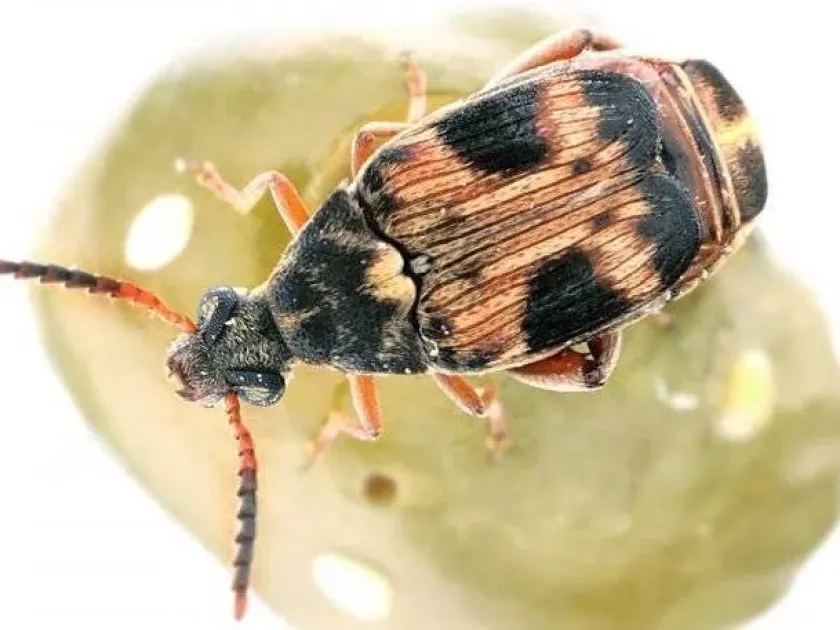
The Four-spotted bean weevil (Callosobruchus dorsalis) is a destructive insect pest belonging to the family Bruchidae. Adult beetles are small, typically ranging from 3 to 4 mm in length, with an oval-shaped body.
The most distinctive morphological feature is the presence of four light-colored spots on the elytra, which makes them easily recognizable. Their bodies are covered with dense, short pubescence, giving them a slightly brownish appearance.
Sexual dimorphism is clearly visible in the antennae structure: males possess serrate or pectinate antennae, while females have more simple, serrate forms. This is a primary diagnostic trait for identifying the sex of the specimen.
The larvae are white, C-shaped, and possess specialized mouthparts for feeding within the seeds. Because they live inside the seed, they are rarely seen until the adult stage emerges.
Eggs are oval-shaped, transparent, and are glued firmly to the surface of host seeds. They look like tiny translucent scales attached to the bean coat, which can be observed under magnification.
What it damages
This pest primarily attacks legumes and pulses. The most susceptible crops include mung beans, cowpeas, chickpeas, and various types of beans, which are critical for global food security.
Larvae bore into the seeds, consuming the embryo and endosperm. This damage destroys the seed's viability, making it completely useless for planting and agricultural purposes.
Economic impact is significant because the feeding activity drastically reduces the weight and market value of the harvested crop. In cases of severe infestation, almost the entire batch can be rendered inedible.
In addition to physical damage, the presence of larval feces and waste products contaminates the food supply, making it unsuitable for human consumption due to hygiene and allergen risks.
Once a batch is infested, the rate of multiplication is exponential. A single storage facility can lose the majority of its pulse stocks within a few months if left unmonitored.
When it appears
The development of Callosobruchus dorsalis is strictly temperature-dependent. The insect thrives in warm environments, with an optimal temperature range of 25–30 degrees Celsius.
In temperate storage facilities, the beetle can reproduce continuously throughout the year. The entire life cycle from egg to adult takes approximately 20 to 40 days, depending on conditions.
In field conditions, infestations usually begin during the pod ripening phase. Adults migrate from nearby storage units or field debris to lay eggs on the developing bean pods.
After harvest, the weevils are transported into storage along with the grain. If the storage environment remains warm, they continue to breed, leading to generations overlapping in the same batch of grain.
Cold weather can suppress their activity, but they are highly resilient. If temperatures drop, the metabolic process slows down, but the insects often survive in a state of reduced activity until conditions improve.
Signs of infestation
The most prominent sign of an infestation is the presence of small, circular holes in the seeds. These are exit holes created by adults after completing their development inside.
Inspecting the surface of the beans can reveal the presence of eggs. They appear as small, whitish oval spots attached to the outer seed coat, sometimes with multiple eggs on a single seed.
High levels of infestation are marked by the visible presence of live adult beetles crawling on the surface of the grain pile or near the walls of the storage containers.
A dusty appearance of the grain pile is another indicator. This dust consists of seed coat fragments and insect frass that accumulate as the larvae hollow out the seeds from within.
- Circular exit holes on seed surfaces.
- Accumulation of powdery debris in storage bags.
- Foul or musty odor emanating from the grain mass.
- Visible presence of adult beetles on packaging.
Control measures
Good agricultural practices are the first line of defense. Harvesting crops as early as possible prevents adult beetles from laying eggs on the pods in the field.
Sanitation of storage areas is vital. Removing all debris and old grain remnants from the previous season significantly reduces the initial population of the pest.
Fumigation with approved chemical agents is the most effective method for eradicating existing infestations in commercial storage settings to ensure the safety of large volumes of grain.
Temperature control is a non-chemical alternative. Keeping stored pulses in refrigerated environments or using heat treatment can effectively kill all life stages of the weevil.
Implementation of monitoring programs using pheromone traps allows farmers to detect the emergence of the pest early, enabling targeted interventions before a full-scale outbreak occurs.
Taxonomy
- Latin name
- Callosobruchus dorsalis
- Order
- Coleoptera (beetles)
- Family
- Bruchidae
- EPPO code
- CALSDR
Discussion
No discussions yet — be the first.