
Four-spotted bean weevil
Callosobruchus analis
Description
How to identify
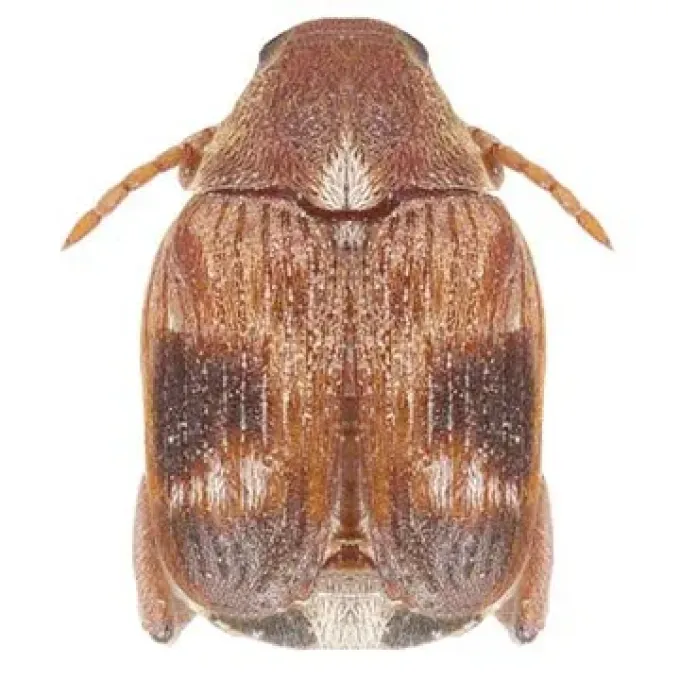
The Four-spotted bean weevil (Callosobruchus analis) is a beetle belonging to the family Bruchidae. Adults typically measure about 3–4 mm in length and feature a distinct color pattern with dark spots on their elytra, giving them a speckled appearance.
The body is oval-shaped and slightly convex, covered with fine hairs. The head is small and tucked underneath the pronotum, equipped with strong mandibles for feeding and boring into seed coats.
The larval stage, which is the most destructive, is white and legless, with a typical C-shaped posture. Larvae are specialized for feeding entirely within the seeds of legumes, where they undergo development.
Sexual dimorphism is present, with subtle differences in the antennae and elytral markings. These characteristics are essential for entomological identification when inspecting grain shipments for trade or seed quality control.
These insects thrive in warm environments and are highly adaptable to various storage conditions, which has allowed them to distribute globally alongside international grain trade routes.
What it damages
This pest primarily attacks various species of legumes. Key crops susceptible to damage include mung beans, peas, chickpeas, lentils, and diverse varieties of beans, both in field settings and in storage facilities.
Damage is characterized by the consumption of the seed embryo and endosperm. This renders the seed unviable for planting and significantly reduces its protein and starch content for human consumption.
In stored grain, heavy infestation results in significant weight loss. As larvae hollow out the seeds, the grain becomes riddled with exit holes, creating a "honeycomb" structure that leads to severe degradation.
The accumulation of larval waste and insect dust promotes the growth of secondary microorganisms, including various molds and bacteria, which further diminish the quality and safety of the stored product.
Beyond direct consumption, the presence of these pests often leads to the rejection of grain batches during phytosanitary inspections, causing substantial financial losses for producers and exporters.
When it appears
In climate-controlled storage facilities, the Four-spotted bean weevil can reproduce continuously throughout the year. If temperatures remain above 20°C, the lifecycle is accelerated, leading to multiple overlapping generations.
In field conditions, the infestation cycle begins when adults migrate to crops during the seed pod development stage. Eggs are laid directly on the surface of ripening pods.
The duration from egg to adult is highly temperature-dependent. Under optimal conditions, a single generation can be completed in approximately 3 to 5 weeks, allowing for rapid population growth.
Winter dormancy occurs only when temperatures drop significantly. However, in heated or insulated storage areas, the insect remains active, posing a constant risk regardless of the external season.
Monitoring for adult presence is crucial before the harvest period, as the movement of contaminated grain is the primary vector for introducing the pest into clean storage sites.
Signs of infestation
The most visible sign of infestation is the presence of small, perfectly circular emergence holes on the surface of the beans. These holes appear when the adult weevil emerges from the pupal chamber.
Under close inspection, the surface of infested seeds may show tiny, translucent oval eggs cemented by the female. These are often difficult to spot without a magnifying lens but are clear indicators of early activity.
A distinctive "dusty" residue, consisting of seed coat fragments and larval excreta, usually accumulates at the bottom of containers or sacks where the weevils are active.
Infested batches often emit a peculiar, musty odor. This smell is a result of the breakdown of seed tissue and the metabolic processes of the insects and secondary fungi developing inside the kernels.
Changes in the sound of the grain pile can also serve as an alert. Experienced warehouse managers often report a soft rustling sound that can be heard near heavily infested batches during quiet periods.
Control measures
Fumigation remains the most effective method for controlling infestations in commercial grain storage. Using approved fumigants (such as phosphine gas) is essential to penetrate deep into the grain mass and reach larvae.
Sanitation practices are critical. Cleaning out storage areas thoroughly between harvests removes residual grain that would otherwise harbor the pest and allow populations to survive between seasons.
Temperature management is a powerful physical control tool. Cooling the grain to temperatures below 10°C effectively suppresses the metabolic rate of the weevils and halts their development cycle.
Integrated Pest Management (IPM) programs should include the use of pheromone traps to detect population spikes, allowing for precise and timely intervention before major damage occurs.
- Maintaining grain moisture levels below 13% to reduce attractiveness.
- Sealing storage structures to prevent the entry of flying adults.
- Performing regular quality inspections of all stored legume shipments.
Taxonomy
- Latin name
- Callosobruchus analis
- Order
- Coleoptera (beetles)
- Family
- Bruchidae
- EPPO code
- CALSAN
Discussion
No discussions yet — be the first.