
Gorse seed weevil
Bruchus ulicis
Description
How to identify
The gorse seed weevil (Bruchus ulicis) is a small beetle belonging to the Bruchidae family. It is a specialized pest primarily associated with the seeds of the gorse plant (Ulex europaeus) and related legumes.
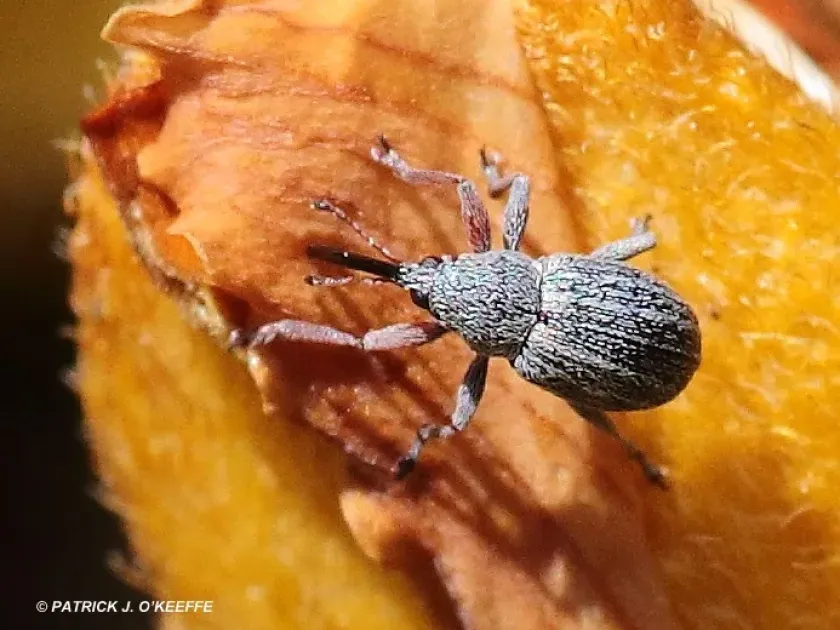
Adult beetles are approximately 3 to 4 mm in length. Their bodies are oval and densely covered with grayish-brown hairs, providing excellent camouflage against the seed pods where they feed and lay eggs.
The head is small and often partially retracted into the prothorax. The elytra (wing covers) typically bear indistinct markings that help the insect blend into its natural environment during the reproductive phase.
The larvae are typically grubs with a curved, fleshy, and whitish body. They possess highly reduced legs and are adapted to living entirely within the confines of a single seed.
Eggs are minute, oval, and deposited by the female on the surface of developing seed pods. Due to their size and cryptic coloration, they are difficult to detect during field surveys.
What it damages
The primary damage is caused by the larvae, which bore into developing seeds. The larva consumes the embryo and the nutritive tissue of the seed, effectively destroying it.
A single larva is capable of completely hollowing out a seed, rendering it useless for germination or commercial purposes. This can lead to a significant decline in the reproductive success of the host plant.
In addition to physical destruction, the holes left by the larvae serve as entry points for secondary pathogens, such as fungi and bacteria, which can cause further seed decay.
The infestation is particularly detrimental in seed production areas, where the quality and viability of the harvested material are paramount for future planting cycles.
High levels of infestation can lead to significant economic losses, especially when the pest is present in large numbers, potentially destroying a large percentage of the crop yield.
When it appears
The life cycle of Bruchus ulicis is synchronized with the phenology of its host plant. Overwintered adults emerge in the spring, corresponding with the host's flowering period.
During the spring and summer, the adults feed on pollen, which is essential for their maturation and subsequent egg production. Mating occurs shortly after emergence.
Eggs are laid on the young, developing pods. Upon hatching, the larvae burrow into the seeds, where they remain throughout the summer to feed and grow through several larval stages.
By late summer or autumn, the larvae pupate inside the seed. The adults typically emerge or remain inside the pod to overwinter, often finding shelter in plant debris or bark crevices.
The weevil is univoltine, meaning it completes only one generation per year, with all major developmental stages occurring during the host plant's active growing season.
Signs of infestation
The first sign of an infestation is the presence of small, barely visible entry holes on the seed pods, created by larvae as they bore into the seeds.
After the harvest, the most obvious sign is the presence of perfectly round exit holes on the seed coat, indicating that the adult beetle has emerged from the seed.
Infested seeds are noticeably lighter than healthy ones. When handling or sorting, these seeds often appear hollowed out and lack the density of viable, healthy seeds.
Minor brown spots or blemishes may sometimes be visible on the surface of the pods, representing the sites where females laid their eggs.
Field monitoring often involves using a sweep net during the flowering stage to detect the presence and population density of the adult weevils.
Control measures
Cultural practices are the most effective management strategy. Early harvesting of seeds can prevent the emergence of the next generation of weevils from the pods.
Cleaning harvested seed thoroughly using gravity separators or other sorting equipment can effectively remove infested, light seeds from the healthy stock.
Maintaining spatial isolation from wild populations of host plants helps reduce the likelihood of weevils migrating into managed fields.
The use of biological control agents, such as entomopathogenic fungi, is being researched as a sustainable way to suppress weevil populations.
- Regular monitoring of adult activity using pheromone traps.
- Sanitation by destroying plant debris post-harvest.
- Strategic timing of insecticide applications to target adults before egg-laying.
- Avoidance of continuous planting of susceptible host species in the same area.
Taxonomy
- Latin name
- Bruchus ulicis
- Order
- Coleoptera (beetles)
- Family
- Bruchidae
- EPPO code
- BRCHUL
Discussion
No discussions yet — be the first.