
Pea weevil
Bruchus signaticornis
Description
How to identify
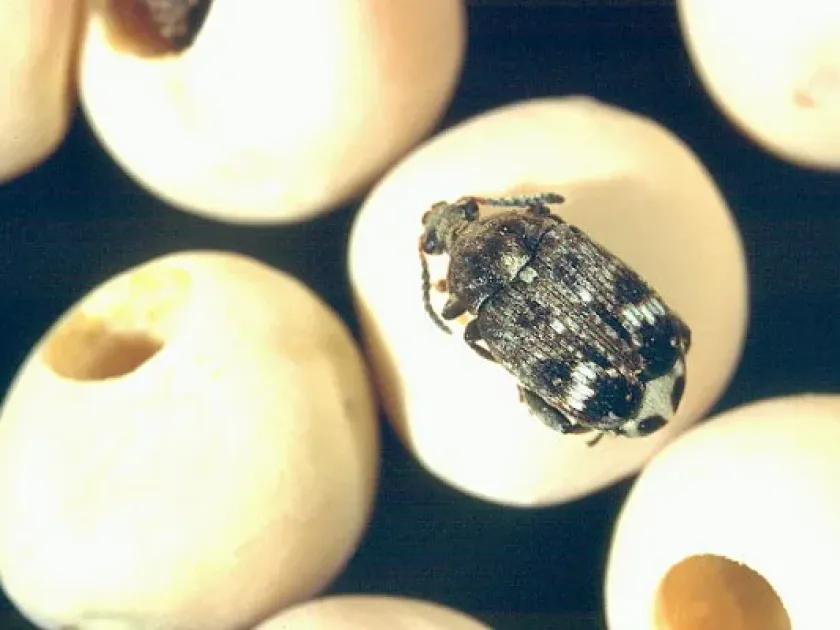
The pea weevil Bruchus signaticornis is a beetle belonging to the Bruchidae family, specifically recognized as a major pest of pulse crops. The adult beetle is small, typically 3 to 4 mm in length, with a dense covering of hair providing a greyish-brown mottled appearance.
The larvae are typically creamy-white, legless, and possess a robust head with mandibles designed to tunnel through the firm tissues of developing pea seeds. As a species, it undergoes complete metamorphosis throughout its development stages.
Adult beetles are strong fliers and exhibit distinct behaviors during the spring, including migration towards flowering pea fields. Their life cycle is highly synchronized with the reproductive phases of the host legume.
The taxonomic classification places it within the Coleopteran order, which suggests high adaptability to various climate zones. Its morphology is perfectly evolved for residing both within the field environments and in storage facilities.
Entomological monitoring confirms that the species requires specific temperature ranges for optimal development, typically thriving in warmer periods that coincide with the bloom and pod-setting stages of the pea plant.
What it damages
The primary damage is caused by the larval stage, which consumes the embryo and endosperm of the pea seed. This leads to a substantial loss in seed weight and significant reduction in overall crop yield.
Infested seeds are often deemed unfit for human consumption due to the contamination with larval waste products and the subsequent invasion of secondary fungi, which thrive in damaged tissue.
The viability of the seed is severely compromised; since the embryo is often destroyed by the developing larva, such seeds cannot be used for future planting, causing economic loss in the seed production sector.
Damage occurs in two major waves: first in the field during the development of pods, and subsequently in storage, where adults continue their life cycle, causing total destruction of stored grain lots.
The impact is measurable not only in weight but also in market value. Infected shipments are often rejected by processors, leading to significant financial losses for producers and cooperatives.
When it appears
Emergence from overwintering sites typically occurs in late spring as temperatures rise consistently above 15°C. Adults move actively towards the fields, where they engage in feeding on floral nectar and pollen.
The egg-laying phase is strictly determined by the phenology of the host plant. Females deposit eggs onto the exterior of young, tender pods, which usually occurs during the pod-formation stage.
After hatching, the neonate larva bores directly through the pod wall into the seed. This process is relatively rapid and occurs during the period of peak pod expansion, making the crop highly vulnerable.
Pupation occurs within the seed, lasting approximately several weeks. By the time the peas reach maturity and are harvested, most of the population has reached the adult beetle stage within the grain.
Post-harvest, if temperatures remain high in storage facilities, the development cycle can continue. Understanding this seasonal timing is critical for implementing effective control strategies.
Signs of infestation
Early field identification includes spotting the small, elongated, yellowish eggs attached to the pod surface. These markers are critical for timing pesticide applications effectively before larvae penetrate the pod.
In mature seeds, a dark, translucent spot often indicates where the larva entered the grain. This is commonly referred to as a "window," through which the adult beetle will later emerge.
The most undeniable sign of damage is the presence of perfectly circular exit holes on the seed coat, indicating that the adult beetle has emerged, leaving a hollowed-out seed behind.
Seed density is significantly reduced in infested samples. A simple floatation test in water can identify heavily damaged seeds, as they tend to be lighter and float to the surface.
- Yellowish egg clusters on young pod surfaces
- Small dark "windows" on the seed coat
- Round exit holes in mature grains
- Decreased thousand-grain weight of the harvest
Control measures
Agricultural practices focus on planting early-maturing varieties of peas, which allows growers to harvest the crop before the beetle population reaches the adult stage and exits the seeds.
Chemical control is most effective when applied during the flowering stage. Systematic insecticides can prevent the females from successfully laying eggs, thereby protecting the developing pods from infestation.
In storage, fumigation or cooling techniques are essential. Keeping grain temperatures below 10°C effectively stops the development of the weevil and prevents further damage to the stored stocks.
Deep autumn plowing of field residues is recommended to reduce the overwintering population. This practice destroys the remaining adults and pupae left in the field after harvest.
Monitoring programs utilizing pheromone traps are highly effective in identifying the onset of beetle migration, allowing for precise treatment timing and minimizing the environmental impact of pesticide use.
Taxonomy
- Latin name
- Bruchus signaticornis
- Order
- Coleoptera (beetles)
- Family
- Bruchidae
- EPPO code
- BRCHSI
Discussion
No discussions yet — be the first.