
Lentil seed beetle
Bruchus lentis
Description
How to identify
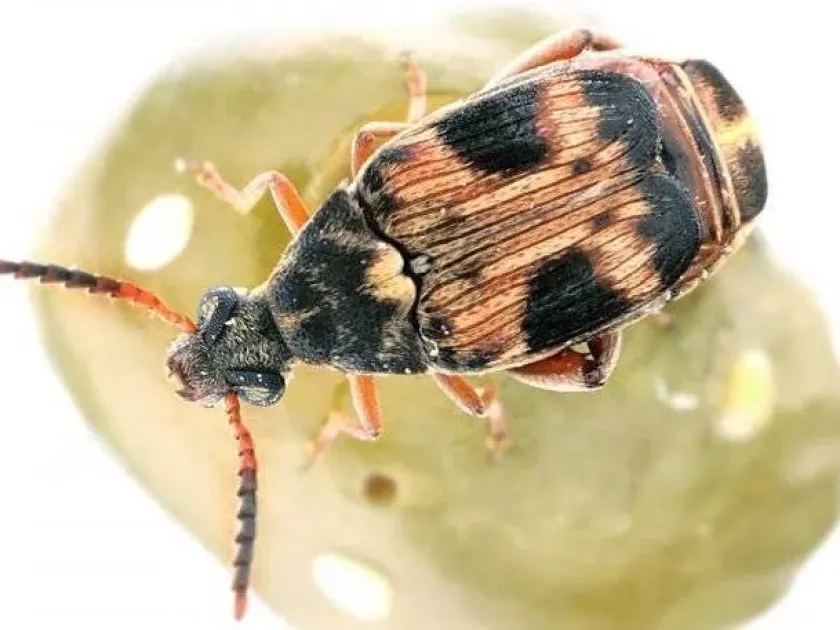
The lentil seed beetle (Bruchus lentis) is a small beetle belonging to the family Bruchidae, within the order Coleoptera. Adult beetles are approximately 3–3.5 mm long, with an oval shape and greyish-brown hair coverage.
Their elytra exhibit distinctive light-colored spots, and the tip of the abdomen features a visible light pattern. The head is small with a downward-oriented chewing mouthpart.
Larvae are pale, C-shaped, and possess a well-developed head capsule. They are strictly endophagous, meaning they complete their entire developmental stage inside the lentil seed.
The pupal stage also occurs inside the damaged grain. Pupae transition through distinct developmental phases, progressively acquiring the features of an adult insect before emergence.
Adult beetles overwinter within infested seeds remaining in the field or in storage facilities, as well as in soil crevices or plant debris.
What it damages
The primary host for this pest is the cultivated lentil (Lens culinaris). Damage occurs when the insect consumes the internal tissues of the developing seed.
Female beetles lay eggs directly onto the surface of developing pods. Upon hatching, the larvae bore through the pod wall and penetrate the seed, consuming the nutrient-rich interior.
Each seed can host one or multiple larvae, which often destroys the embryo, rendering the seed non-viable for germination and unsuitable for commercial food consumption.
Visible exit holes indicate that the adult beetle has emerged, which significantly lowers the market value and physical weight of the harvested crop.
Besides physical destruction, the entrance and exit points created by the beetle serve as vectors for fungal infections and other secondary pests during storage.
When it appears
Overwintered adults migrate to lentil fields during the budding and flowering stages of the crop. This period is critical for the pest's reproductive cycle.
Mating and egg-laying are highly dependent on temperature, with warm, dry weather conditions accelerating the rate of development for eggs and larvae.
The incubation period for eggs typically ranges from one to two weeks. Once inside the seed, the larvae develop throughout the summer months.
There is generally one generation per year, though temperature-controlled storage environments may allow for additional overlapping generations in extreme cases.
As pods mature and harvest approaches, the adult beetles are often already present inside the seeds, ready to emerge or enter a dormant state.
Signs of infestation
The most common early sign is the presence of small, yellowish, oval-shaped eggs glued to the exterior of young lentil pods.
- Darkened spots on the surface of the pods at the point of larval penetration.
- Circular exit holes (1–2 mm in diameter) found in harvested or dry seeds.
- A reduction in overall seed weight and quality during the cleaning process.
- Fine powder-like dust consisting of larval frass found under the stored grain.
When an infested seed is split open, the larva or the pupal chamber can be clearly seen inside, confirming the presence of an active infestation.
Control measures
Effective management begins with robust crop rotation, ensuring a significant temporal and spatial gap between lentil plantings to interrupt the pest cycle.
Deep autumn plowing is a recommended cultural practice to bury and destroy overwintering sites, significantly reducing the initial beetle population in the spring.
Early and timely harvesting is essential to prevent the majority of adult beetles from emerging and re-infesting fields or storage areas.
Chemical control using authorized insecticides may be applied during the flowering stage, provided that the economic threshold of the pest population is exceeded.
Post-harvest fumigation of seed stocks is critical to eliminate any remaining larvae or adults, ensuring that seeds intended for storage or export remain pest-free.
Taxonomy
- Latin name
- Bruchus lentis
- Order
- Coleoptera (beetles)
- Family
- Bruchidae
- EPPO code
- BRCHLE
Discussion
No discussions yet — be the first.