
Pea weevil
Bruchus brachialis
Description
How to identify
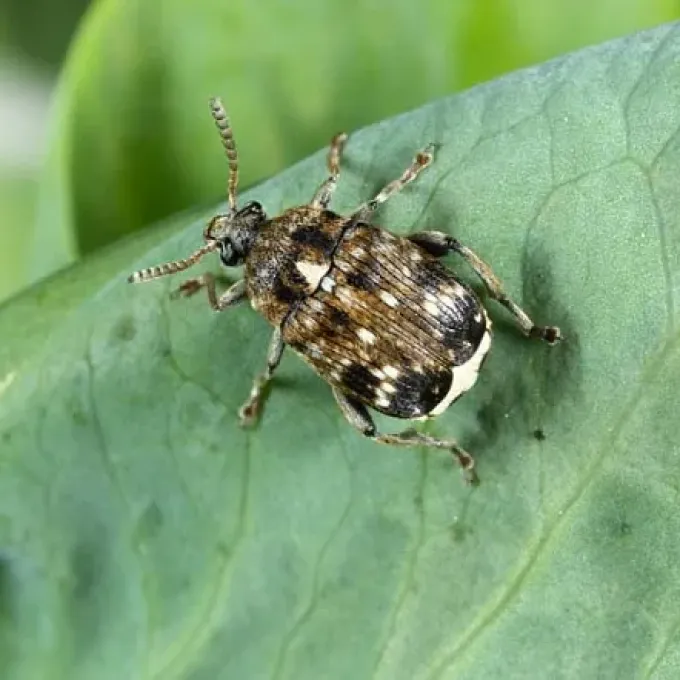
The pea weevil (Bruchus pisorum) is a significant beetle species belonging to the family Chrysomelidae (subfamily Bruchinae). Adults are typically 4–5 mm long, with a brownish-black body covered in patches of gray and white pubescence that provide camouflage.
The larvae are specialized for development within pea seeds. Upon hatching, the first-instar larva has functional legs, which are shed after it bores into the pea. Subsequent larval stages are legless, creamy white grubs that consume the seed's interior.
Adult beetles are strong fliers and migrate long distances to locate flowering pea fields. Their ability to remain dormant in protected areas or storage facilities during winter ensures their continued presence across seasons, making them a persistent agricultural threat.
During the flowering stage, the beetles feed on pollen and floral parts. Once mating occurs, females lay eggs externally on the surface of developing pea pods. These eggs are elongated, yellow, and cemented securely to the pod wall.
Successful development of the species depends heavily on ambient temperatures. Warm, dry conditions accelerate the life cycle, while cold weather can slow down the development of larvae and pupae within the pods, though they remain viable pests.
What it damages
The primary economic damage is caused by larvae destroying the inner contents of pea seeds. By feeding on the cotyledons and the germ, they directly reduce the seed's viability and market value for both food and propagation purposes.
Infested peas exhibit a characteristic circular exit hole, covered by a thin flap of skin, which signifies that the adult beetle has emerged. Such damaged seeds are lighter in weight and suffer from reduced nutritional value, rendering them unsuitable for human consumption.
In addition to physical destruction, the presence of larval waste products increases the risk of mold growth and secondary bacterial infections. This leads to the rapid deterioration of bulk stored grain if not managed with proper aeration and cooling.
For seed producers, infestation is particularly critical because even a low percentage of larvae can make a entire batch unusable for sowing. Rigorous inspection and sorting are required to remove damaged peas, increasing the cost of production.
The infestation often remains hidden until the beetle prepares to emerge. This creates a risk where seemingly healthy grain could be carrying latent infestations, which then spread rapidly once the beetles exit their host seeds.
When it appears
Adults emerge from overwintering sites in early spring, synchronized with the onset of pea flowering. This synchronization is vital for the pest, as they require pollen for maturation and the young pods for oviposition.
The summer months are characterized by the rapid growth of larvae inside the pods. As the peas mature, the larvae complete their development, pupate within the seed, and eventually transition into adults before the harvest occurs.
With the onset of autumn and cooling temperatures, the new generation enters a state of diapause. They remain in protected locations—either within the harvested seeds in silos or in outdoor debris—until the following spring, when the cycle begins anew.
Signs of infestation
Initial signs of infestation appear on the exterior of developing pods as small, yellow, oval-shaped eggs. These are often difficult to see without close inspection but serve as the first indicator that management action is required.
Later in the season, tiny dark entry points become visible on the surface of the green or drying peas. These marks are where the young larvae have bored through the seed coat to reach the nutrient-rich interior.
The final and most prominent sign is the perfectly circular "window" or exit hole found on dry harvested peas. This indicates that the weevil has finished its life cycle and has left the seed, leaving behind a hollowed-out chamber.
Control measures
Cultural control strategies include the use of early-maturing pea varieties, which allow harvesting to be completed before the adult beetles emerge from the pods. Crop rotation is also essential to break the life cycle by ensuring no host plants are present.
Chemical control focuses on applying insecticides during the blooming stage. It is crucial to target the beetles before they lay eggs on the pods, as once the larvae bore into the seeds, they are protected from most contact-based sprays.
Post-harvest management involves cleaning and cooling the grain. Reducing the moisture content of the peas and maintaining cold storage temperatures helps inhibit the survival and further emergence of the beetles in stored stocks.
Fumigation of grain lots is often necessary if infestation levels are high, especially for seeds destined for export or long-term storage. Maintaining sanitary conditions in storage facilities is paramount to preventing the recurrence of this pest.
- Use of certified, pest-free seed stock.
- Implementation of field buffer zones.
- Monitoring adult population levels with pheromone traps.
- Deep plowing to bury infested plant debris.
Taxonomy
- Latin name
- Bruchus brachialis
- Order
- Coleoptera (beetles)
- Family
- Bruchidae
- EPPO code
- BRCHBR
Discussion
No discussions yet — be the first.