
Vetch seed beetle
Bruchus atomarius
Description
How to identify
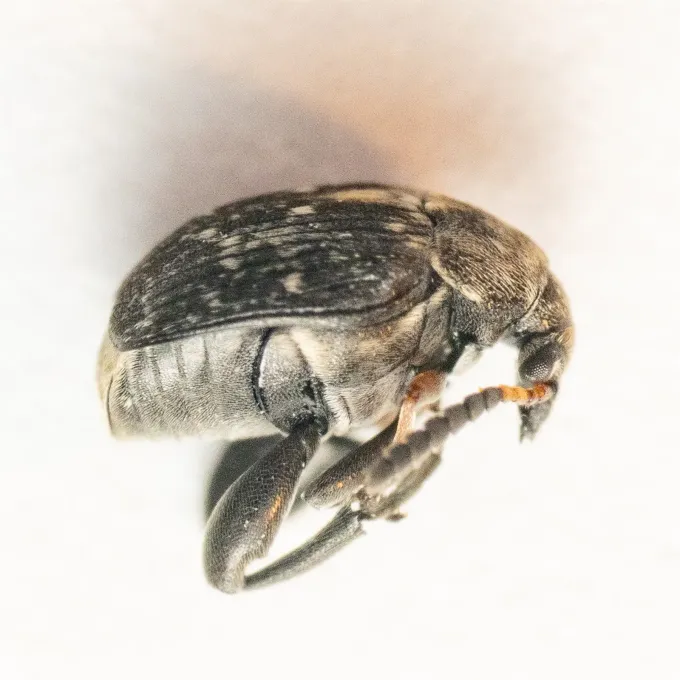
The vetch seed beetle (Bruchus atomarius) belongs to the Coleoptera order and the Bruchidae family. These insects are small, typically measuring 3–4 mm, with a dark, densely haired body that camouflages them against the plant surface.
Adult beetles possess a distinct morphology where the elytra (wing covers) are slightly shorter than the abdomen, exposing the pygidium. This is a key identification feature for agronomists during field surveys.
The larvae are white, legless, and adapted for an endoparasitic life inside the seeds. They have strong mandibles designed to consume the nutrient-rich tissues of the developing vetch seed.
These pests are closely synchronized with the phenological development of their host plants. Understanding this link is vital, as the beetles emerge from overwintering sites just as the vetch enters its flowering stage.
Regular field scouting using sweep nets during the pod-formation stage is the most reliable way to identify the presence of these beetles before they begin their egg-laying process.
What it damages
The vetch seed beetle primarily targets vetch (Vicia sativa). Its damage is categorized as internal, making it difficult to detect until the seed is fully developed or harvested.
The larva enters the seed during the milky stage of development, where it begins to feed. It systematically consumes the embryo and the endosperm, leaving only the thin seed coat intact.
This feeding behavior drastically reduces the germination rate of the seeds. Since the embryo is often the first part to be consumed, the seeds become biologically inviable for future sowing.
Economically, this beetle can cause significant yield losses. Infested pods show decreased grain weight, and in cases of high infestation, the market value of the vetch crop drops significantly due to quality degradation.
Furthermore, the exit holes created by the beetles when they emerge act as entry points for secondary pathogens, such as fungi, which can cause rotting of the remaining grain stored in silos.
When it appears
The lifecycle begins when the overwintered adults emerge in late spring, corresponding with the flowering of vetch. They feed on pollen and nectar, which is essential for their reproductive maturation.
The egg-laying period typically spans several weeks. Females glue their eggs to the surface of the developing pods, ensuring that upon hatching, the young larvae can easily penetrate the pod wall and reach the seeds.
Larval development takes approximately one to two months, occurring entirely inside the grain. By the time the crop is ready for harvest, the insect has usually reached the adult stage.
Upon harvesting, the beetles are often transported to storage facilities along with the grain. If not managed properly, they can continue to thrive and multiply in the storage environment.
As winter approaches, the beetles enter a state of diapause. They seek shelter in cracks of granary walls, or in field debris, where they stay dormant until the environmental conditions become favorable again.
Signs of infestation
The earliest signs of infestation are tiny white patches on the pod surface, which are the eggs laid by female beetles. These are small but visible under careful inspection.
As the larvae penetrate the pods, minor discoloration may appear at the entry site. However, the most characteristic sign of damage is the appearance of perfectly circular exit holes on the mature seeds.
Seeds infested by the beetle feel hollow or lighter than normal when handled. If the seed coat is broken, the internal contents will appear powdery and consumed, often containing larval waste (frass).
During the harvest, an unusual amount of pod shattering or early pod opening can be an indicator of significant larval activity that has weakened the pod structure.
The presence of adult beetles crawling on the plant foliage during the flowering stage is a clear sign that the population is active and ready to lay eggs on the newly formed pods.
Control measures
Effective management begins with strict crop rotation, ensuring that vetch is not planted in the same field for at least 3–4 years. This disrupts the beetle's lifecycle by moving away from their overwintering site.
Early harvesting is a crucial strategy. Collecting the crop as soon as it reaches maturity prevents the beetles from completing their development and emerging from the seeds in the field.
Chemical control involves applying systemic insecticides during the blooming phase, targeting the adult beetles before they start oviposition. Careful timing is essential for the effectiveness of the treatment.
For seed stocks, fumigation is the gold standard for control. It is the most effective method to eliminate both larvae and adults hidden inside the grains, ensuring the seeds remain viable for planting.
- Use clean, certified seeds free from infestation.
- Deep plowing of field residues to bury and kill overwintering insects.
- Use pheromone traps to monitor adult beetle flight activity.
Taxonomy
- Latin name
- Bruchus atomarius
- Order
- Coleoptera (beetles)
- Family
- Bruchidae
- EPPO code
- BRCHAT
Discussion
No discussions yet — be the first.