
Vetch seed beetle
Bruchus affinis
Description
How to identify
The Vetch seed beetle (Bruchus affinis) is a coleopteran insect belonging to the family Bruchidae, specifically adapted to feeding on seeds of the Lathyrus genus.
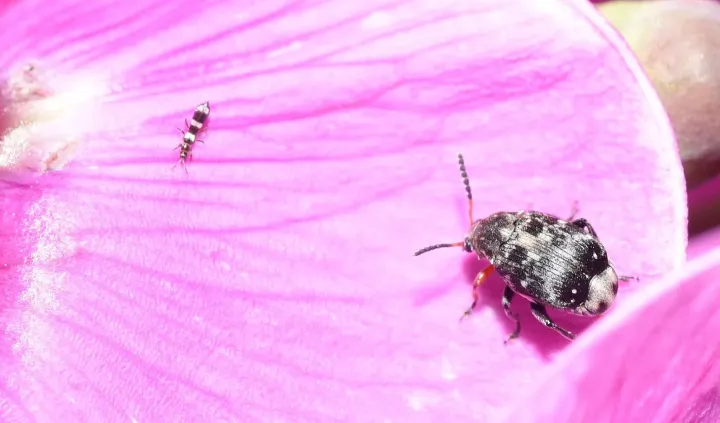
Adult beetles are small, typically measuring 3 to 4 mm in length, and their bodies are covered with dense greyish or brownish pubescence, which provides camouflage.
A distinctive feature for identification is a prominent tooth located on the hind femur, a characteristic that differentiates this species from other closely related bruchids.
Larvae are fleshy, white, and legless, perfectly adapted for a concealed life inside the seed, where they consume the endosperm and embryo to complete their development.
Adult beetles are strong flyers and actively seek out host plants during the flowering phase, which is critical for their mating and subsequent egg-laying process.
What it damages
The primary hosts of this pest include various species of Lathyrus, commonly known as chickling pea or vetchling, which are important for forage and agricultural use.
Damage occurs when the larva bores into the developing seed, destroying the internal tissues and significantly reducing the weight and overall quality of the yield.
Infested seeds show a drastic reduction in germination percentage, making them completely useless for future planting or professional seed stock production.
Economic losses can be substantial, as the presence of larvae renders the grain unmarketable for human consumption and animal feed due to poor nutritional value and hygiene.
The holes left by exiting adults create entry points for secondary infections, such as various types of molds and fungi, further degrading the stored grain quality.
When it appears
The lifecycle begins in spring as temperatures rise, triggering the emergence of overwintering adult beetles from sheltered areas or infested seed stocks.
Adults migrate to flowering crops to feed on pollen and locate suitable host plants for oviposition, which typically coincides with the development of young pods.
After hatching, the larvae penetrate the pod wall and then the seed coat, establishing themselves deep within the grain where they feed throughout the summer season.
The transition from larva to pupa and eventually to adult occurs within the seed, with new adults emerging through circular exit holes once the grain reaches maturity.
The pest typically survives the winter as an adult or late-stage larva inside dry seeds stored in bins or remaining in crop residues left in the fields.
Signs of infestation
Early identification is possible by observing adult beetles resting on the flowers or stems of the host plants during warm, sunny weather conditions.
Small, oval-shaped eggs can be spotted on the surface of young, tender pods, usually laid in clusters or individually depending on the infestation level.
The most recognizable sign of an established infestation is the presence of perfectly round exit holes in mature seeds, indicating that the beetle has completed its lifecycle.
Infested seed lots often appear lighter in mass, with many grains containing interior hollows filled with frass and larval debris upon closer inspection.
Dull coloration and visible entry marks on the seed coat are reliable indicators of current or past damage that warrants immediate post-harvest management.
Control measures
Integrated pest management strategies are crucial, starting with early harvesting to collect the crop before the new generation of beetles can emerge and infest other areas.
Field hygiene is essential; deep plowing after harvest helps bury and destroy crop residues, effectively eliminating the primary overwintering sites for the beetle.
If seed infestation is detected post-harvest, appropriate fumigation or cold storage treatments should be applied to prevent further destruction of the stored seed stock.
Chemical control using insecticides may be necessary during the flowering and pod-setting stages to suppress the adult beetle population and reduce egg-laying pressure.
- Implement a strict crop rotation schedule to avoid planting Lathyrus in the same field for at least two to three consecutive years.
- Use certified, beetle-free seed for planting to prevent introducing the pest into new agricultural fields.
- Ensure granaries are thoroughly cleaned and disinfected before the storage of new harvest to eliminate residual populations.
Taxonomy
- Latin name
- Bruchus affinis
- Order
- Coleoptera (beetles)
- Family
- Bruchidae
- EPPO code
- BRCHAF
Discussion
No discussions yet — be the first.