
Alfalfa seed chalcid (Bruchidius marginalis)
Bruchidius marginalis
Description
How to identify
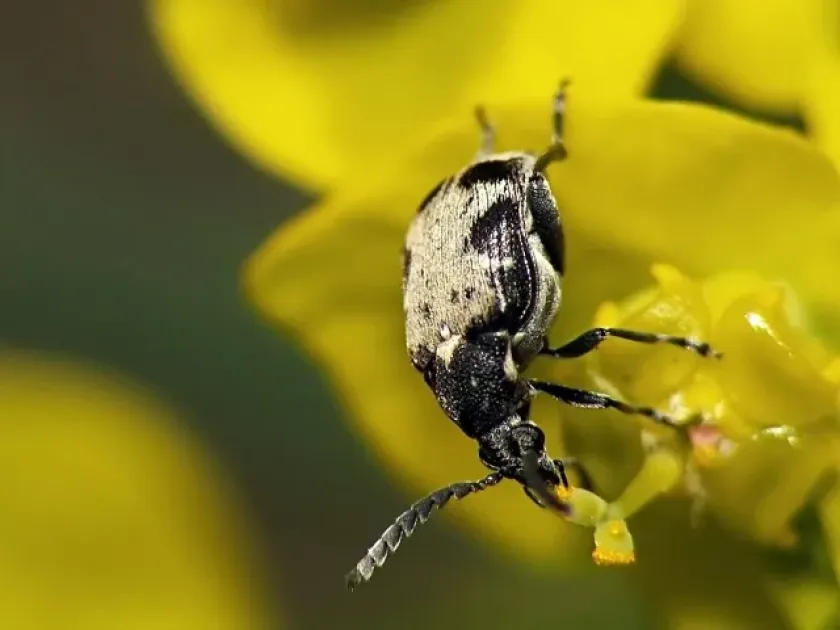
The alfalfa seed beetle (Bruchidius marginalis) belongs to the Bruchididae family within the order Coleoptera. Adult beetles are small, measuring 2.5–3.5 mm in length, and are covered with dense greyish-yellow hairs.
Their body color ranges from dark brown to black. The pronotum is conical, and the elytra are shortened, leaving the end of the abdomen exposed, which often displays characteristic light-colored hair patches.
The larvae are legless, white-colored with a small brown head, and are specifically adapted for living inside the seeds of leguminous plants, particularly alfalfa.
Adult beetles are active during the day, showing a preference for sunny weather conditions, which are ideal for mating and searching for suitable host plants for oviposition.
The life cycle of this beetle is highly synchronized with the growth stages of alfalfa, making it a specialized pest that poses a significant threat to seed production.
What it damages
The primary host plant for this pest is alfalfa (Medicago sativa), specifically the developing seeds. The larvae feed inside the pods, consuming the internal content of the seeds.
Damage caused by the larvae leads to a substantial reduction in seed germination capacity. The infested seeds lose weight and nutritional value, rendering them unsuitable for commercial planting.
Infestation rates can be high, with potential seed yield losses ranging from 30% to over 50%. Often, the internal damage is not apparent until the seed is processed.
Additionally, the feeding activity of the larvae can create openings that facilitate the entry of secondary pathogens, including various fungal infections that further degrade seed quality.
Damage is most severe during the pod formation and seed maturation stages, necessitating careful monitoring during these critical phases of the plant's development.
When it appears
Overwintered adult beetles emerge in late spring or early summer, coinciding with the flowering period of the first cut of alfalfa.
Females lay eggs on the surface of developing pods as soon as the seeds reach the milk stage. The larval development occurs entirely within the seed and lasts for several weeks.
The species overwinters primarily in the adult stage, hiding in soil cracks, under crop residues, or within storage facilities where alfalfa seeds are kept.
Depending on the climatic zone, the beetle may complete one or two generations per year. Warm and dry weather conditions generally accelerate the development and reproduction of the population.
Pupation takes place inside the infested seed. Once the adult emerges, it cuts a characteristic exit hole through the seed coat and the pod wall to escape.
Signs of infestation
The most reliable sign of an infestation is the presence of small, round exit holes on the surface of mature pods and seeds.
During field inspections, small, elongated eggs can sometimes be observed on the pod surface, although this requires careful examination with a hand lens.
While the plants might appear healthy from a distance, the threshing process reveals a large number of empty or partially eaten seeds, which is a hallmark of this pest.
A decrease in the thousand-seed weight is a major indicator of a severe infestation level that occurred during the growing season on a specific field.
Accumulated frass and insect debris inside the seed pod are definitive signs that the larvae have been actively feeding within the crop.
Control measures
Cultural control methods include early harvesting of the alfalfa crop, which can help destroy eggs before the larvae have a chance to penetrate the seeds.
Spatial isolation is critical; new seed crops should be located away from older, established alfalfa fields that serve as reservoirs for the beetle population.
Chemical control involves the application of appropriate insecticides during the budding and early flowering stages to suppress adult beetle populations.
It is essential to select and apply pesticides in a way that minimizes impact on pollinators, particularly honey bees, which are vital for alfalfa seed production.
- Deep plowing of the field after harvest to destroy overwintering sites.
- Using certified, clean seed lots for planting to prevent spread.
- Fumigation of stored seeds if an infestation is detected post-harvest.
Taxonomy
- Latin name
- Bruchidius marginalis
- Order
- Coleoptera (beetles)
- Family
- Bruchidae
- EPPO code
- BRCIMA
Discussion
No discussions yet — be the first.