
Seed beetle
Bruchidius
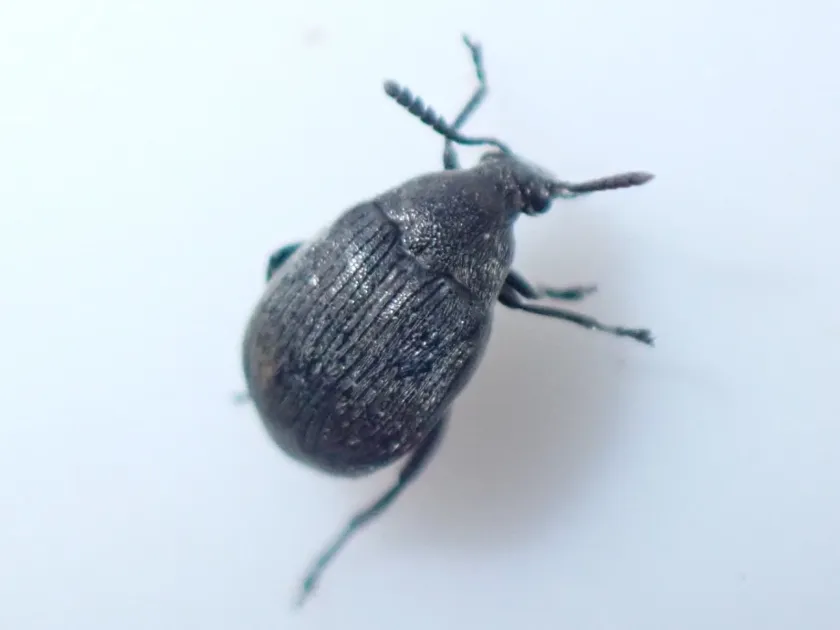
Description
How to identify
The genus Bruchidius belongs to the seed beetle family (Bruchidae) within the order Coleoptera. These are small beetles, typically 2 to 5 mm long, with a characteristic oval body shape, often covered in dense light hairs that give them a mottled appearance.
The head is small and retracted, equipped with powerful chewing mouthparts. Most species feature serrated antennae, which serve as a crucial taxonomic trait for identifying the pest in the field or when analyzing seed samples.
The larvae possess a thick, C-shaped, legless body that is creamy white in color. They are perfectly adapted to life inside seeds, utilizing a strong chitinous apparatus to bore through the seed coat and feed on the nutrient-rich tissues within the grain.
Pupae of these species develop within the infested seed, where they undergo pupation after completing their larval cycle. Adult beetles exit the seed by creating a characteristic round hole, which serves as a primary indicator of infestation within a grain lot.
The biology of these beetles is closely linked to legume plants, where they complete their entire life cycle. Unlike some other species, many members of this genus can produce several generations per season under favorable temperature conditions.
What it damages
The primary damage is caused by larvae developing inside the seeds of leguminous crops such as vetch, alfalfa, clover, and soybeans. This pest can destroy up to 50% of grain volume, significantly reducing its nutritional value.
Infested seeds lose their viability, rendering them unsuitable for use as sowing material. Furthermore, the commercial quality of the grain decreases, making it unfit for food or feed processing industries.
In the field, adult beetles may feed on the pollen of flowering legumes, but the most severe damage occurs during the generative phase, when pods are forming. Mass reproduction of the pest leads to the total destruction of the seed embryo.
Post-harvest, the activity of seed beetles often continues in storage facilities if fumigation measures are not implemented. In warehouse conditions, the pest can spread rapidly, infesting healthy neighboring grain lots.
Economic losses arise from direct weight loss of the grain and the costs associated with mandatory cleaning and quarantine treatment. Heavy infestations often make it impossible to sell the product on markets due to strict phytosanitary regulations.
When it appears
Adult activity (flight) begins during the flowering period of forage and grain legumes, typically from late spring to mid-summer. Beetles move actively between plants, mating and laying eggs directly onto the surface of developing pods.
The development of one generation in the field takes between 30 and 50 days, depending on the temperature regime. The optimal temperature for reproduction is 22–28 degrees Celsius, combined with high air humidity.
By the time the crop matures, most larvae have already penetrated the seeds, where they enter a dormant phase or continue development. In late summer or autumn, a new generation of adults emerges, seeking overwintering sites.
Pests primarily overwinter as adults in bark crevices, plant debris, under stones, or directly within warehouse structures. Some species may overwinter as larvae inside seeds dropped on the field.
The onset of a new cycle in the following year is directly correlated with soil warming and the emergence of the first seedlings of susceptible crops. Monitoring the population during this period is critical to preventing mass infestations.
Signs of infestation
The most obvious sign of infestation is the presence of small, perfectly round exit holes on the seed surface, left by the emerging adult beetles. Sometimes, small spots can be seen on the pods, indicating the entry point of the larva.
When an infested seed is cut open, one can find a cavity filled with the larval powdery excrement. In heavily infested lots, the grain becomes very light, loses its sheen, and acquires a characteristic musty odor.
The presence of adult beetles on inflorescences or pods during the vegetation period is an indirect sign that egg-laying will soon begin. Visual inspection of pods allows for the detection of tiny whitish eggs attached to the pod valves.
In storage facilities, the presence of the pest is indicated by a specific sound made by the beetles as they move within the grain pile, as well as the accumulation of "dust" resulting from grain consumed by the insects.
Laboratory analysis using X-ray imaging allows for the detection of infested seeds before the beetles emerge, which is critical for the export of grain products.
Control measures
Agrotechnical methods include early harvesting before the beetles begin to emerge from the seeds. Deep plowing of crop residues and the destruction of volunteers, which serve as reservoirs for the pest in the field, are essential.
Adherence to crop rotation, incorporating crops that are not hosts for specific seed beetle species, helps significantly reduce population levels. Using healthy, treated seed material prevents the introduction of the pest into clean fields.
During the vegetation period, systemic or contact insecticides are applied once the economic threshold is reached. It is crucial to perform treatments before the larvae penetrate the pod, as the effectiveness of insecticides drops sharply afterward.
In storage conditions, the primary protection method is fumigation with authorized phosphine-based products. Cooling the grain mass to temperatures below +10 degrees Celsius is also effective in halting larval development.
Pheromone traps are used to monitor population density, allowing for precise determination of mass flight dates and timely intervention. Regular disinfection of empty storage facilities before stocking new crops is a mandatory requirement.
Taxonomy
- Latin name
- Bruchidius
- Order
- Coleoptera (beetles)
- Family
- Bruchidae
- EPPO code
- BRCISP
Discussion
No discussions yet — be the first.