
Notoxus monocerus
Notoxus monocerus
Description
How to identify
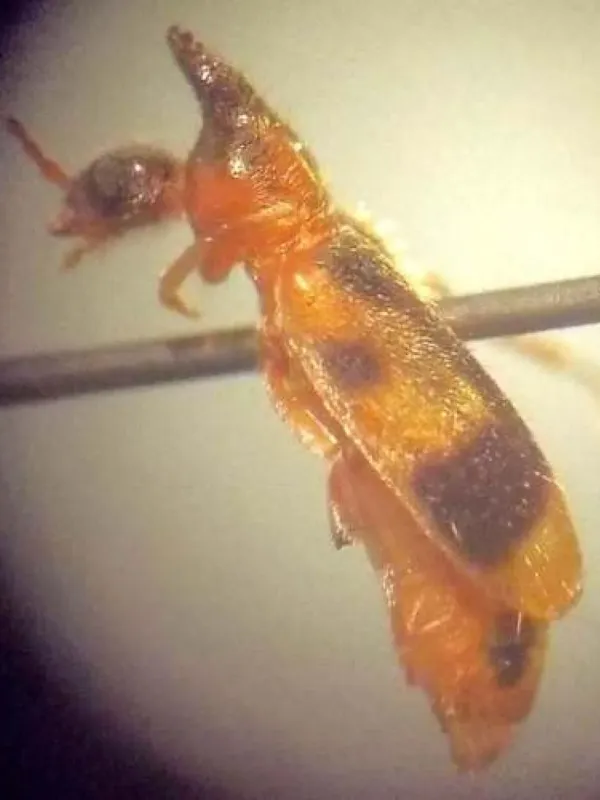
Notoxus monocerus, commonly known as a type of ant-like flower beetle, belongs to the family Anthicidae. This insect is identified by its distinct horn-like protrusion on the pronotum that extends over the head.
The beetle typically measures 3–4 mm in length and features a brown or reddish-brown coloration with dark spots on its elytra, which provides camouflage.
The body is covered in fine, dense hairs, giving it a matte appearance. These beetles are highly mobile and possess functional wings, allowing for rapid colonization of host fields.
Morphologically, the "horn" is the primary diagnostic feature that separates this species from other similar beetles found in agricultural landscapes.
They are primarily associated with moist soil environments and organic debris, where they spend much of their lifecycle hiding from predators and unfavorable weather.
What it damages
Notoxus monocerus can impact various crops, including cereals, vegetables, and technical crops like sugar beet and sunflowers, especially during the early growth stages.
Adult beetles primarily feed on pollen, flower buds, and young leaf tissues. This feeding can damage the reproductive organs of plants, potentially reducing seed set and yields.
While the larvae are often saprophagous (feeding on decaying organic matter), they can occasionally damage the roots of crop seedlings if organic food sources are scarce.
Direct damage to seedlings is considered the most significant threat, as it can cause stand thinning and force farmers to replant affected areas.
High population densities lead to visible foliage damage and general physiological stress, which slows down the plant's growth rate and increases vulnerability to secondary diseases.
When it appears
The activity cycle of Notoxus monocerus begins in spring, as soon as soil temperatures reach thresholds favorable for the emergence of overwintering adults.
Peak activity and mating seasons typically occur during May and June, aligning with the critical development stages of many spring-sown crops.
Depending on the climatic conditions, these beetles may complete one or more generations per season, with activity remaining high in warm, humid weather.
Adults are most active during the day, particularly during sunny periods, when they frequently visit flowers and foliage to feed and mate.
As winter approaches, the beetles seek shelter in the soil or under dense plant debris, entering a state of diapause until the following spring.
Signs of infestation
The most common sign of infestation is the presence of small, irregular holes in the leaves and petals caused by adult beetle feeding.
Field inspection using an insect sweep net during the day is the most effective way to detect the presence of these beetles among the canopy.
In cases of root damage, seedlings may appear wilted, stunted, or discolored, indicating that the larvae have been feeding on the root system underground.
An abundance of beetles on flower heads or foliage is a strong indicator that localized damage to reproductive structures is occurring.
The general thinning of crop stands, if unexplained by other pests or pathogens, often warrants a closer inspection for Notoxus populations at the base of the plants.
Control measures
Integrated Pest Management (IPM) strategies for Notoxus monocerus rely heavily on cultural practices, such as deep plowing to disturb overwintering sites.
Effective weed control is crucial, as weeds serve as alternative hosts and reservoirs for the beetle population throughout the growing season.
Rotating susceptible crops with non-host species helps break the lifecycle of the beetle, significantly reducing the pest pressure on future harvests.
Chemical control involving systemic or contact insecticides can be effective if applied during the early adult emergence phase before substantial damage occurs.
- Use of certified seed treatments to protect young seedlings.
- Timely monitoring using sticky traps in affected fields.
- Maintenance of balanced nutrient levels to promote rapid seedling recovery.
- Avoidance of monoculture by implementing diverse crop rotation schemes.
Taxonomy
- Latin name
- Notoxus monocerus
- Order
- Coleoptera (beetles)
- Family
- Anthicidae
- EPPO code
- NOTXMC
Discussion
No discussions yet — be the first.