
Anthicus flavipes
Anthicus flavipes
Description
How to identify
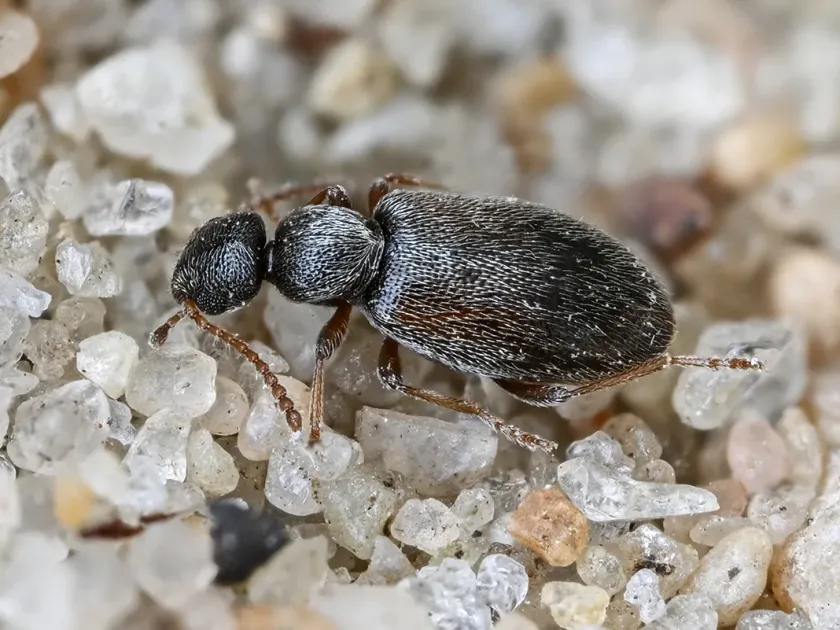
Anthicus flavipes is a small beetle belonging to the family Anthicidae, commonly known as ant-like flower beetles. As the common name suggests, these insects exhibit a distinct morphological resemblance to ants, characterized by a visible constriction between the pronotum and the head.
Adult beetles are typically small, measuring between 3 and 4 mm in length. Their coloration ranges from dark brown to black, often with noticeably yellowish legs, which serves as a key identifying feature for the species. The body is frequently covered in fine setae (hairs).
The larvae are typically vermiform (worm-like) with well-developed chewing mouthparts. They prefer cryptic habitats, often residing within the upper layers of the soil or beneath moist decaying organic matter near crop fields.
The life cycle follows complete metamorphosis: egg, larva, pupa, and adult. Adults are highly mobile and agile, allowing them to rapidly colonize agricultural areas during favorable environmental conditions.
Accurate field identification often requires the use of pitfall traps or entomological sweeps. Because they are often active at dusk or dawn, visual inspection during the hottest parts of the day may fail to reveal their presence.
What it damages
This species is considered a pest that can affect a range of crops, particularly during the germination and early seedling stages. It feeds on various agricultural products including legumes, cereals, and certain vegetable crops.
Damage is primarily caused by both adults and larvae feeding on vegetative tissues. Adults often consume the epidermis of young leaves and damage the stems near the soil surface, leading to structural weakness in the plant.
Larval feeding on the root system or the hypocotyl area of seedlings can be particularly destructive. This interference with nutrient uptake often results in stunted growth, chlorosis, and, in severe cases, the death of the seedling.
Damaged tissues create entry points for secondary infections. Fungal and bacterial pathogens easily colonize the wounds left by the beetles, potentially leading to widespread disease outbreaks in the field.
The severity of the damage is often exacerbated by environmental stress, such as drought, which forces the pests to feed more aggressively on the succulent tissues of young, emerging crops.
When it appears
The activity of Anthicus flavipes is highly dependent on temperature and soil moisture levels. Emergence typically begins in early spring, as soil temperatures rise above 12–15 degrees Celsius, coinciding with the sowing season of many crops.
The peak population density usually occurs in late spring or early summer, when environmental conditions are optimal for both larval development and the dispersal of adult beetles across the landscape.
Depending on the climatic region, multiple generations may occur within a single growing season. Prolonged warm springs significantly accelerate the maturation process, leading to rapid population growth.
As temperatures drop in the autumn, the beetles enter a diapause phase. They seek refuge in deeper soil layers or beneath dense plant debris, where they successfully overwinter until the following spring.
Proactive monitoring is essential during the first few weeks of seedling emergence, as this is the window of maximum vulnerability for the crop and the period of highest pest activity.
Signs of infestation
The primary indicators of an Anthicus flavipes infestation include irregular feeding holes along the edges of cotyledons and small punctures on the stems of young seedlings.
Plants may exhibit localized wilting or lodging, often caused by the beetles feeding at the base of the stem. If these signs are observed, careful examination of the surrounding soil often reveals the presence of beetles or larvae.
Stunted growth, unrelated to soil fertility or water deficiency, may suggest root system injury caused by larvae. Digging into the soil near the root zone can help confirm the source of the distress.
Adult beetles can often be spotted on the soil surface or resting in the shade of clods during the cooler parts of the day. Their rapid movement is a characteristic behavior when disturbed.
- Irregular feeding patterns on young leaves.
- Seedling wilting due to stem injury.
- Localized thinning of crop stands.
- Adult beetles found under crop residue or in soil cracks.
Control measures
Management of Anthicus flavipes requires an integrated approach. Cultural practices, such as deep plowing in the autumn, help disrupt the overwintering sites and reduce the initial spring population.
Crop rotation is a critical component of pest control. By changing the host plant, the local population of the beetle is deprived of its preferred food source, leading to a natural decline in numbers.
For high-risk areas, the use of insecticide-treated seeds (seed dressings) provides a reliable defense during the critical germination phase, protecting the sensitive hypocotyl and young roots.
If population levels exceed the economic threshold, foliar application of contact or systemic insecticides may be necessary. Treatments are most effective when performed in the evening to target the beetles while they are active on the surface.
Effective weed control is also essential, as many weeds act as alternative hosts and reservoirs for the pest population between crop cycles. Maintaining field hygiene reduces the overall pest load throughout the season.
Taxonomy
- Latin name
- Anthicus flavipes
- Order
- Coleoptera (beetles)
- Family
- Anthicidae
- EPPO code
- ANTCFV
Discussion
No discussions yet — be the first.