
Ant-like flower beetle
Anthicus cervinus
Description
How to identify
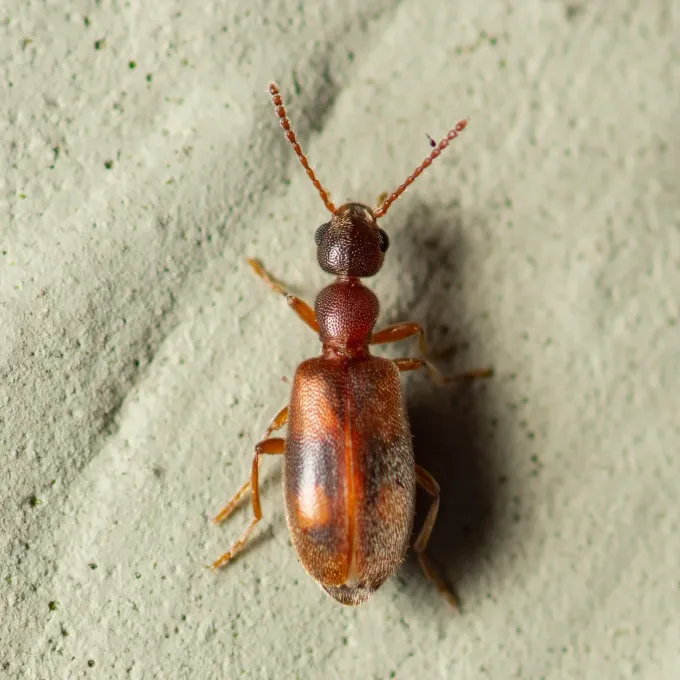
Anthicus cervinus, commonly known as an ant-like flower beetle, belongs to the family Anthicidae within the order Coleoptera.
These beetles are small, typically measuring between 2.5 and 3.5 mm in length, and have a distinct morphology characterized by a narrow thorax.
Their coloration is generally light brown or reddish-tan, and the body is covered in fine, short hairs, giving it a somewhat matte appearance.
The larvae are whitish, elongated, and possess chewing mouthparts, which they use while living in soil or organic matter environments.
Adult beetles are highly agile and possess a rapid, nervous movement style, which is a defensive mechanism to escape threats quickly.
What it damages
This beetle species is known to infest various agricultural crops, including cereals, sugar beets, and various vegetable gardens.
The primary damage is caused when adult beetles feed on germinating seeds and the stems of young seedlings during the early spring growth stage.
They are facultative feeders, meaning they can consume both plant tissues and decomposing organic matter, thriving in fields with heavy residue.
Feeding near the root collar or soil level often results in the wilting and eventual death of the young plant, thinning the crop stand.
Economic damage is most significant in fields with high soil moisture levels or poor sanitation, where the beetle population can reach high densities.
When it appears
Adult beetles emerge from their overwintering sites in the soil as soon as spring temperatures start to rise consistently.
The peak activity and reproductive phase occur during May and June, coinciding with the most vulnerable stages of crop germination and emergence.
The lifecycle involves eggs being laid in the soil, followed by larval development and pupation, typically completing one generation per year.
As summer temperatures peak, activity may shift, but they generally remain present in fields with sufficient plant cover and debris.
When autumn temperatures drop, adults move deeper into the soil or under dense plant litter to enter a state of dormancy for the winter.
Signs of infestation
Signs of infestation include small, irregular feeding marks on the base of stems and potential girdling of seedlings near the soil surface.
Patches of wilting or stunted growth in a field may indicate a localized population of the beetle affecting the root zone of the young plants.
Closer inspection of the soil surface during cool, damp mornings often reveals the presence of mobile adults scurrying away when disturbed.
Seedlings may suddenly collapse if the stem damage at the base is severe enough to interrupt nutrient and water transport.
- Stunted or yellowing seedlings.
- Girdled stems near the soil line.
- Visible beetles in soil samples or near crop debris.
Control measures
Effective crop rotation is the primary defense, as it prevents the beetle from establishing large, stable populations in one location over time.
Thorough tillage practices help disrupt the overwintering habitat and reduce the overall success of larval development within the soil.
Sanitation of field borders and the removal of excessive crop residue minimize the niches where these beetles thrive and reproduce.
Chemical control with approved insecticides may be necessary if early-season monitoring confirms population levels that threaten crop establishment.
Regular field scouting using ground traps or soil inspection is essential to detect early infestations before they lead to widespread seedling loss.
Taxonomy
- Latin name
- Anthicus cervinus
- Order
- Coleoptera (beetles)
- Family
- Anthicidae
- EPPO code
- ANTCCE
Discussion
No discussions yet — be the first.