
Anthicus antherinus
Anthicus antherinus
Description
How to identify
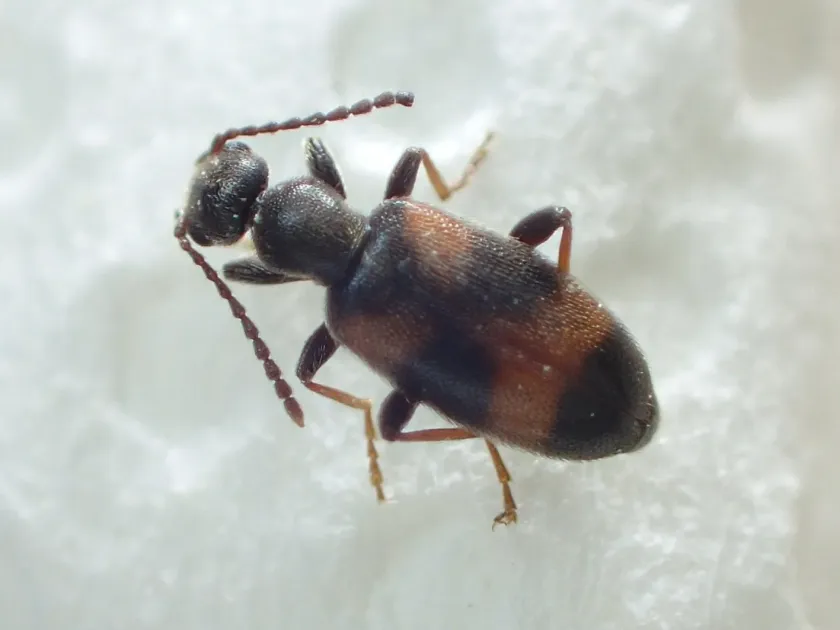
Anthicus antherinus, commonly known as an ant-like flower beetle, belongs to the family Anthicidae within the order Coleoptera. These small beetles reach a length of 3 to 4 mm and possess a distinctive morphology that resembles an ant, featuring a narrow head and pronotum.
Their body coloration is typically dark brown or black, often marked with lighter, distinct bands on the elytra. The surface of the insect is covered with fine, short hairs, which is a diagnostic characteristic of the genus.
The life cycle follows complete metamorphosis, including egg, larval, pupal, and adult stages. These beetles are highly mobile and are frequently found on foliage, flowers, and in the soil surface layer.
In natural ecosystems, they dwell in decaying organic matter and on various flowering plants, where they find both shelter and sources of food.
Identification is achieved by examining specific structural features, such as the shape of the pronotum and the elytral pattern, which distinguish A. antherinus from other related species.
What it damages
While often considered an occasional pest, Anthicus antherinus can cause significant damage in intensive agriculture, particularly to young seedlings and generative plant parts.
Major crops affected include cereals, oilseeds, and vegetables, with damage becoming most apparent during the flowering and pollination phases.
Beetles consume flower petals, anthers, and ovules, which directly interferes with the fertilization process and results in lower crop yields.
Larvae living in the soil may feed on the delicate root systems of young plants, leading to stunted growth and reduced vigor, especially under drought conditions.
The damage is usually localized but can reach economic thresholds in high-density populations, leading to visible thinning of crop stands.
When it appears
Mass emergence of adult beetles typically occurs from late spring through the summer months, coinciding with the flowering stages of most field crops.
Peak activity is observed during warm, sunny days when the beetles are actively moving across plants to feed and mate.
Adults overwinter in the soil or under plant debris, utilizing these areas as thermal refugia against harsh winter temperatures.
Activity resumes in spring as soil temperatures rise, prompting the beetles to migrate onto emerging crops to initiate their first feeding cycle.
The number of generations per year is highly dependent on local climatic conditions and the availability of suitable food sources throughout the growing season.
Signs of infestation
The most prominent sign of an infestation is the presence of small, irregular holes or grazing marks on flower petals and reproductive organs.
Inconsistent pollination, resulting in deformed fruit or premature flower drop, is a common indicator of significant beetle activity in the field.
Visual inspections conducted in the early morning often reveal adult beetles clustered on flowers or upper leaves of the host plants.
- Presence of insect excrement on leaves surrounding damaged flowers.
- Wilting or yellowing of seedlings due to larval feeding on root tissues.
- Detection of adult beetles in monitoring traps deployed for integrated pest management.
Plants affected by larval feeding on roots may show poor turgor pressure and general weakness even when moisture levels are optimal.
Control measures
Managing Anthicus antherinus requires an integrated approach that combines cultural practices with targeted chemical interventions when necessary.
Cultural control measures, such as deep fall plowing, are highly effective as they disturb overwintering sites and disrupt the lifecycle of larvae in the soil.
Crop rotation and diligent weed management significantly reduce the availability of alternative hosts and breeding grounds for the beetles.
If population levels exceed economic thresholds, the application of contact-stomach insecticides may be warranted, provided that guidelines for protecting pollinators are strictly followed.
Continuous field monitoring is essential for timely detection of the pest, allowing for precise and economical implementation of crop protection measures.
Taxonomy
- Latin name
- Anthicus antherinus
- Order
- Coleoptera (beetles)
- Family
- Anthicidae
- EPPO code
- ANTCAN
Discussion
No discussions yet — be the first.