
Black spider beetle
Xyletinus ater
Description
How to identify
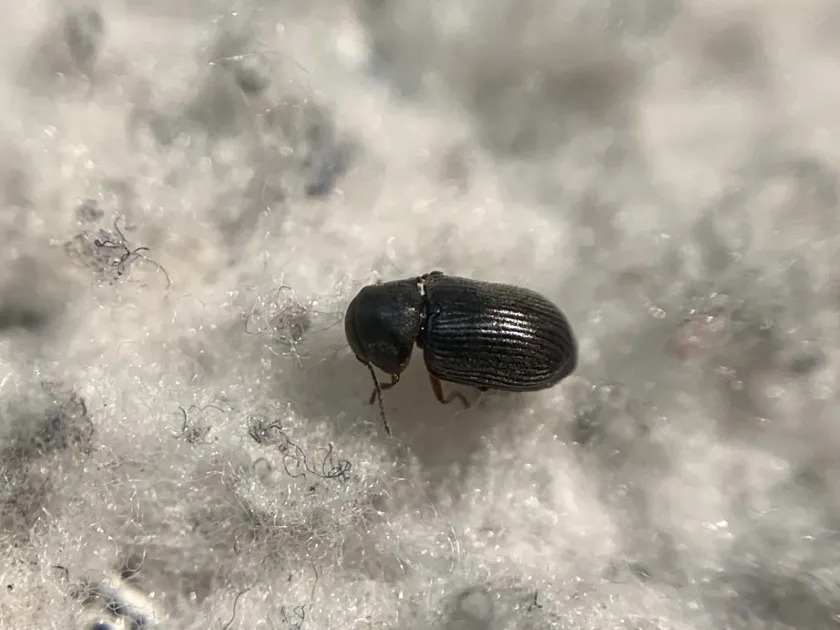
The black spider beetle (Xyletinus ater) is a member of the Ptinidae family within the order Coleoptera. Adult beetles are small, typically ranging from 3 to 5 mm in length, and are characterized by their dark, nearly black appearance.
The body of the beetle is cylindrical and somewhat convex, covered with fine, densely packed hairs that protect it from environmental stressors.
Like other species in the genus Xyletinus, the head is typically recessed into the pronotum, which serves as a key identifying morphological feature.
The larvae are typically white or yellowish, with a curved body shape and strong, sclerotized mandibles adapted for boring into solid plant tissues.
These insects are highly resilient and capable of thriving in sheltered environments, making them persistent pests in storage facilities.
What it damages
The larvae of the black spider beetle primarily consume dry plant debris, wood, and stored agricultural seeds that are kept in suboptimal conditions.
Within storage warehouses, this pest can cause significant damage by boring into wooden pallets, structural beams, and other timber components, weakening them over time.
Stored agricultural products, including grains and dry root crops, are at risk if left undisturbed for long periods, leading to internal degradation.
Damage is characterized not only by the physical loss of material but also by contamination with larval frass, which compromises the quality of the entire stock.
Infestations are often exacerbated in warehouses where temperature and humidity fluctuations provide ideal conditions for continuous larval growth.
When it appears
The activity of adult beetles is most pronounced during the warmer months, typically occurring from late spring through the mid-summer period.
Adults emerge from their pupation sites to mate and lay eggs, typically depositing them in cracks and crevices within wood or dried vegetable matter.
Upon hatching, the larvae immediately begin boring into the substrate, where they continue their development for several months or even longer.
The length of the lifecycle is highly dependent on ambient conditions, with warmer temperatures accelerating the growth rate of the larvae.
Wintering usually takes place in the larval stage, allowing the insect to survive cold periods inside the protective tunnels it has excavated.
Signs of infestation
The presence of tiny, circular exit holes on the surface of infested materials is the most obvious external indicator of an active infestation.
A fine, powder-like frass is typically found accumulating beneath these exit holes, marking the locations where the larvae have been feeding.
In cases of heavy infestation, a faint rasping or scratching sound may be audible inside the wood as larvae feed on the internal fibers.
The presence of adult beetles, especially near light sources or on surfaces, suggests that a new generation has emerged within the immediate area.
A noticeable decrease in the mass of stored items or the structural breakdown of wood components serves as a warning of long-term pest colonization.
Control measures
Sanitation is the cornerstone of control; regular cleaning of warehouses to remove dust, debris, and grain remnants is essential to disrupt the pest's habitat.
Maintaining a low-moisture environment is highly effective, as the development of Xyletinus ater larvae is significantly retarded in dry conditions.
If an infestation is identified, the use of fumigation or authorized residual insecticides can help eliminate the pest population within the facility.
It is crucial to perform regular inspections of stored goods and wooden infrastructure to detect potential issues before they reach a critical level.
Quarantine practices and the careful screening of incoming materials are necessary to prevent the introduction of this beetle into sterile or well-managed storage units.
Taxonomy
- Latin name
- Xyletinus ater
- Order
- Coleoptera (beetles)
- Family
- Anobiidae
- EPPO code
- XYLNAT
Discussion
No discussions yet — be the first.