
Deathwatch beetle
Xestobium rufovillosum
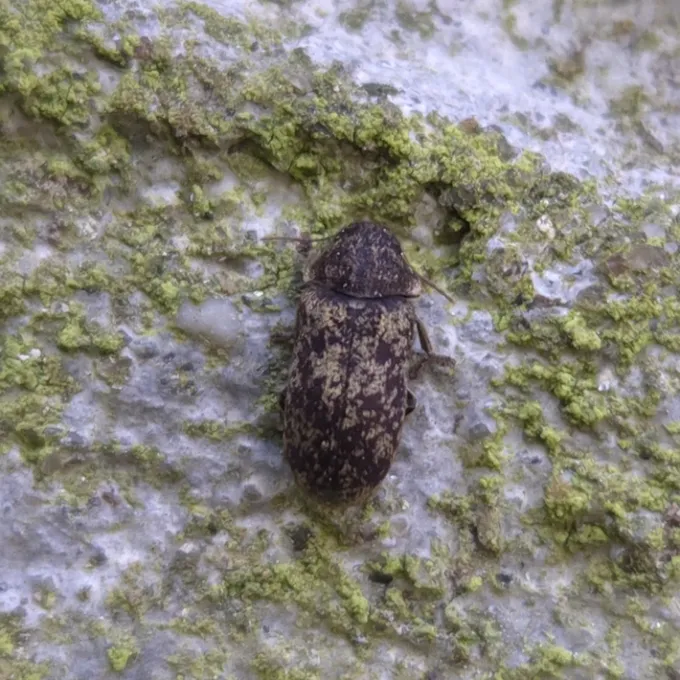
Description
How to identify
The Deathwatch beetle (Xestobium rufovillosum) is a species of wood-boring beetle in the family Anobiidae of the order Coleoptera, known for its significant impact on structural timber.
Adult beetles measure between 5 to 7 mm in length and possess a dark brown body covered with patchy yellowish-gray scales, which provides excellent camouflage against wood surfaces.
They are famous for their unique mating ritual where the beetle bangs its head against the wood, producing a rhythmic ticking sound often mistaken for the ticking of a clock.
The larvae are cream-colored and C-shaped, equipped with strong mandibles that allow them to tunnel deep into the heartwood of the timber they inhabit.
The total life cycle is long, often spanning several years depending on environmental conditions, which complicates long-term management and eradication efforts.
What it damages
This pest specifically targets seasoned hardwoods, particularly oak, and is notorious for damaging historic buildings, churches, and antique wooden furniture.
The beetle thrives in timber affected by fungal decay; the fungus softens the wood and makes it easier for larvae to digest, leading to accelerated structural decline.
Larvae consume the interior of the timber, leaving a honeycomb of tunnels that often remain undetected until the structural integrity of the wood is severely compromised.
In exterior settings, the Deathwatch beetle can attack old or stressed orchard trees, causing internal rot and weakening the main trunk or structural branches.
Economic damage is high because the remediation of historic timber frames often requires specialized restoration work rather than simple insecticidal treatment.
Signs of infestation
The most visible indicator of an infestation is the presence of small, circular exit holes, approximately 2-3 mm in diameter, left by emerging adult beetles.
Fine, granular frass, or wood dust, can often be found beneath these exit holes, marking the areas where the larvae have been actively boring through the timber.
The rhythmic ticking sound, particularly during the spring mating season, serves as a distinct auditory cue that an active population exists in the structure.
Soft or crumbly wood surfaces that give way under light pressure are clear signs that the internal structure has been destroyed by years of larval activity.
Dampness or historical fungal water damage on wood members is a strong precursor indicator that the site is highly susceptible to future infestation.
Control measures
Effective management begins with moisture control, as the beetle rarely attacks timber with a moisture content of less than 15 percent, focusing on fixing leaks and improving ventilation.
Chemical treatments using boron-based compounds or professional-grade insecticides are effective for preventing or treating infestations in accessible timber.
Localized infestations can be treated with direct injection of chemical preservatives into the larval galleries to ensure deep penetration of the wood.
For severe structural infestations, specialized fumigation or heat treatment may be necessary to eliminate larvae that are inaccessible to surface applications.
- Fixing plumbing and roof leaks
- Installing moisture barriers
- Applying borate-based wood preservatives
- Regular structural inspections by professionals
Taxonomy
- Latin name
- Xestobium rufovillosum
- Order
- Coleoptera (beetles)
- Family
- Anobiidae
- EPPO code
- XESTRU
Discussion
No discussions yet — be the first.