
Drugstore beetle
Stegobium
Description
How to identify
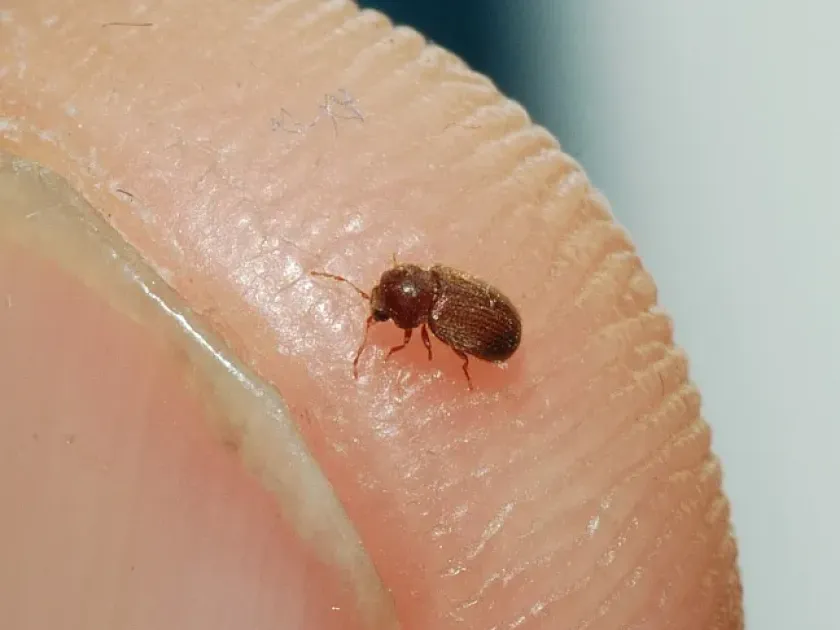
The drugstore beetle, Stegobium paniceum, is a member of the Ptinidae family. It is a small insect, measuring approximately 2 to 3 mm in length, with a cylindrical, reddish-brown body covered in fine, silky hair.
Adult beetles have wings and are capable of flight, which allows them to infest new areas within a storage facility. Their head is typically bent downwards and tucked under the pronotum, giving them a distinct humped appearance.
The larvae are small, C-shaped grubs with a white body and a dark brown head. Their bodies are covered in numerous bristles, which helps them move effectively within their food source.
Pupation occurs in small, oval-shaped cells constructed by the mature larvae. These cocoons are made from particles of food and waste materials cemented together, providing protection during development.
These pests are cryptic and prefer dark, undisturbed areas, often staying hidden inside the products they are infesting until the adults emerge to mate.
What it damages
This species is a notorious generalist feeder, capable of consuming almost any dry organic matter. This includes grain, flour, dried fruits, herbs, spices, and pet food.
The larvae are responsible for the damage. They bore irregular tunnels through the food items, leaving behind a fine, powdery residue of frass and debris that renders the product unusable.
In addition to food products, drugstore beetles frequently attack non-food items such as leather, woolen goods, pharmaceutical products, and even the glue in book bindings.
The economic impact is significant due to the loss of product weight and the cost of sanitation. Contaminated goods often require complete disposal due to the presence of insect remains and toxic excretions.
Because they can infest a wide variety of materials, drugstore beetles are extremely difficult to eradicate once they become established in a multi-product storage environment.
When it appears
In temperature-controlled environments, such as homes or heated warehouses, the drugstore beetle can reproduce throughout the year, with no seasonal pause.
Optimal conditions for development include temperatures between 25°C and 30°C. Under these ideal parameters, the beetle can complete its life cycle in as little as 40 days.
Development is heavily dependent on moisture. Higher humidity levels typically accelerate the larval growth rate and improve the survival rate of the population.
Adult females deposit eggs directly into the food source or in crevices. The larvae emerge and immediately bore into the substrate, making detection during the early stages of infestation very challenging.
In unheated areas, the insect's metabolism slows down significantly during winter months, but it does not die off, allowing it to resume activity as soon as temperatures rise in the spring.
Signs of infestation
The most recognizable sign of an infestation is the appearance of small, circular exit holes, about 1-2 mm in diameter, on the surface of the infested product or packaging.
Visible fine, powdery dust, which is essentially the excrement of the larvae, is usually present underneath or around the infested food containers.
The presence of adult beetles, especially near light sources in the evening, is a clear indicator that a breeding population exists somewhere in the vicinity.
Damaged items may feel lighter or change in texture due to the internal tunneling of the larvae. In some cases, webbing might be observed if other secondary infestations occur.
A musty or slightly unpleasant smell may emanate from long-term infested materials, caused by the accumulation of larval waste and the growth of fungi in the tunnels.
Control measures
- Practice strict sanitation by cleaning up spilled grains and food debris regularly.
- Store susceptible goods in airtight containers made of glass, plastic, or metal.
- Use pheromone traps to monitor and reduce the number of adult beetles.
- Rotate stock frequently to prevent long-term storage of susceptible products.
- Consult with pest management professionals for chemical fumigation in cases of severe infestation.
Taxonomy
- Latin name
- Stegobium
- Order
- Coleoptera (beetles)
- Family
- Anobiidae
- EPPO code
- STEGSP
Discussion
No discussions yet — be the first.