
Comb-horned powderpost beetle
Ptilinus pectinicornis
Description
How to identify
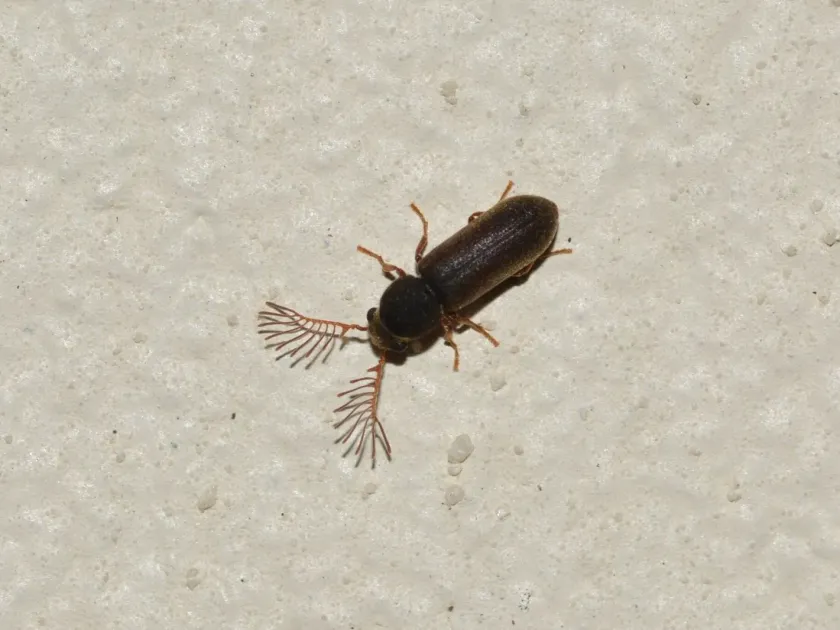
The comb-horned powderpost beetle (Ptilinus pectinicornis) is a small wood-boring insect belonging to the family Anobiidae. Adults are typically 3 to 5 mm long, featuring a cylindrical, dark brown to black body.
The species is named for the distinctive comb-like antennae of the males, while females possess shorter, serrated antennae. The body is covered with fine pubescence, and the pronotum bears a characteristic bump.
The larvae are white, C-shaped, and equipped with strong mandibles designed to tunnel through dense wood. Their development is entirely internal, making them a significant hidden threat.
They are widely distributed throughout the forested regions of Eurasia. They predominantly infest various deciduous tree species under specific environmental conditions.
Recognizing the adult stage is essential for timing monitoring efforts, although the destructive stage is exclusively the larval phase deep within the wood.
What it damages
These beetles primarily target deciduous hardwoods, including beech, birch, alder, aspen, maple, and sometimes oak. They are considered technical pests of both standing trees and seasoned lumber.
The larvae bore extensive, winding galleries throughout the wood, which progressively reduces the structural integrity of the material, leaving it structurally weakened.
Infestations affect not only weakened forest trees but also stored timber, wooden construction elements, antique furniture, and historical artifacts.
Significant infestations can lead to the total degradation of wood, rendering it useless for structural purposes or craftsmanship, often resulting in heavy economic losses.
Because the damage is internal, the infestation is frequently discovered only after significant structural harm has already occurred, often leading to total loss of the infested item.
When it appears
Adult emergence typically occurs during the summer months, primarily in June and July. This period coincides with mating and the search for suitable oviposition sites.
Beetles emerge through small circular exit holes, leaving the timber to reproduce. Females deposit eggs in bark crevices or existing exit holes, facilitating larval entry.
Developmental rates are highly temperature-dependent. Warmer seasons accelerate the life cycle, leading to faster population growth and increased pressure on host materials.
The complete life cycle from egg to adult usually spans one to two years, though it can vary based on wood moisture, species, and ambient environmental conditions.
Monitoring for adult activity during early summer is the most effective way to identify the start of a new infestation cycle in stored or structural wood.
Signs of infestation
The most visible sign of an active infestation is the presence of small, circular exit holes, roughly 1.5–2 mm in diameter, on the surface of the wood.
Fine wood dust, commonly known as frass, usually accumulates below these exit holes. This debris is pushed out by larvae while they expand their tunnels inside the wood.
A faint ticking sound can sometimes be heard in quiet environments, produced by the larvae or mating adults deep within the wooden material.
Surface degradation, such as a hollow sound when tapped or wood crumbling under pressure, often indicates that the interior has been turned into a gallery network.
In cases of long-term infestation, the timber loses its mechanical strength and takes on a spongy texture, indicating a high density of larval tunnels.
Control measures
Preventative measures center on controlling wood moisture content. Ensuring that timber remains dry and well-ventilated reduces its suitability for female oviposition.
Chemical control involves the application of specialized insecticides, wood preservatives, or systemic treatments that can penetrate deeply into the wood matrix.
Thermal treatment, specifically kiln drying or localized heating, is a highly effective method to kill all life stages of the beetle within the wood without chemical residues.
In construction, the use of professional-grade wood preservatives acts as a protective barrier, preventing larval entry and establishing long-term resistance to infestation.
- Regular inspections of structural timbers and wooden antiques.
- Fumigation of infested rooms or valuable collections by professionals.
- Removal and disposal of severely infested timber components.
- Implementation of humidity control in storage facilities.
Taxonomy
- Latin name
- Ptilinus pectinicornis
- Order
- Coleoptera (beetles)
- Family
- Anobiidae
- EPPO code
- PTIIPE
Discussion
No discussions yet — be the first.