
Brown wood-boring beetle
Ptilinus fuscus
Description
How to identify
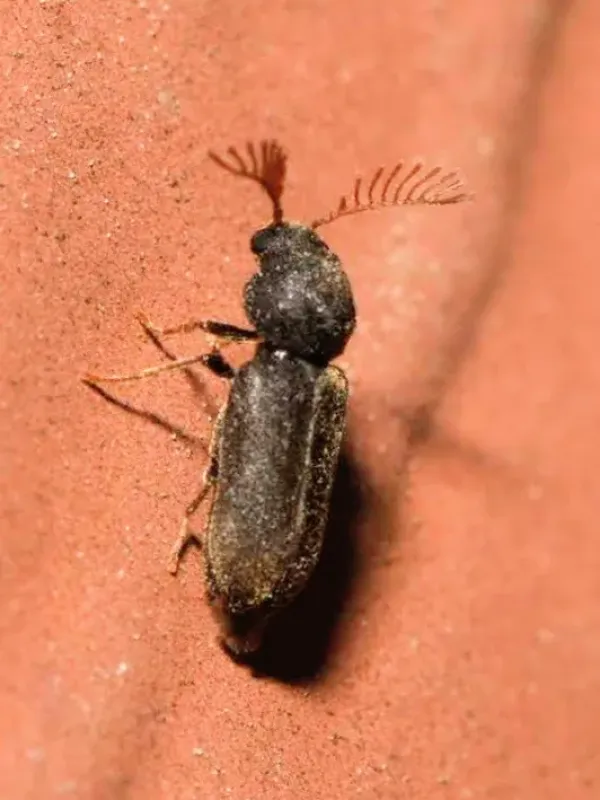
The brown wood-boring beetle (Ptilinus fuscus) is a member of the Ptinidae family within the order Coleoptera. Adult beetles are typically 3–5 mm in length, characterized by a dark brown, cylindrical body.
A key diagnostic feature of this species is the antennae morphology; males possess pectinate (comb-like) antennae, while females have serrate (saw-like) antennae, which distinguishes them from related species.
The larvae are typically cream-colored, C-shaped, and possess robust mouthparts designed for tunneling through hardened wood fibers. They spend the vast majority of their life cycle sequestered inside wood.
Pupation occurs within the galleries created by the larvae, meaning the beetles only emerge once they have reached maturity and are ready to seek a mate to begin the next generation.
Due to their cryptic behavior, adult beetles are rarely seen in open environments, making the identification of the species primarily dependent on examining the physical damage and the exit hole patterns.
What it damages
Ptilinus fuscus larvae primarily feed on the wood of various deciduous trees. In forest ecosystems, they are considered secondary pests, infesting weakened, dead, or decaying wood rather than healthy, living trees.
In human-made structures, the beetle is a serious threat to seasoned timber, furniture, wooden structural elements, and stored wood products. They thrive in environments where wood moisture content is suitable for larval development.
The larvae bore intricate galleries inside the wood, systematically destroying the structural integrity of the material from within, which can lead to the collapse of supporting beams over time.
Because the damage is internal, it often remains unnoticed until a significant portion of the timber has been hollowed out, evidenced only by the presence of exit holes on the surface.
Heavy infestations can lead to significant economic loss, especially when historical artifacts or high-value timber structures are affected by the destructive feeding of the larvae.
When it appears
Adult emergence typically occurs during late spring and summer when temperatures are warm enough to support reproductive activity. During this time, adults leave the wood to mate.
The lifecycle of the beetle is highly temperature-dependent. In warmer regions or indoor settings with climate control, development cycles can be shortened, allowing for faster population growth.
When located in heated buildings or warehouses, the development of the larvae can continue throughout the year, as the indoor environment mitigates the impact of external seasonal changes.
The start of the flight season is marked by the sudden appearance of new exit holes on the surface of timber, which indicates that the new generation of adults has emerged.
During the winter, larvae inside the wood may enter a state of dormancy or continue feeding slowly, depending on the ambient temperature and the moisture content of the infested material.
Signs of infestation
The most visible sign of infestation is the presence of small, circular exit holes, approximately 1–2 mm in diameter, appearing on the surface of the timber as if drilled by a small tool.
Beneath or near these holes, you will often find fine, flour-like frass (wood dust). The color of this dust typically matches the color of the wood being consumed, indicating recent activity.
In severe cases, an audible clicking or crunching sound can sometimes be heard coming from within the wood, which is produced by the larvae as they grind through the wooden fibers.
Wood surfaces might appear slightly depressed or brittle, and structural components may sound hollow when tapped, indicating that a significant network of tunnels has been excavated inside.
- Presence of small circular exit holes.
- Accumulation of fine wood dust (frass) under the affected area.
- Hollow sound when tapping wooden surfaces.
- Structural weakness and crumbling of wood fibers.
Control measures
Preventative measures are the most effective strategy, including the application of professional wood preservatives and insecticide treatments that prevent female beetles from laying eggs.
If an infestation is confirmed, localized treatment involves injecting insecticide solutions directly into the exit holes or the tunnels to reach the larvae within the gallery network.
For large-scale structural infestations, fumigation is a highly effective option, as the gas can penetrate deep into the timber to eliminate the population at all developmental stages.
Maintaining appropriate humidity levels in timber storage areas is a crucial cultural control method, as high moisture levels create an ideal environment for the beetle's life cycle.
Regular inspection of all structural wood and the removal or replacement of severely damaged elements are essential to contain the infestation and protect the integrity of the remaining structure.
Taxonomy
- Latin name
- Ptilinus fuscus
- Order
- Coleoptera (beetles)
- Family
- Anobiidae
- EPPO code
- PTIIFU
Discussion
No discussions yet — be the first.