
Silky wood borer
Priobium sericeum
Description
How to identify
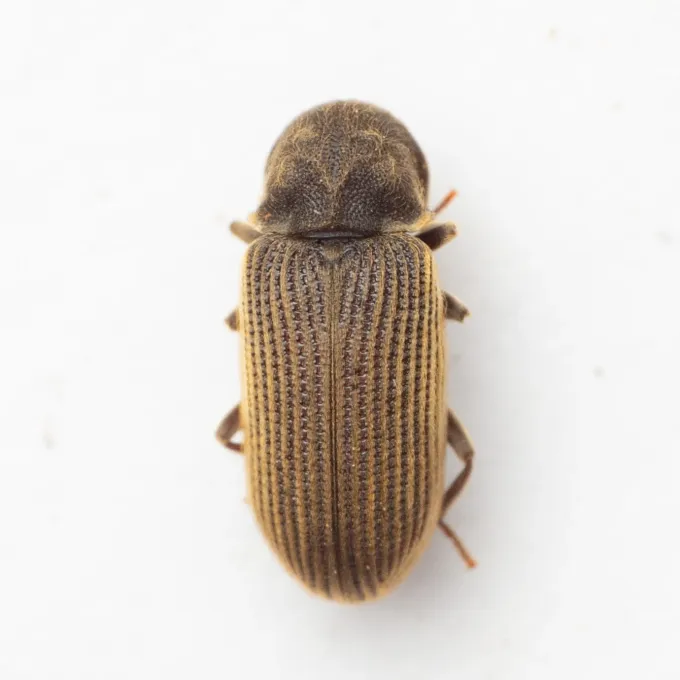
The Silky wood borer (Priobium sericeum) is a member of the death-watch beetle family (Anobiidae). These beetles are small, typically measuring between 3 to 5 mm in length, with an elongated and cylindrical body shape.
They are distinguished by their dark brown to black coloration and a dense covering of fine, light-colored hairs on the elytra, which gives them a silky appearance. The larvae are cream-colored, C-shaped, and possess strong mandibles adapted for boring into hardened wood.
What it damages
This pest is a xylophagous insect that primarily infests deciduous trees, favoring species like oak, beech, and hornbeam. In forest ecosystems, they target weakened, dying, or dead wood, playing a role in the natural decomposition of woody debris.
However, in agricultural and residential settings, the Silky wood borer can become a serious pest of wooden structures, historical buildings, and timber-based products, causing internal structural degradation.
When it appears
Adult beetles are typically active during late spring and summer months. During this period, they emerge from the wood to mate and locate suitable sites for oviposition, often utilizing existing cracks or surface imperfections.
The life cycle is relatively long, often taking one to two years to complete. Throughout this time, the larvae remain deeply embedded within the wood, continuously consuming the fibers and expanding their galleries.
Signs of infestation
The primary indicators of an infestation are small, circular exit holes found on the surface of the timber. These are created by emerging adults once they have finished their developmental cycle inside the wood.
Below the infested area, you may find fine wood powder, known as frass, which consists of larval excrement and wood particles. Severe infestations often lead to a hollow sound when the wood is tapped and a significant reduction in structural integrity.
Control measures
The most effective strategy involves preventative maintenance, such as keeping timber dry and applying wood preservatives or insecticide treatments to protect susceptible surfaces.
In cases where infestations are detected, it is essential to remove and dispose of heavily infested wood. For treated furniture or valuable artifacts, professional fumigation or localized insecticide injection into larval tunnels is recommended.
Taxonomy
- Latin name
- Priobium sericeum
- Order
- Coleoptera (beetles)
- Family
- Anobiidae
- EPPO code
- PRIBSE
Discussion
No discussions yet — be the first.