
Long-clubbed woodborer
Priobium carpini
Description
How to identify
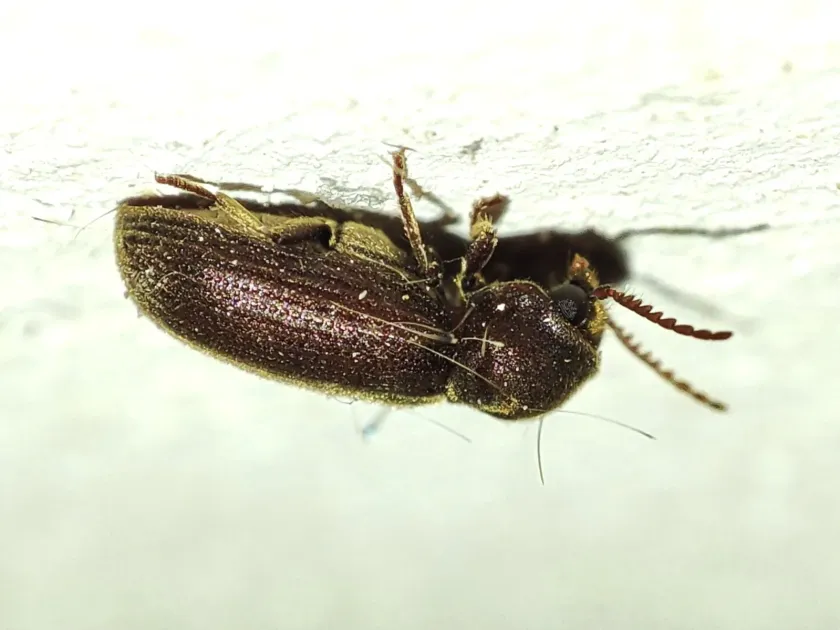
The long-clubbed woodborer (Latin Priobium carpini) is a beetle species belonging to the Anobiidae family within the order Coleoptera. Adult beetles are elongated, measuring 3–5 mm in length, with a dark brown to blackish coloration.
Its diagnostic feature is the structure of the antennae, where the final segments are noticeably elongated, giving the insect its common name. The elytra are covered in fine grooves and dense, short hairs.
The larvae are typical of the family, characterized by a creamy-white, slightly curved body and a well-developed head capsule with strong mandibles for chewing through solid wood.
Adults are capable of flight, which facilitates their dispersal across orchards and forests during the warmer months of the year.
This species is a typical xylophagous insect, primarily colonizing deciduous trees, but it can occasionally inhabit the timber of wooden structures.
What it damages
The primary hosts for the long-clubbed woodborer include various deciduous trees such as hornbeam, beech, oak, linden, and willow.
In forest environments, the pest typically attacks weakened, decaying, or fallen timber, functioning as a natural decomposer within the ecosystem.
In agricultural and garden settings, the woodborer poses a threat to aging fruit trees, especially those with pre-existing bark damage or frost cracks that offer entry points.
Larvae bore intricate and winding galleries deep inside the wood, leading to the destruction of internal tissues and structural weakening of branches or trunks.
Heavy infestations accelerate the decline of trees that have already lost their natural resistance to environmental stress factors.
When it appears
The adult flight period usually occurs during the warm season, typically spanning from May through July, depending on local climatic conditions.
During this period, mating occurs, and females lay eggs in bark crevices or existing holes in the wood surface, ensuring the survival of the next generation.
Larval development occurs entirely within the wood and may last from one to three years, depending on the wood's condition and ambient temperature.
Pupation takes place inside the wood in specially constructed chambers near the surface, just before the adult beetle emerges.
The insect typically overwinters as larvae of various stages, and sometimes as fully developed adults waiting for spring temperatures to emerge.
Signs of infestation
The most prominent sign of an infestation is the appearance of small, round exit holes, approximately 1.5–2 mm in diameter, on the bark surface.
Accumulations of wood dust, known as frass, can often be found near these exit holes or collected at the base of the tree trunk.
In cases of severe infestation, symptoms include premature wilting of foliage, branch dieback, or the overall decline of the tree's health.
Bark may begin to flake off in affected areas, and the wood may sound hollow when tapped, indicating extensive internal damage by larval galleries.
- Round exit holes in the bark.
- Accumulated piles of fine wood frass.
- Branch dieback and general tree decline.
Control measures
The primary control strategy involves rigorous sanitation, including the removal and disposal of dead, diseased, or heavily infested trees from the orchard.
Regular whitewashing of trunks and scaffold branches can help seal bark crevices, reducing the available sites for females to lay eggs.
In instances of localized infestation, systemic insecticides can be injected directly into the larval galleries to eliminate the pest within the wood.
Maintaining optimal tree vigor through proper irrigation, fertilization, and protection from bark sunscald is essential for preventing attacks on trees.
For wooden structures located near gardens, professional timber treatment or fumigation services should be employed to prevent the spread of these woodborers.
Taxonomy
- Latin name
- Priobium carpini
- Order
- Coleoptera (beetles)
- Family
- Anobiidae
- EPPO code
- PRIBCA
Discussion
No discussions yet — be the first.