
Drugstore beetle
Nicobium
Description
How to identify
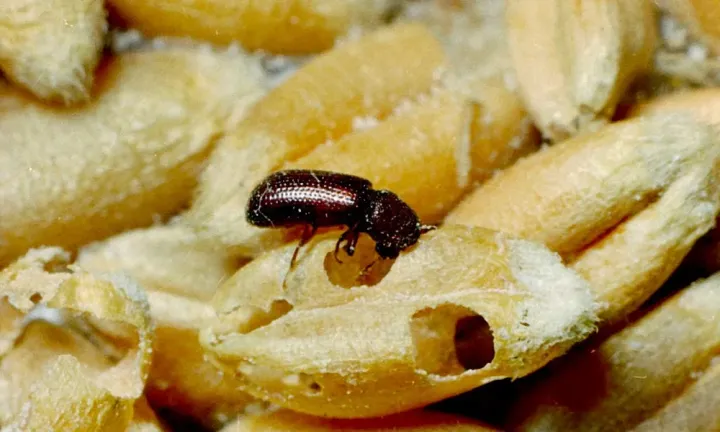
The drugstore beetle Stegobium paniceum is a small, brown beetle of the family Anobiidae, notorious for infesting a wide variety of dry stored products.
Adults are small, typically measuring 2 to 3.5 mm in length, with a cylindrical body that is covered in fine, silky, yellowish hairs.
The head of the beetle is strongly bent downwards and is not visible from above, which is a key diagnostic feature for identifying this specific species.
Larvae are small, white, and grub-like, with a brown head. They are responsible for the primary damage to stored goods as they bore tunnels through the substrate.
Pupation occurs within a protective cocoon made of food particles glued together by secretions produced by the larvae during their final stage.
What it damages
The drugstore beetle is a polyphagous pest, meaning it consumes a vast array of dry goods, including grains, flour, bread, spices, and dried fruits.
It is famously known for its ability to infest even toxic pharmaceutical products, hence the name "drugstore beetle," as well as various medicinal herbs.
Beyond food items, they can cause significant damage to historical collections, including books, leather bindings, dried flower arrangements, and taxidermy.
The damage caused by larvae includes the destruction of product integrity, leaving behind frass, silk webbing, and exit holes that ruin the commercial value.
In industrial settings, they can rapidly move from one container to another, spreading the infestation across entire storage facilities if left unchecked.
When it appears
In climate-controlled storage facilities and households, the drugstore beetle can reproduce throughout the year without any seasonal dormancy.
The life cycle is highly dependent on temperature, with optimal development occurring in warm conditions between 25 and 30 degrees Celsius.
Females deposit eggs directly into the food source, ensuring that newly hatched larvae have immediate access to nutrients required for rapid development.
Under ideal conditions, the generation time from egg to adult can be completed in as little as 6 to 8 weeks, leading to multiple overlapping generations.
While they prefer warm environments, the beetles are resilient and can survive in cooler temperatures, though their metabolic rates significantly drop.
Signs of infestation
The most recognizable sign of an infestation is the presence of numerous small, circular "shot-holes" about 1–2 mm in diameter on the surface of packages.
Inside the product or packaging, fine, powdery debris accumulates, which is a mixture of larval waste, food dust, and discarded larval skins.
Adult beetles are often observed near light sources, such as windows, as they are phototactic and active flyers during the warmer parts of the day.
When disturbing an infested product, one might notice a faint crunching sound or find clumps held together by fine larval webbing, indicating internal activity.
Empty pupal cases or the presence of dead beetles in hidden corners of pantry shelves are strong indicators of an established population in the vicinity.
Control measures
Sanitation is the most critical control measure; all spillages of grain or flour must be cleared immediately to eliminate potential breeding sites.
Infested goods should be discarded immediately or treated with extreme temperatures: deep freezing at -18°C or heating to 60°C for several hours.
Storage areas should be kept clean, dry, and cool, as low humidity and lower temperatures significantly reduce the speed of beetle reproduction.
For large-scale operations, fumigation with registered insecticides by professionals is necessary to penetrate deep into bulk storage areas.
Pheromone-baited sticky traps are an effective tool for monitoring and reducing adult beetle populations, helping to pinpoint sources of infestation early.
Taxonomy
- Latin name
- Nicobium
- Order
- Coleoptera (beetles)
- Family
- Anobiidae
- EPPO code
- NICOSP
Discussion
No discussions yet — be the first.