
Spruce bark borer
Microbregma emarginatum
Description
How to identify
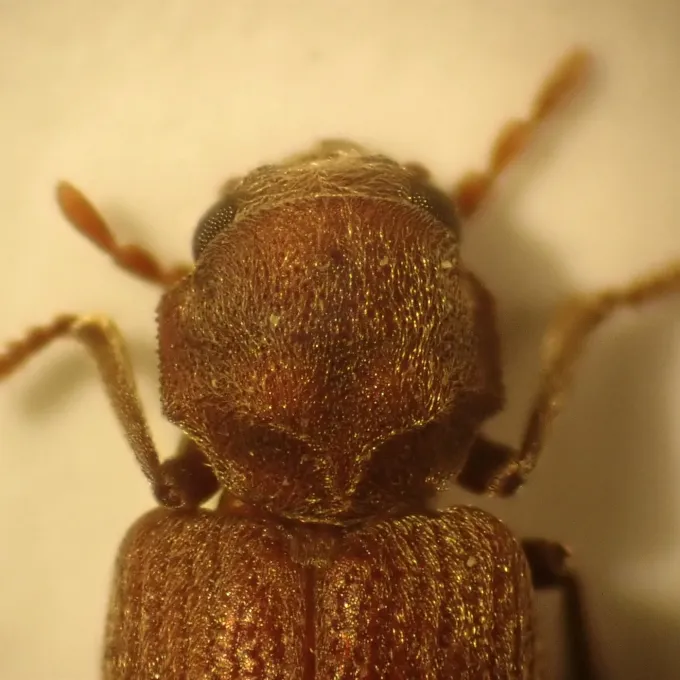
The spruce bark borer (Microbregma emarginatum) is a small beetle belonging to the family Anobiidae, within the order Coleoptera. Adult beetles are typically 3–5 mm long, with a cylindrical body and a dark brown or reddish-brown color that mimics the bark of their host trees.
The head of the beetle is tightly retracted into the prothorax, which is a characteristic feature of this family. This anatomy allows the insects to navigate through the confined spaces under the bark of conifer trees without mechanical injury.
The elytra, or wing covers, are covered with fine, dense setae (hairs), giving the insect a matte appearance. This sets them apart from the shiny surfaces often seen in other wood-boring beetle species found in temperate coniferous forests.
The larvae are typical for the family: white, C-shaped grubs with well-developed mandibles. They live a secluded life, tunneling entirely within the inner bark and cambial layer of the tree, which makes them difficult to detect during the early stages of infestation.
As a specialist forest insect, this species thrives in environments where host trees are already stressed, often by fungal pathogens or environmental factors, creating the conditions necessary for the successful colonization of new host material.
What it damages
The primary host for Microbregma emarginatum is Norway spruce (Picea abies). The insect typically colonizes weakened, suppressed, or recently felled trees, but during population outbreaks, it can also attack healthy trees within the stand.
While spruce is the main target, the borer can occasionally infest other coniferous species in the same vicinity. In young forest stands, damage to the trunk can lead to significant growth reduction and increased mortality rates.
The damage occurs as the larvae create complex, winding galleries in the cambium and inner bark. This tunneling disrupts the tree's vascular system, blocking the transport of water and nutrients, which eventually leads to the death of the infested section of the trunk.
The galleries act as entry points for blue-stain fungi and other wood-decay pathogens. These secondary infections accelerate the deterioration of the tree, often killing the host much faster than the beetle would on its own.
Economic damage includes the degradation of timber quality, loss of biodiversity in forest stands, and the financial burden of implementing large-scale sanitary logging in affected areas.
When it appears
The adult flight period typically occurs in late spring and early summer. During this time, the beetles emerge to seek out suitable hosts, often guided by chemical signals (volatiles) released by stressed trees.
After mating, females lay their eggs in bark crevices. Upon hatching, the larvae burrow into the bark. The developmental process of the larvae takes several months, encompassing the entire summer season.
Pupation occurs in late summer or early autumn. The larvae construct small pupal chambers close to the surface of the bark, where they transition into the pupal stage and then emerge as adult beetles.
The species primarily overwinters as larvae inside the wood. This hibernation strategy provides the necessary thermal insulation, protecting the population from the harsh winter temperatures and natural predators.
Development resumes in the following spring as temperatures rise. Once the warmth of the season returns, the mature beetles chew exit holes through the bark to complete their lifecycle and begin the next generation.
Signs of infestation
The most reliable sign of an infestation is the presence of small, round exit holes on the bark surface. These holes are usually less than 2 mm in diameter and can be easily overlooked by an untrained eye.
Frass, or fine wood shavings and excrement, accumulating at the base of the tree or caught in bark crevices is a clear indication that the larvae are active inside the trunk.
If the bark is carefully removed, complex tunnel networks can be seen in the cambium layer. These galleries are often tightly packed with larval excrement, which may have a specific granular texture.
Crown symptoms, such as the yellowing or browning of needles on specific branches or the top of the tree, indicate that the tree's vascular system has been severely compromised by the larval tunneling.
Resin flow or "pitching out" on the bark surface is a sign of the tree's attempt to defend itself. However, when multiple beetles attack the same tree simultaneously, the resin flow is often insufficient to prevent colonization.
Control measures
The primary management strategy for the spruce bark borer is prompt sanitary logging. Removing infested trees before the next generation of adults emerges is the most effective way to keep the population under control.
Maintaining forest hygiene is crucial. All logging residue, branches, and wind-thrown trees should be removed or processed quickly to prevent them from becoming breeding sites for the borer.
Promoting forest health through the creation of mixed-species stands makes the forest less attractive to the beetle, as diverse environments disrupt the host-finding process of the insect.
In ornamental or park settings, monitoring with pheromone traps can help track the beetle's activity and enable timely intervention if population levels begin to rise significantly.
Chemical control is rarely practiced in forestry due to environmental concerns but may be considered for high-value ornamental spruce trees. Applications must be timed precisely with the adult flight period for maximum effectiveness.
Taxonomy
- Latin name
- Microbregma emarginatum
- Order
- Coleoptera (beetles)
- Family
- Anobiidae
- EPPO code
- ANOBEM
Discussion
No discussions yet — be the first.