
Microbregma woodborer
Microbregma
Description
How to identify
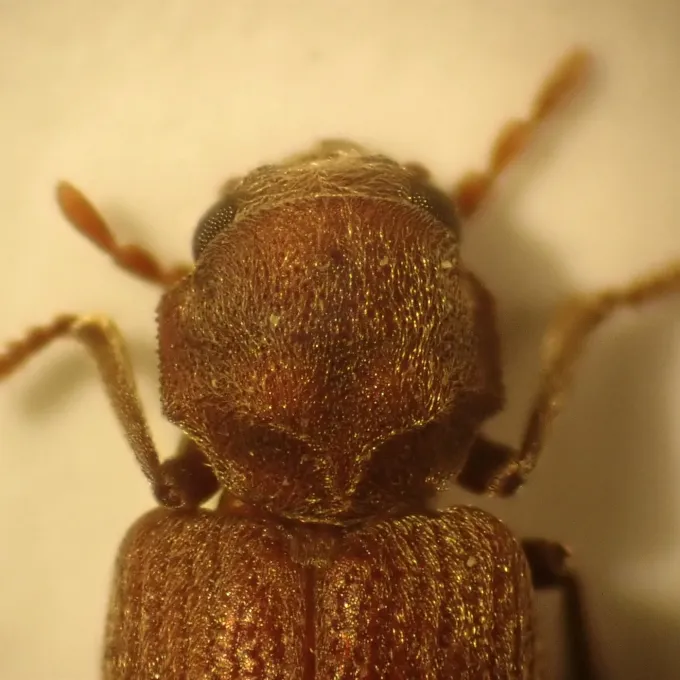
The genus Microbregma belongs to the family Anobiidae, commonly known as death-watch beetles or woodborers. These beetles typically feature a cylindrical, robust body often covered in fine, dense pubescence, giving them a matte appearance.
Adult beetles are relatively small, usually ranging from 3 to 5 millimeters in length. A key identification feature is the pronotum, which extends forward like a hood, concealing the head from above.
The larvae are typically C-shaped, off-white or cream-colored, and possess well-developed mandibles. Their morphology is highly specialized for boring into dense wood, which serves as both their primary food source and habitat.
The life cycle encompasses four distinct stages: egg, larva, pupa, and adult. The larval stage is the most prolonged and destructive phase, as the insects spend their time tunneling deep into the wooden material.
Due to their cryptic behavior, Microbregma species are rarely seen in their adult stage. They are most often detected only when the adults emerge to mate, leaving characteristic exit holes on the surface of the timber.
What it damages
These pests primarily target weakened or moisture-affected timber. They are common in both coniferous and deciduous forests, where they colonize fallen trees, snags, and stumps, playing a role in natural wood decomposition.
In the timber industry, Microbregma acts as a significant pest. By tunneling into structural wood and stored lumber, they cause structural degradation and compromise the mechanical strength of the wood fibers.
Wooden buildings, particularly those constructed from insufficiently dried or improperly treated wood, are at high risk. The infestation can spread slowly, with larvae gradually hollowing out internal sections of beams and joints.
Antique furniture and heirloom wooden items are particularly vulnerable if kept in environments with high humidity. The infestation can remain undetected for years until the wood starts to collapse or lose its integrity.
Damage caused by these beetles often creates a favorable environment for moisture-loving fungi and molds, which work in tandem with the larvae to accelerate the decay process of the wood.
Signs of infestation
The most diagnostic sign of an infestation is the presence of small, perfectly round exit holes on the surface of the timber. These are created by emerging adults and usually measure 1–2 mm in diameter.
A fine, powdery substance known as frass is often found beneath infested wood. This material consists of excreted wood particles and larva waste, providing a clear visual indicator of active boring.
In quiet environments, one might detect a faint, dry ticking or scraping sound produced by the larvae as they grind away at the wood fibers inside, especially during the warmer months.
The timber surface may show signs of sagging or unevenness, indicating that the internal structure has been compromised to the point where the outer layer can no longer be supported.
- Circular exit holes on the wood surface.
- Piles of fine, wood-colored frass underneath infested areas.
- Audible scraping or ticking noises from within the wood.
- Reduced wood density and structural integrity upon testing.
- Surface depressions or crumbling wood fibers.
Control measures
Prevention is the most effective strategy against Microbregma. Ensuring wood is properly seasoned and keeping structural timber dry significantly reduces its attractiveness to egg-laying females.
Chemical treatments, such as applying borate-based wood preservatives or insecticidal coatings, provide a robust barrier that prevents larvae from establishing themselves within the wood fibers.
For existing infestations, injecting specialized liquid insecticides directly into the larval galleries is a common corrective measure used to eliminate the insects deep within the wood.
Fumigation is the most powerful professional control method. It utilizes toxic gases to penetrate deep into wood, killing all life stages, including eggs and larvae, without damaging the structural elements.
Sanitation practices, such as the rapid removal of dead or dying timber from forests and the proper disposal of infested construction waste, are essential for managing population levels and preventing spread.
Taxonomy
- Latin name
- Microbregma
- Order
- Coleoptera (beetles)
- Family
- Anobiidae
- EPPO code
- MCBRSP
Discussion
No discussions yet — be the first.