
Cigarette beetle
Lasioderma
Description
How to identify
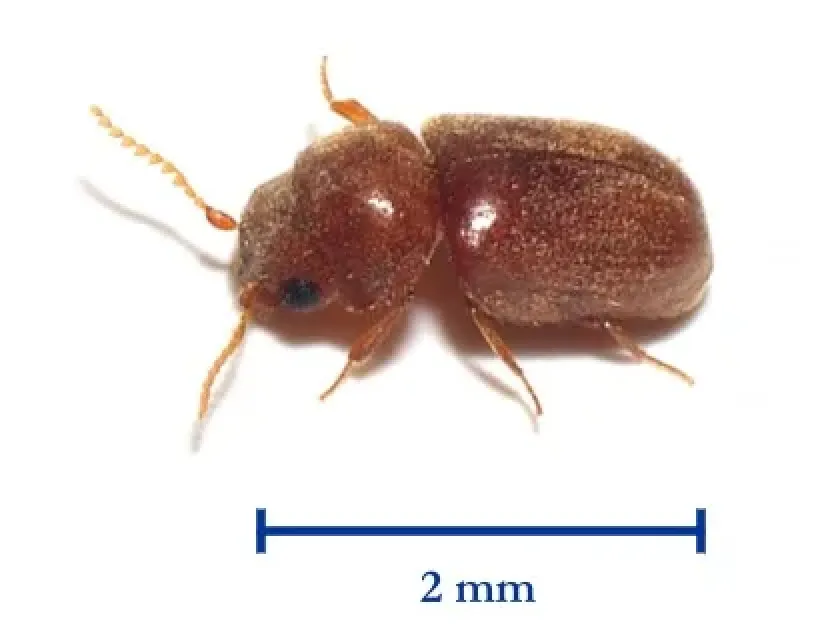
The cigarette beetle Lasioderma serricorne belongs to the order Coleoptera and the family Anobiidae. It is a small insect, roughly 2–3 mm in length, characterized by a brownish, oval-shaped body covered with fine hairs.
The head of the adult beetle is sharply bent downwards, being almost hidden beneath the pronotum, which is a classic diagnostic trait for members of this family. Their antennae are serrated, giving the species its specific name.
The larvae are C-shaped, covered in dense, coarse hairs, and reach about 4 mm in length. They are typically found boring deep within food sources, which makes early detection difficult.
Pupation occurs within a protective cell or cocoon, constructed by the larva from substrate particles and silk-like secretions. The entire developmental cycle is highly temperature-dependent.
In optimal conditions (temperatures above 25°C and 70% humidity), the beetle can complete its life cycle in as little as 30 to 40 days, leading to multiple generations per year.
What it damages
The cigarette beetle is a notorious polyphagous pest that causes significant damage to tobacco products, including cigars, cigarettes, and bulk tobacco, where it creates intricate feeding galleries.
Beyond tobacco, this pest frequently infests dried fruits, grains, flour, spices, pet food, and various medicinal herbs stored in warehouses or private homes.
The larval stage causes the most severe damage by consuming the product and contaminating it with frass (excrement), webbing, and cast skins, rendering the product unmarketable.
The beetle can bore through various packaging materials, including cardboard, paper, and thin plastic films, facilitating its spread between different stored products within a facility.
Economic losses are driven by both the volume of destroyed raw materials and the high costs associated with professional fumigation or complete disposal of infested inventory.
Signs of infestation
The most immediate sign of infestation is the presence of small, circular exit holes in the surface of products or their containers, made by emerging adults.
A second common sign is the accumulation of fine, powdery dust or "frass" near infested products, which is a byproduct of larval feeding and digestive processes.
The third sign is the presence of fine webbing or silk strands within the substrate, which larvae use to stabilize their pupal chambers and larval tunnels.
The fourth sign involves spotting the adult beetles themselves, which are most active in low light conditions and can be found crawling on surfaces near the infestation.
The fifth sign includes an unusual or unpleasant odor emanating from stored commodities, often signaling that a large population has already established itself within the bulk.
Control measures
Good sanitation is the first line of defense; regular cleaning of warehouses, removal of dust, and eliminating spilled grain or tobacco debris are crucial to prevent population growth.
Fumigation using phosphine-based products is the standard industrial method for controlling established infestations in warehouses and bulk storage facilities.
Pheromone-based monitoring traps should be deployed throughout storage areas to provide early warning of insect presence, allowing for targeted intervention.
Temperature control, such as freezing or heating infested goods, is highly effective for smaller quantities to eliminate eggs, larvae, and adults without chemical residues.
- Implement regular inspection schedules
- Seal cracks and crevices in storage buildings
- Use high-quality airtight packaging
- Maintain low humidity levels
- Utilize professional pest control services
Taxonomy
- Latin name
- Lasioderma
- Order
- Coleoptera (beetles)
- Family
- Anobiidae
- EPPO code
- LASDSP
Discussion
No discussions yet — be the first.