
House borer
Hemicoelus
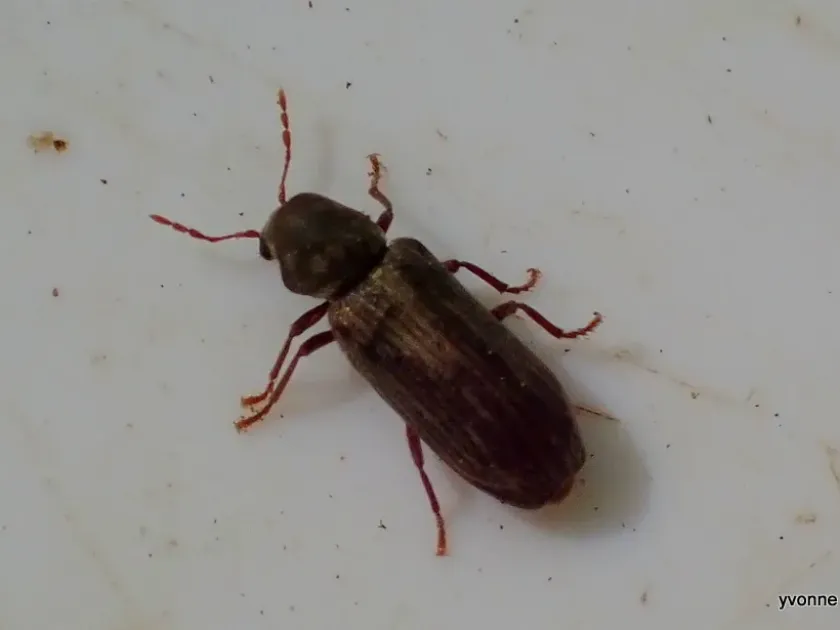
Description
How to identify
The house borer (Hemicoelus fulvicornis) belongs to the Anobiidae family, commonly known as deathwatch beetles. Adults are small, usually between 3 and 5 mm long, with a cylindrical dark brown to black body, well-adapted to life in dark, secluded wood crevices.
The head of the beetle is retracted beneath the pronotum, which resembles a hood. The elytra (wing covers) display fine rows of punctures, a distinct morphological feature used for identification of this specific species within the wood-boring group.
The larvae are the destructive life stage; they are creamy-white, C-shaped grubs with powerful mandibles designed for excavating wood. They spend their entire development phase deep inside the timber, invisible to the naked eye.
Adults are capable of flight and typically emerge in spring and summer to mate and lay eggs on suitable wooden surfaces. They prefer seasoned wood that has been in place for several years and often target damp areas of a structure.
Development is highly dependent on environmental conditions, particularly moisture content and temperature. Under favorable conditions, the life cycle may take between one and three years, complicating eradication efforts if not addressed early.
What it damages
The house borer targets both softwood and hardwood, specifically attacking structural timbers such as joists, roof trusses, floorboards, and wall studs. It is a major economic pest for historic buildings and older wooden constructions.
Larvae create extensive tunnel networks within the wood. By consuming the inner structure, they weaken the mechanical integrity of the timber while leaving the outer layer intact, often causing sudden structural failures.
Beyond building components, the beetle causes severe damage to furniture, wooden artifacts, and sculptures. Its ability to infest interior wood makes it a persistent threat to valuable antiques and heritage items.
The pest thrives in environments with poor ventilation or high humidity. Damp wood is significantly more susceptible to infestation, as the larvae find it easier to penetrate and digest the softer, degraded fibers.
Unlike some other wood-boring species, the house borer does not inhabit living trees in forests. Its presence is strictly tied to human-built structures and stored timber, making it a "technical" pest in residential and commercial settings.
Signs of infestation
The most prominent sign of infestation is the appearance of small, circular exit holes, measuring about 1–2 mm in diameter. These are created by adult beetles emerging from the wood after metamorphosis.
Fine, powdery wood dust, known as frass, often accumulates beneath the infested timber. Finding small piles of this dust indicates that larvae are actively feeding inside and pushing waste material out of their tunnels.
In quiet environments, a distinct rhythmic clicking sound might be heard. This is produced by males tapping their heads against the gallery walls, a communication behavior that confirms the presence of an active colony.
Structural damage can often be detected by tapping on wood; a hollow, dull sound suggests that the interior has been significantly compromised by larval galleries. This method is effective for evaluating beams and support posts.
Careful inspection may reveal galleries directly underneath the surface of the wood. These galleries often intersect, completely disintegrating the internal wood grain over long periods of time.
Control measures
Proactive protection is crucial. Before construction, all timber should be treated with high-quality insecticides and wood preservatives that penetrate deeply into the fibers to prevent egg-laying and larval survival.
If an infestation is discovered, local treatment via injection of insecticidal fluids into exit holes is the primary method. All reachable surfaces should subsequently be treated with persistent wood preservatives.
For severe or widespread infestations, professional fumigation may be required. This process ensures that toxic gas reaches deep into the wood structure to eliminate larvae and adults in areas unreachable by liquid topical treatments.
In cases where structural integrity is compromised, the most effective solution is the removal and replacement of the damaged timber. Patching or filling holes is purely aesthetic and does not restore the strength of the wood.
- Ensure adequate ventilation in attics and crawl spaces.
- Reduce moisture content by repairing roof leaks and plumbing issues.
- Inspect wooden items periodically for new holes or dust.
- Isolate and treat or discard infested furniture to prevent further spread.
Taxonomy
- Latin name
- Hemicoelus
- Order
- Coleoptera (beetles)
- Family
- Anobiidae
- EPPO code
- HMICSP
Discussion
No discussions yet — be the first.