
Gastrallus immarginatus
Gastrallus immarginatus
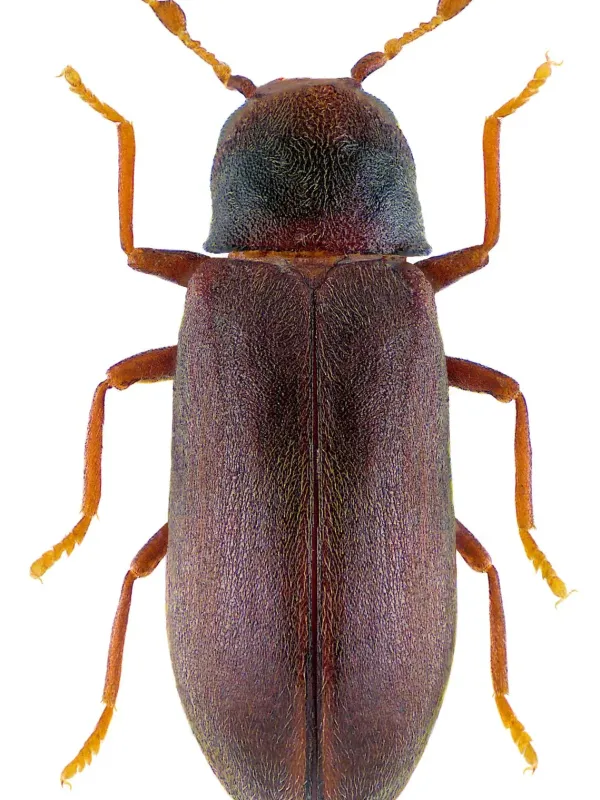
Description
How to identify
Gastrallus immarginatus is a wood-boring beetle belonging to the order Coleoptera and the family Ptinidae. It is a small insect that has successfully adapted to life within dry wood, causing significant damage to wooden structures, artifacts, and stored plant materials.
The adult beetle is elongated, typically ranging in color from light brown to dark brown. Measuring only a few millimeters in length, these beetles are often difficult to detect until the infestation has already caused visible structural damage.
The larvae are white, curved, and equipped with strong mandibles designed for feeding on hard wood fibers. They spend their entire developmental period hidden deep within the substrate, which protects them from environmental changes and many topical predators.
These insects exhibit high adaptability to various indoor conditions, provided that the wood has the appropriate moisture content. They are frequently found in buildings, museum collections, and warehouses where wooden materials are stored under stable temperatures.
Professional identification usually involves inspecting the exit holes, analyzing the frass (boring dust), and sometimes using specialized light traps or pheromone lures to monitor adult activity during their emergence phase.
What it damages
Gastrallus immarginatus primarily targets dry hardwood, including construction timber, furniture, and antique wooden items. In agricultural storage facilities, it can also infest dry plant stalks and woody residues.
The damage is caused entirely by the larval stage, which bores complex systems of tunnels through the wood. Over time, these tunnels weaken the internal structure, causing the wood to lose its integrity, load-bearing capacity, and aesthetic value.
The severity of the damage is compounded by the fact that these beetles can thrive in low-moisture environments, allowing them to remain active even in modern, heated buildings where other wood-boring pests might struggle to survive.
If left unmanaged, a localized infestation can spread throughout a structure, causing extensive damage to wooden elements. This leads to high costs associated with repair, restoration, or complete replacement of the affected items.
Agricultural and historical sites are particularly vulnerable, as the degradation caused by these beetles can result in the irreversible loss of valuable assets, historical artifacts, or structural safety in storage buildings.
When it appears
The emergence of adult beetles typically occurs during the spring and summer months. During this period, adults leave the wood to mate and seek new sites for oviposition, effectively spreading the infestation to nearby wooden materials.
In temperature-controlled environments, such as heated houses or warehouses, the life cycle of Gastrallus immarginatus can be accelerated, potentially leading to continuous generations throughout the entire year.
Females lay their eggs in cracks, crevices, or existing exit holes on the surface of the wood. This behavior allows them to re-infest previously damaged objects, significantly increasing the density of the infestation over a relatively short period.
The developmental period from egg to adult takes several months, depending on wood quality and environmental temperature. Monitoring the emergence of adults is crucial for determining the right timing for pest control interventions.
Early spring marks the beginning of the most active period for adult beetles, making it the ideal time to place monitoring devices and assess the overall health of wooden structural components in buildings.
Signs of infestation
The most recognizable sign of an infestation is the presence of tiny, perfectly round exit holes on the surface of the wood. These holes indicate that the beetles have completed their development and emerged as adults.
The accumulation of fine, wood-colored dust known as frass is a reliable indicator of active larval feeding. This dust is often found in small piles directly beneath or near the exit holes on wooden surfaces.
Tapping or prodding wooden surfaces may reveal a hollow sound, suggesting that the internal structure has been consumed by the larvae. Extensive tunneling makes the wood brittle and prone to structural failure.
In quiet environments, one might hear faint ticking or scratching sounds. These sounds are produced by larvae feeding and moving within the wood, providing an auditory clue that the infestation is currently active.
Surface deformation, wood peeling, or unexplained structural weakness are late-stage signs of an infestation. Once these symptoms appear, the internal damage is usually extensive, necessitating immediate remediation efforts.
Control measures
Moisture management is the most effective preventative measure. Keeping wooden materials dry and well-ventilated reduces their attractiveness to the beetles and disrupts the life cycle of the larvae.
Applying insecticide-treated wood preservatives or antiseptics during the initial construction or restoration phase creates a chemical barrier that prevents larvae from penetrating the wood and inhibits egg-laying by adults.
If an infestation is already active, fumigation or direct injection of insecticides into the exit holes can be used to reach the larvae within the wood. Professional pest control services are often required for large-scale infestations.
Heat treatment, where the wood is heated to high temperatures (60-70°C), is a highly effective and eco-friendly method to eliminate all stages of the beetle, including eggs and larvae, without using harsh chemicals.
For valuable historical artifacts or sensitive wooden items, inert gas treatment (anoxic environments) is the preferred method. It effectively eliminates the pest while preserving the material’s integrity and historical value.
Taxonomy
- Latin name
- Gastrallus immarginatus
- Order
- Coleoptera (beetles)
- Family
- Anobiidae
- EPPO code
- GSTAIM
Discussion
No discussions yet — be the first.