
Gastrallus
Gastrallus
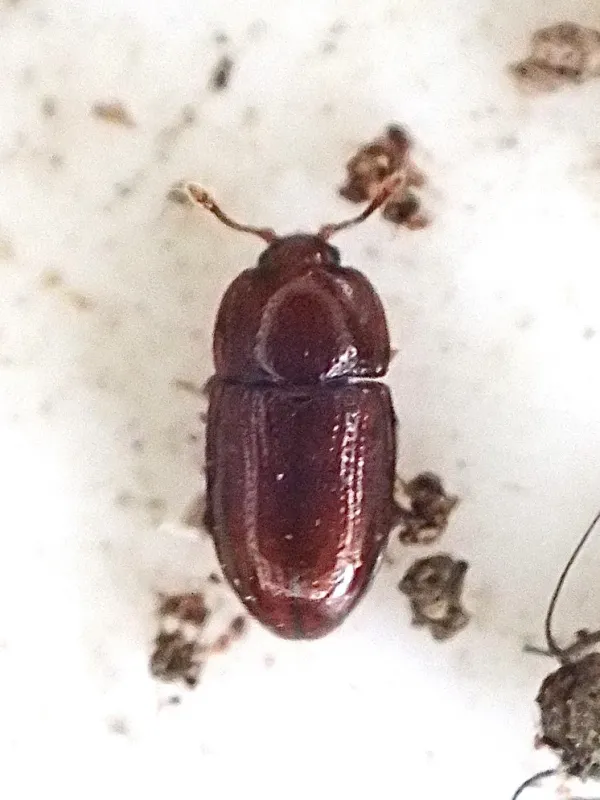
Description
How to identify
The genus Gastrallus belongs to the Anobiidae family within the order Coleoptera. These are small beetles, typically ranging from 2 to 4 millimeters in length.
Adult beetles have a cylindrical, compact body shape typical of the family, usually dark brown or brownish in color. The head is deeply retracted into the pronotum.
Larvae are C-shaped, white, and equipped with strong mandibles adapted for boring into tough plant materials or wood.
The beetles are capable of flight, allowing them to disperse effectively within storage facilities, warehouses, or collections of dried plants.
They are well-adapted to environments with low humidity, which often makes them problematic in indoor conditions where control is difficult.
What it damages
Gastrallus is primarily a pest of dry plant-based materials. The larvae perform the most damage by tunneling deep within the structure of the substrate.
In nature, they infest dry twigs and dead wood, but in human environments, they target stored botanical specimens and historical artifacts.
Herbarium collections are particularly vulnerable, as the larvae consume dried plant parts, leaving the specimens disintegrated or riddled with holes.
The structural integrity of woody materials can be severely compromised if the infestation remains undetected over a long period.
Economic losses are often associated with the destruction of biological archives, rare wood samples, or commercial stocks of specific dry plant materials.
Signs of infestation
The most prominent sign of an infestation is the presence of tiny, round exit holes on the surface of the infested material.
Frass, or fine boring dust, is frequently found beneath the infested objects, indicating the ongoing activity of larvae inside the material.
Dissecting a damaged specimen reveals a complex network of irregular tunnels created by the feeding larvae.
During the mating season, adult beetles may be seen crawling on the surface of infested items or gathered near light sources.
Affected materials may sound hollow or appear weakened, easily breaking when slight mechanical pressure is applied during handling.
Control measures
Fumigation is the most effective method for eradicating Gastrallus, as the gas can penetrate the deep tunnels created by the larvae.
Maintaining a low-humidity environment is a critical preventative measure, as it discourages the development of larvae in stored collections.
Regular monitoring and physical inspection of samples are essential for the early detection of localized outbreaks in storage facilities.
For high-value collections, freezing at temperatures below -20°C for several days is an effective, non-chemical way to eliminate the pest.
- Quarantine of new materials.
- Use of pheromone traps for population monitoring.
- Sealing storage containers to prevent re-infestation.
- Professional pest control services for large-scale outbreaks.
Taxonomy
- Latin name
- Gastrallus
- Order
- Coleoptera (beetles)
- Family
- Anobiidae
- EPPO code
- GSTASP
Discussion
No discussions yet — be the first.