
Spruce bark beetle (Ernobius mollis)
Ernobius mollis
Description
How to identify
Ernobius mollis, commonly known as the spruce bark beetle or pine bark anobiid, is a species of beetle belonging to the family Anobiidae (death-watch beetles) within the order Coleoptera.
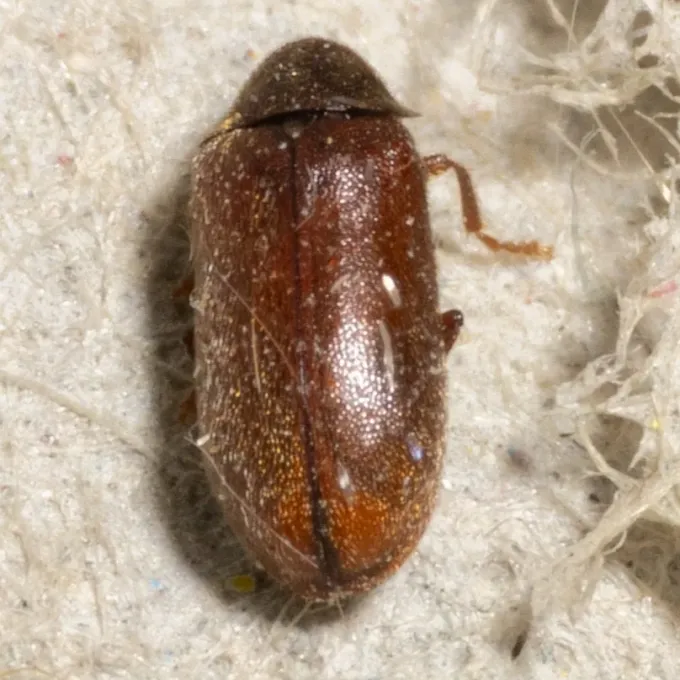
The adult beetle is small, measuring between 3 and 5 mm in length. Its body is typically reddish-brown to dark brown and is covered with dense, fine golden hairs, giving it a dull appearance.
The larvae are white, C-shaped, and possess a distinct brown head. They are specifically adapted to tunnel through the cambium and outer sapwood of coniferous trees.
As a holometabolous insect, the species undergoes a complete life cycle comprising egg, larva, pupa, and adult stages. They primarily complete one generation per year, depending on environmental conditions.
Adult beetles are most commonly observed during the late spring and summer months, when they emerge to mate and lay eggs in crevices of the bark.
What it damages
This beetle primarily targets coniferous timber, particularly spruce, pine, and fir. It is a major pest of unbarked logs, fallen branches, and timber stored in forests or lumber yards.
In structural settings, the spruce bark beetle can infest timber that retains its bark, causing damage to the surface layers of wooden beams and framing materials.
The larvae cause structural damage by mining extensive, irregular galleries within the sapwood, often working just beneath the bark surface where they feed on the cambium and wood tissues.
While the beetle prefers dead or dying trees, it can easily infest freshly cut logs left in the forest, significantly reducing the commercial value of the timber.
The cumulative damage leads to the deterioration of the wood's surface integrity, eventually causing the bark to loosen and the sapwood to lose its structural strength.
Signs of infestation
The most visible sign of an infestation is the presence of small, circular exit holes, approximately 1-2 mm in diameter, on the surface of the bark or exposed wood.
Frass, a fine powdery mixture of wood dust and larval excrement, is often found ejected from these holes or accumulated in bark crevices near the entrance points.
Beneath the bark, one can observe winding larval tunnels that are tightly packed with frass, revealing the path of destruction left by the developing larvae.
Adult beetles may be seen crawling on the surface of logs during the peak emergence period in late spring, particularly on warm, sunny days.
If left unchecked, the structural decay of the timber surface and the presence of loose, sagging bark are clear indicators that the infestation has reached a mature stage.
Control measures
The primary control measure is the immediate debarking of coniferous logs after harvesting, as the beetle depends on the bark to lay its eggs and establish colonies.
Storing timber in dry, ventilated areas significantly lowers the moisture content required for larval development, making the wood less attractive to the pest.
For infested materials, chemical treatment with wood preservatives or systemic insecticides can be applied to penetrate the surface and neutralize the larvae.
Heat treatment (kiln drying) of lumber is the most effective way to ensure the total destruction of all life stages of the beetle within the wood, ensuring the material is pest-free.
Regular monitoring of timber piles and wooden structures for exit holes and frass is essential to prevent large-scale outbreaks and protect the longevity of the wood products.
Taxonomy
- Latin name
- Ernobius mollis
- Order
- Coleoptera (beetles)
- Family
- Anobiidae
- EPPO code
- ERNOMO
Discussion
No discussions yet — be the first.