
Conifer cone beetle
Ernobius conicola
Description
How to identify
The conifer cone beetle (Ernobius conicola) is a small wood-boring insect belonging to the family Anobiidae within the order Coleoptera.
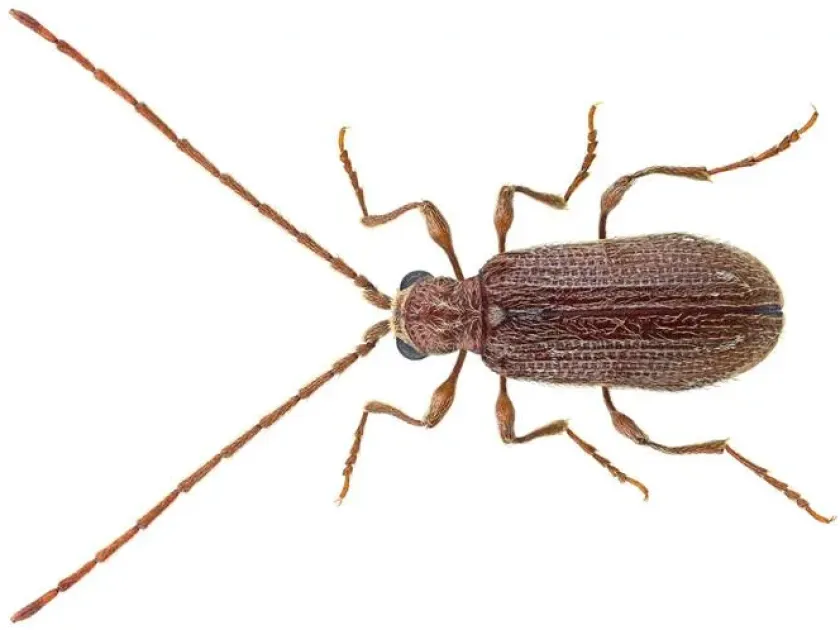
Adult beetles typically measure between 3 to 5 millimeters in length, possessing an elongated body covered in fine, dense hairs, usually brown or reddish-brown.
The larvae are C-shaped, legless, and white with a hardened brown head capsule, specialized for boring into the dense tissues of coniferous cones.
This species is highly adapted to a life cycle spent within the reproductive cones of various coniferous trees, primarily spruce and pine species.
Due to their cryptic behavior inside the host, they are often overlooked until significant damage to the seed crop is already established.
What it damages
The primary hosts of this beetle are the cones of various coniferous species, where larvae cause severe damage by feeding on seeds.
By tunneling through the cone scales and the central axis, the larvae destroy both the pulp and the developing seeds inside the cone.
This feeding activity significantly reduces the viability and quantity of the seed harvest, causing major losses for forestry nurseries.
The structural damage caused by the larvae also leads to the premature drying and malformation of the cones before natural shedding.
In outbreaks, the pest can jeopardize reforestation efforts by destroying the majority of the available viable seeds in a given seed orchard.
When it appears
Adult beetles typically emerge in late spring or early summer, coinciding with the development phase of young cones.
Mated females lay their eggs on the surface or within the crevices of young cones, providing larvae immediate access to food upon hatching.
The larval stage spans most of the summer, as they burrow deep inside the cone to feed and develop safely from environmental threats.
The life cycle can be completed in one year, though it may take two years in cooler climates depending on seasonal temperatures.
Pupation usually occurs within the host cone, and the new generation of adults overwinters either inside the cone or as larvae in the debris.
Signs of infestation
The most visible indicator of an infestation is the presence of small, circular exit holes on the outer scales of the cones.
Accumulated frass, which looks like fine sawdust or debris, can often be found near the base of the cones or on the branches below.
Affected cones often appear stunted, deformed, or discolored compared to healthy ones in the same canopy.
Internally, the cone structure is hollowed out, with tunnels visible in the scales and the central stem, confirming the presence of the beetle.
A simple check by squeezing the cone will reveal structural weakness, as infested cones crumble easily due to the larval feeding.
Control measures
Sanitation is the primary method of control, involving the collection and destruction of infested cones to prevent adult emergence.
Monitoring using pheromone traps or visual surveys of cone density can help determine the timing for necessary protective interventions.
In commercial seed orchards, targeted insecticide applications may be used during the peak flight period of adult beetles to reduce egg-laying.
Biological control through the preservation of natural predators and parasitoids is a sustainable approach for managing population levels in forests.
Maintaining healthy tree stands and avoiding overly dense planting can also reduce the overall susceptibility of the trees to beetle attacks.
Taxonomy
- Latin name
- Ernobius conicola
- Order
- Coleoptera (beetles)
- Family
- Anobiidae
- EPPO code
- ERNOCO
Discussion
No discussions yet — be the first.