
Narrow-necked anobiid
Ernobius angusticollis
Description
How to identify
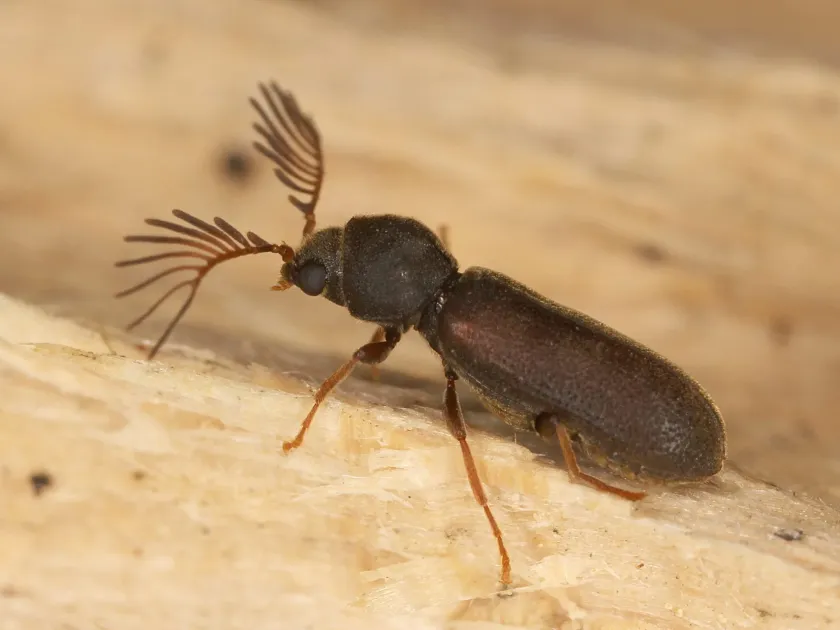
The narrow-necked anobiid (Ernobius angusticollis) is a member of the Ptinidae (formerly Anobiidae) family within the order Coleoptera. Adult beetles are small, ranging from 3 to 5 mm in length, and possess a distinct elongated, cylindrical body.
The coloration of these beetles typically ranges from reddish-brown to dark brown, with the entire body covered in fine, short hairs. The pronotum is narrow, which provides the species with its common name, and the head is largely retracted into the thorax.
The larvae are white, slightly curved, and equipped with a robust chewing mouthpart. They are perfectly adapted for tunnel-boring within woody tissues, spending their entire juvenile life cycle inside coniferous reproductive organs.
As a specialized wood-boring insect, it primarily targets the cones of various conifer species. Its life cycle is synchronized with the development of the cones, ensuring a consistent food supply for the developing larvae.
Identification often requires careful microscopic examination of adult genitalia, as the external morphology of Ernobius angusticollis is very similar to other related species inhabiting coniferous forest ecosystems.
What it damages
The primary hosts of the narrow-necked anobiid are the cones of pine and spruce trees. The larvae cause significant damage by tunneling through the cone scales and destroying the seeds located within the seed chambers.
This feeding activity leads to the loss of viable seeds, which is a major concern for forestry operations and seed orchards aiming to collect high-quality genetic material for reforestation efforts.
Infested cones often show signs of structural degradation, such as premature drying, deformation, and loss of scales. In cases of high infestation, a large percentage of the crop may be rendered useless.
While the larvae are predominantly cone-dwellers, they can occasionally inhabit thin bark or damaged twigs of weakened trees, especially if the primary food source is depleted or environmental stress is high.
The economic impact is particularly felt in commercial seed plantations, where pest outbreaks necessitate extensive cleaning, sorting, and disposal of infested materials, driving up production costs.
When it appears
Adult beetles typically emerge in late spring or early summer, with peak flight activity often occurring between May and June, depending on local temperatures and the progression of the growing season.
After mating, females lay their eggs beneath the scales of developing cones. Once hatched, the larvae immediately begin boring into the cone tissue, starting their developmental cycle which remains internal for the duration of the larval stage.
The length of the life cycle varies depending on climate, with some populations completing development in a single year, while others in cooler climates may require two years to reach the adult stage.
Pupation takes place within the larval tunnels inside the cone. Upon transformation, the adult beetle bores a characteristic circular exit hole to emerge into the environment, ready to seek a mate and begin the next generation.
The survival of the population through winter is achieved by hibernating as larvae inside the protective environment of the host cone, which provides insulation against extreme cold.
Signs of infestation
The most visible sign of an infestation is the presence of numerous small, circular exit holes on the surface of the cones, indicating that the adults have already emerged from the interior.
A fine, brownish "frass" or sawdust found at the base of the tree or under the cone cluster is a primary indicator of active larval tunneling and feeding inside the host tissue.
Upon breaking open an infested cone, one can observe complex, irregular galleries filled with larval excrement, and the seed quality will be visibly poor or entirely absent due to the destruction of the interior.
Decreased density and brittleness of the cones are common signs of internal infestation, often preceding the premature dropping of cones from the branches before the natural shedding period.
- Circular exit holes on cone scales.
- Presence of brownish frass underneath the crown.
- Deformed or prematurely dried cones.
- Internal galleries and larval waste within the cone.
Control measures
The most effective strategy for managing this pest is the timely collection of cones before the adult beetles emerge. Ensuring that cones are harvested immediately upon maturity prevents the spread of the next generation.
Once collected, cones should be stored in secure, insect-proof facilities or containers to prevent any escaping adults from re-infesting new areas or neighboring healthy stocks.
Heat treatment of seeds or cones in specialized kilns is a highly effective method for killing larvae and eggs. This must be performed with careful temperature regulation to preserve the viability and germination rate of the seeds.
Sanitation practices, including the removal of fallen cones and debris from around plantations, are crucial to reducing the local reservoir of the pest and minimizing the risk of re-infestation.
Monitoring using pheromone traps can provide data on flight patterns, allowing forest managers to schedule harvest times or treatment applications precisely when the adult population is most vulnerable.
Taxonomy
- Latin name
- Ernobius angusticollis
- Order
- Coleoptera (beetles)
- Family
- Anobiidae
- EPPO code
- ERNOAN
Discussion
No discussions yet — be the first.