
Spruce cone borer
Ernobius abietis
Description
How to identify
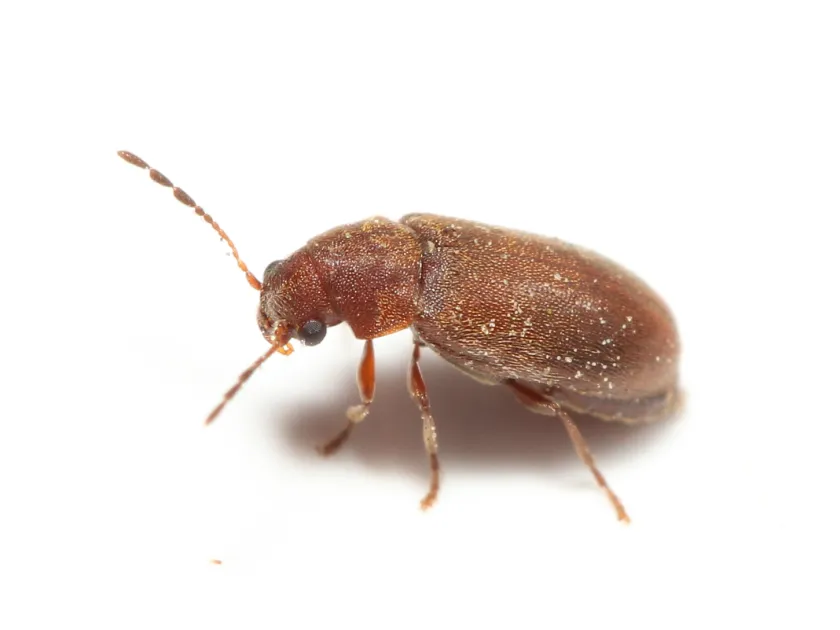
The spruce cone borer (Ernobius abietis) is a small beetle belonging to the family Anobiidae, within the order Coleoptera. Adult beetles are typically 3–5 mm in length, characterized by a cylindrical, brownish body covered with fine hairs.
They are specialized pests whose existence is strictly tied to the reproductive organs of spruce trees. The larvae are small, legless grubs with a distinct brown head, perfectly adapted for life inside woody tissue.
Adults possess functional wings, which they use to migrate between trees, especially during the mass flight period. Their morphology is evolved for camouflage, blending perfectly with the bark and scales of spruce cones.
The life cycle usually involves one generation per year, though specific weather conditions can slightly alter development times. Their biological strategy is to exploit high-yield seed years to maximize reproductive success.
Females are highly selective when choosing a site for oviposition, laying eggs deep between the scales of maturing cones to ensure the larvae have immediate access to nutrients.
What it damages
The spruce cone borer primarily targets Norway spruce and related Picea species. By feeding on the internal structures of the cones, these insects cause significant damage to the seed harvest.
Larvae tunnel through the cone core and consume developing seeds, effectively ruining the seed crop and preventing natural regeneration of the forest stand.
Heavy infestations can lead to premature cone drop and severe deformation. This renders the cones useless for commercial seed extraction and genetic conservation programs.
Beyond direct damage, the entry points created by the beetles and larvae serve as gateways for secondary pathogens, such as fungi, which further degrade the cone tissue.
In forestry, the economic impact is substantial as it reduces the yield of viable seeds, forcing nurseries to seek alternative sources and increasing reforestation costs.
When it appears
The emergence of adult beetles typically occurs in late spring and early summer, aligning perfectly with the development of fresh spruce cones on the trees.
Once eggs hatch, the larvae bore into the cone and feed continuously throughout the summer and autumn months, growing as they consume the inner seeds.
They pass the winter as larvae inside the cones, remaining in a state of diapause to survive cold temperatures. This developmental stasis is vital for their survival in northern climates.
Pupation takes place in early spring within the larval galleries. After a short pupal stage, the new generation of adults chews its way out to begin the cycle again.
Observing the phenology of both the trees and the beetle is crucial for predicting potential outbreaks and timing mitigation efforts effectively.
Signs of infestation
The most reliable sign of an infestation is the presence of small, circular exit holes on the exterior of the cone scales created by emerging adults.
Evidence of larval activity can often be spotted as fine, brownish frass or "wood flour" accumulating around the entry holes or on the scales.
Infested cones often exhibit signs of distress, such as premature browning, stunted size, and distortion, making them distinguishable from healthy cones on the tree.
Internal examination of a suspected cone will reveal a network of tunnels packed with granular excrement, along with the larvae or pupae themselves.
Early identification is often difficult, necessitating systematic sampling of cones from various levels of the canopy to accurately gauge the infestation level.
Control measures
Effective management begins with the timely harvest of cones before the beetles have a chance to emerge in the spring, thereby removing the pest from the cycle.
On specialized seed orchards, applying contact insecticides during the peak flight of adult beetles can prevent egg-laying and significantly reduce damage.
Silvicultural practices, such as maintaining healthy, well-spaced stands, help prevent the stress that makes trees more susceptible to pest colonization.
Storage of cones in secure facilities with controlled temperatures can ensure that any larvae present are neutralized before they complete their development.
- Systematic monitoring of flight periods.
- Sanitary removal of fallen and damaged cones.
- Use of biological control agents where applicable.
Taxonomy
- Latin name
- Ernobius abietis
- Order
- Coleoptera (beetles)
- Family
- Anobiidae
- EPPO code
- ERNOAI
Discussion
No discussions yet — be the first.