
Pine cone borer
Ernobius abietinus
Description
How to identify
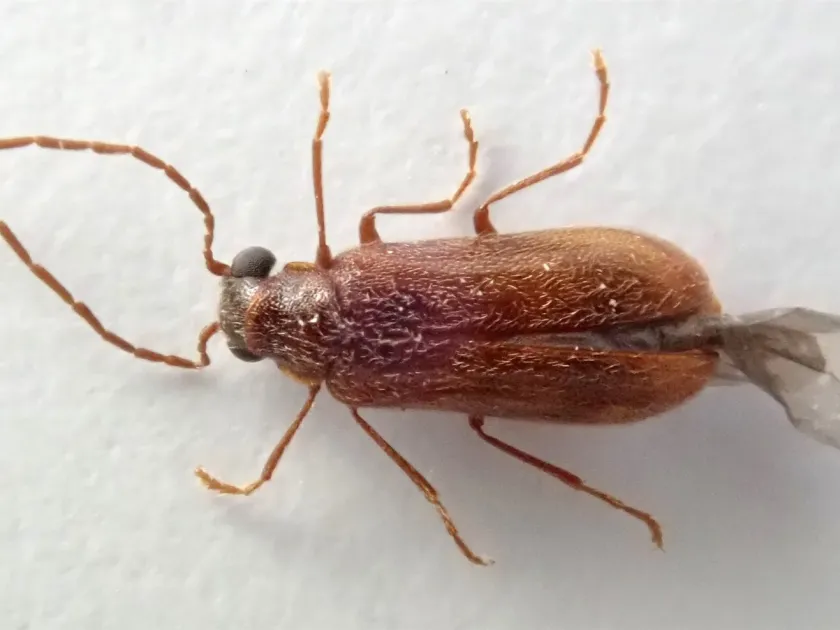
The pine cone borer Ernobius abietinus is a species of beetle belonging to the family Anobiidae (death-watch beetles) in the order Coleoptera. Adult beetles are small, typically ranging from 3 to 5 millimeters in length, with a brownish, hairy body.
The larvae are specialized for boring into the reproductive structures of coniferous trees. They possess a soft, slightly curved, whitish body and a well-developed head with mandibles suitable for consuming tough woody tissues of pine cones.
The species is taxonomically distinct due to its specialized life cycle associated with the development of pine cones. Its evolutionary history is closely linked to the availability of cones from specific host species, primarily pines.
Adult beetles are nocturnal or crepuscular, often hiding during the day to avoid predators. Their cryptic coloration helps them blend in with the bark of coniferous trees, making them difficult to spot without specific trapping methods.
The survival of the species relies on the synchronization of their life cycle with the physiological development of the cones, ensuring that food resources are available when the larvae hatch.
##damage##Larvae primarily feed on the scales and seeds of the Scotch pine (Pinus sylvestris) and other related conifers. This feeding activity causes direct economic losses by destroying the seeds within the cones.
Damage is most severe in seed orchards and nurseries where the quality and quantity of seeds are essential for reforestation efforts. Significant infestations can lead to a complete loss of the annual seed harvest on affected trees.
Feeding tunnels created by the larvae disrupt the structural integrity of the cones, leading to deformation, premature drying, and failure to open properly, which complicates mechanical seed extraction.
The internal damage caused by the larvae also facilitates the entry of secondary pathogens, such as fungi, which can spread to healthy parts of the cone or even the tree itself, weakening the plant.
In years with heavy infestations, the cumulative impact of the pine cone borer can severely hinder natural forest regeneration and lead to substantial financial deficits for forestry enterprises.
##season##The flight period of adult beetles usually occurs during the late spring and summer months, coinciding with the development and maturation stages of the young cones.
Larval development occurs throughout the summer and into the autumn. They remain active inside the cones, growing and creating complex galleries as they consume the inner tissues and seeds.
The winter period is typically spent in the larval stage, either inside cones still attached to the tree or in those that have fallen to the forest floor under the layer of leaf litter.
Pupation takes place in the spring, once temperatures rise. Shortly after, the new generation of adults emerges through small exit holes to begin the reproductive cycle once again.
Effective monitoring must take place during the peak flight season to determine the appropriate timing for any necessary protective measures, such as the application of insecticides.
##signs##The most visible sign of infestation is the presence of small, circular exit holes on the exterior of the cone scales, left behind by adults after they emerge.
Fine, brownish sawdust-like frass (excrement) scattered beneath the trees or collected at the base of the cone stalks is a clear indicator that larvae are actively feeding inside.
Externally, affected cones often appear smaller, deformed, or discolored compared to healthy cones on the same tree, showing signs of premature browning or shriveling.
Dissecting a suspect cone reveals internal tunnels packed with bore dust and frass, and often the presence of larvae or empty pupal chambers within the seeds or scales.
- Small circular exit holes (approx. 2mm) on cone surface
- Presence of fine brown frass on branches or ground
- Premature browning and deformation of cones
- Lack of viable seeds inside damaged cones
The primary control measure involves forest hygiene practices, such as the early collection and proper disposal of fallen cones to reduce the overwintering population of the pest.
In seed orchards, targetted insecticide applications during the adult flight period can be effective in preventing egg-laying on the developing cones.
Pheromone traps are increasingly used to monitor beetle population density, providing managers with the data needed to time interventions accurately and minimize chemical usage.
Storage management is crucial; harvested cones should be stored in areas where temperature and humidity are controlled to prevent further development of any larvae present at the time of collection.
Biological control, including the protection and encouragement of natural parasitoid wasps, is also essential for maintaining long-term population balance in forested areas.
Taxonomy
- Latin name
- Ernobius abietinus
- Order
- Coleoptera (beetles)
- Family
- Anobiidae
- EPPO code
- ERNOAB
Discussion
No discussions yet — be the first.