
Epauloecus
Epauloecus
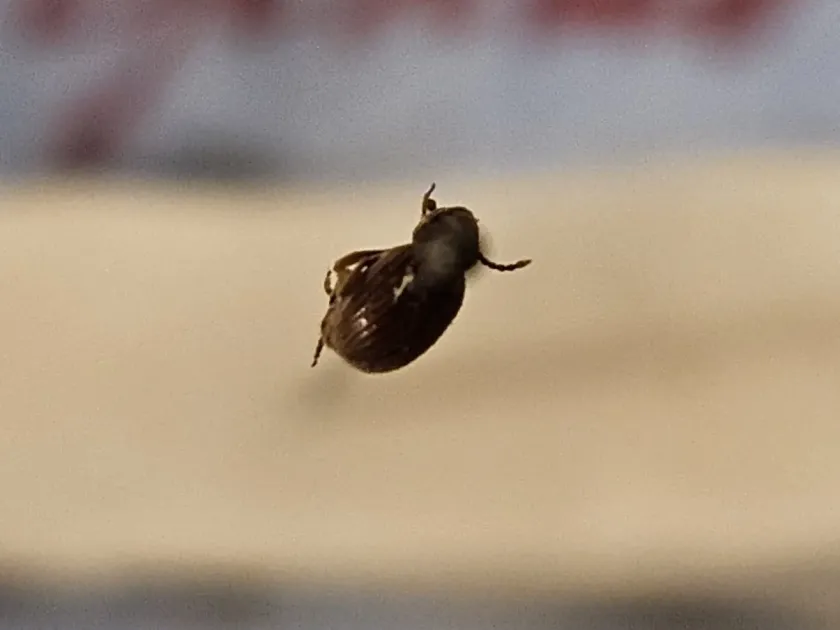
Description
How to identify
Epauloecus is a genus of beetles belonging to the Ptinidae family, commonly known as spider beetles. These insects are characterized by their rounded bodies, often covered with dense hairs or scales, which help them blend into their surroundings.
Adult beetles lead a secretive lifestyle and are primarily nocturnal. Their size is small, typically only a few millimeters in length. The head is tucked closely against the pronotum, a hallmark morphological feature of this group of stored-product pests.
The larvae of Epauloecus have a distinct appearance typical of spider beetles: they are C-shaped, creamy white, with a well-developed head and strong mandibles designed for boring into dry plant materials.
Systematically, this genus is closely related to better-known storage pests, but it can also be found in specific field conditions associated with the accumulation of organic waste or debris.
Accurate identification of the species often requires microscopic analysis of genitalia and elytral punctuation, as different species within the genus can look extremely similar to the naked eye.
What it damages
The primary food source for Epauloecus consists of dry plant matter. In an agricultural context, this pest most commonly infests stored grains, pulses, seeds, and other dry goods in storage facilities.
Beyond storage sites, beetles may occasionally be found in fields near unharvested plant debris, where they feed on decaying organic matter, though direct damage to growing crops is rare.
The larval stage poses the most significant threat, as they bore galleries inside seeds, reducing their weight, germination potential, and overall commercial value.
Larval waste products, including frass and silken webbing, significantly contaminate seed batches, rendering them unsuitable for food or planting purposes.
Under high humidity conditions in warehouses, the pest reproduces much faster, promoting the growth of secondary mold and accelerating the spoilage of stored commodities.
When it appears
Epauloecus activity in heated facilities and warehouses can occur year-round, provided the temperature remains favorable for larval development.
In unheated warehouses or natural environments, the development cycle slows down during the winter as insects enter a state of diapause to survive unfavorable temperatures.
Mass emergence of adult beetles is often tied to the warmer season, when temperature levels reach optimal thresholds for active mating and oviposition.
The insect's life cycle is highly dependent on environmental humidity: with optimal levels (above 60%), a full generation can develop within just a few months.
Monitoring for the presence of this pest should begin in early spring, especially in areas where grain residue or dust accumulates, as these serve as primary reservoirs for infestation.
Signs of infestation
The primary signs of Epauloecus presence include damaged or "eaten" seeds, inside which small, circular holes bored by larvae are visible.
On the surface of stored goods, one can observe accumulations of powdery dust consisting of grain particles and fine larval excrement.
During inspections of storage areas, adult beetles are frequently found; when disturbed, they exhibit "thanatosis" (playing dead), pulling in their legs and remaining motionless.
Infested grain batches may emit a distinct, unpleasant odor caused by larval waste products and the concurrent development of secondary microorganisms.
Another characteristic sign is the presence of empty larval skins or adult carcasses in areas where they congregate, such as floor crevices or corners of storage containers.
Control measures
The cornerstone of control is maintaining strict sanitary conditions in storage facilities: regular wet cleaning, removal of spills, and elimination of dust where pests accumulate.
Physical control methods, such as winter freezing of facilities or heat treatment of grain, effectively eliminate all developmental stages of the Epauloecus beetle.
Sealing storage facilities and maintaining low grain moisture (below 13%) are critical steps, as dry products are significantly less attractive for infestation.
If high pest populations are detected, fumigation of storage facilities using approved insecticides is necessary, strictly following regulatory application guidelines.
- Thorough cleaning of equipment after the season
- Use of pheromone traps for monitoring
- Chemical seed treatment for protection
- Maintenance of clean surrounding areas
Taxonomy
- Latin name
- Epauloecus
- Order
- Coleoptera (beetles)
- Family
- Anobiidae
- EPPO code
- EPAUSP
Discussion
No discussions yet — be the first.