
Spruce furniture beetle
Dryophilus pusillus
Description
How to identify
The spruce furniture beetle (Dryophilus pusillus) is a small wood-boring insect belonging to the family Anobiidae, commonly found in coniferous forests and landscapes.
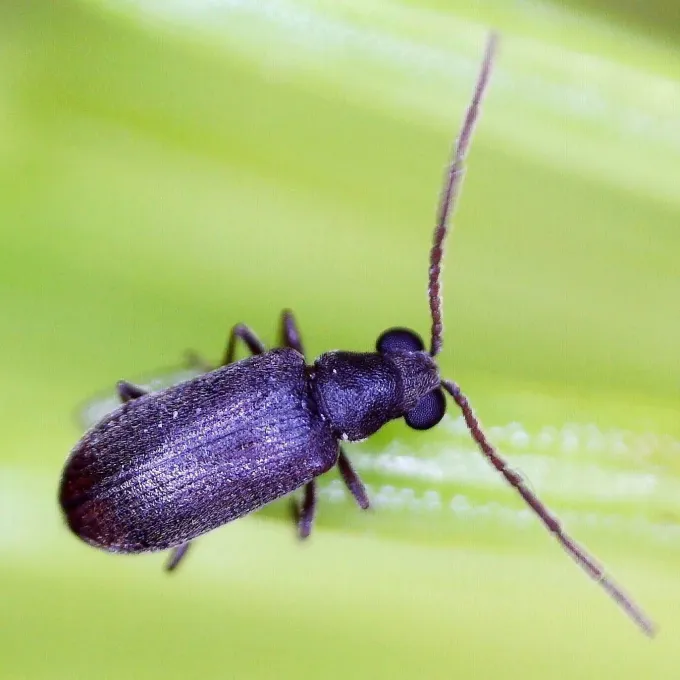
Adult beetles are tiny, measuring between 2.5 and 3.5 mm in length, and possess a cylindrical body covered in fine hairs, giving them a dull, matte brown or black appearance.
A key identifying feature is the pronotum, which is dome-shaped and partially covers the head, making the head invisible when viewed from directly above.
The larvae are typically white or cream-colored, C-shaped, and equipped with strong mandibles adapted for tunneling through the woody tissues of spruce branches.
As members of the order Coleoptera, they undergo complete metamorphosis and are highly specialized to thrive on the branches of various spruce and pine species.
What it damages
The primary hosts for this pest are Norway spruce and other related species, although it can occasionally infest various conifers that are already under stress.
Infestations typically begin on smaller, thinner branches within the lower and middle canopy, where moisture levels are optimal for larval development.
Larvae consume the inner bark and outer sapwood, creating extensive galleries that disrupt the vascular system and transport of nutrients throughout the branch.
Visible symptoms of damage include the loss of needles and the progressive death of infected twigs, leading to a thinning and unsightly canopy.
In ornamental garden settings, this beetle can significantly degrade the aesthetic value of spruce trees, making them look sparse and unhealthy.
When it appears
Adult beetles typically emerge in late spring, specifically during May and June, seeking mates and suitable egg-laying sites on host trees.
Females deposit their eggs into bark crevices, bud scales, or pre-existing exit holes, ensuring the newly hatched larvae have immediate access to wood.
Larval development is a slow process that spans the entire growing season, with the insects feeding continuously until they reach maturity.
Pupation occurs within small chambers carved deep into the wood, where the insects may remain during the winter before emerging as adults the following spring.
The life cycle can vary based on local climatic factors, occasionally requiring two years for a full generation to complete if conditions are suboptimal.
Signs of infestation
The most reliable indicator of an infestation is the presence of small, perfectly circular exit holes (1–1.5 mm) on the surface of the bark.
A pile of fine, sawdust-like frass (boring dust) accumulating in branch axils or on the ground beneath the tree is a strong sign of active larval activity.
Branches that appear yellowed, withered, or brittle despite adequate environmental conditions often house developing beetle colonies inside the wood.
Careful inspection of the tree canopy might reveal snapped twigs with internal galleries, which are often packed with yellowish or brownish waste material.
- Circular emergence holes on twigs.
- Presence of sawdust-like frass on bark.
- Premature yellowing and needle drop.
- Weakened or snapped branches within the crown.
Control measures
Sanitation is the most critical management practice; all infested or dead branches should be pruned and destroyed to reduce the local beetle population.
Maintaining tree vigor through proper irrigation, mulching, and balanced fertilization makes trees less susceptible to initial colonization by the beetles.
Chemical control via systemic or contact insecticides can be timed to coincide with the spring adult emergence to protect the tree before egg-laying occurs.
Encouraging biodiversity by protecting natural predators, such as woodpeckers and specialized parasitic wasps, can provide long-term biological control.
Regular monitoring of coniferous collections is essential to catch early signs of infestation and implement control measures before significant damage occurs.
Taxonomy
- Latin name
- Dryophilus pusillus
- Order
- Coleoptera (beetles)
- Family
- Anobiidae
- EPPO code
- DRYPPU
Discussion
No discussions yet — be the first.