
Spruce wood borer
Anobium thomsoni
Description
How to identify
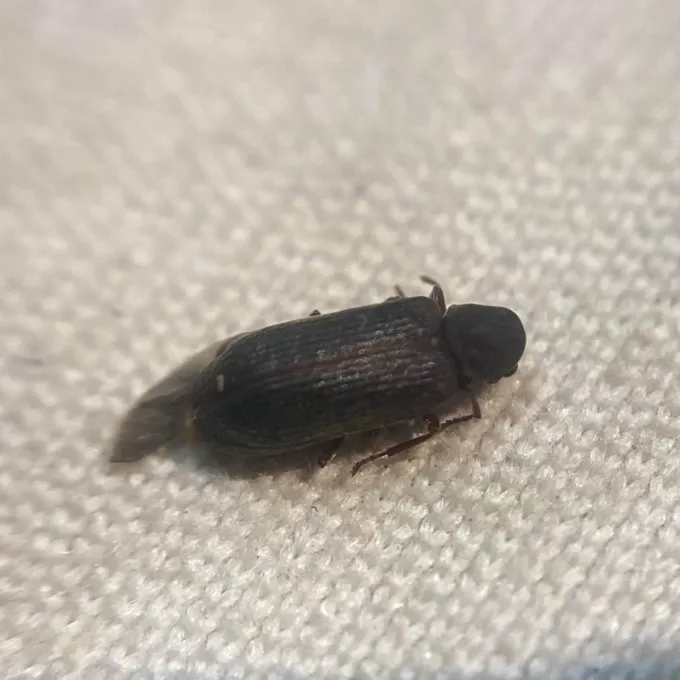
The spruce wood borer (Anobium thomsoni) belongs to the family Anobiidae, commonly known as death-watch beetles or wood borers. These beetles are small, usually ranging from 3 to 5 mm in length, with a cylindrical body shape.
The head of the adult beetle is tucked under the pronotum, a structural adaptation that makes it difficult to see from above. Their bodies are typically brown or dark brown and covered with fine, short hairs.
Larvae are the primary stage of development that causes damage; they are white, C-shaped, and equipped with strong mandibles adapted for boring through hard wood fibers.
The life cycle of the beetle is significantly influenced by the moisture content of the wood. Adults emerge during the warmer seasons, leaving behind characteristic round exit holes in the timber.
Identifying this species in the field often involves careful examination of the exit hole diameter and the type of wood substrate, as they show a strong preference for spruce (Picea) and other coniferous species.
What it damages
The spruce wood borer primarily attacks spruce trees. In forest environments, it thrives on weakened, diseased, or fallen trees, where it plays a role in the natural decomposition of woody debris.
In human-made structures, the borer becomes a significant pest. The larvae create extensive, complex networks of tunnels inside wooden beams, flooring, and structural timber, compromising their integrity.
The damage is often hidden from view, as the beetle works deep within the wood, leaving only small exit holes on the surface when they complete their cycle and emerge as adults.
Over time, infested wood becomes structurally unsound, appearing brittle and filled with fine wood dust. Left untreated, the wood can lose its load-bearing capacity, leading to severe structural failure.
Construction materials that have not been adequately seasoned or treated with preservatives are particularly susceptible to infestation, especially if stored in humid environments.
Signs of infestation
The most visible sign of an infestation is the presence of numerous small, round holes on the surface of the wood, known as "shot holes," where adult beetles have emerged.
Accumulated frass, a fine powdery dust produced by the larvae, is a key indicator of active infestation. This dust is often found in small piles beneath the affected wooden elements.
In quiet environments, a faint clicking or tapping sound may be heard. This is produced by the beetles as they strike their heads against the walls of their tunnels, often as part of mating behavior.
Affected wood often shows signs of internal degradation when tapped; a dull, hollow sound indicates that the interior has been significantly riddled with tunnels.
A cross-section of infested wood reveals a chaotic maze of tunnels packed with wood debris and larval excrement, which clearly demonstrates the extent of the internal damage caused.
Control measures
Preventive measures are the most effective way to manage the spruce wood borer. This includes using chemical preservatives during the construction phase to make the wood unattractive to egg-laying females.
Proper timber management is essential: storing wood in dry, well-ventilated areas prevents the high moisture levels that these beetles require to complete their life cycle successfully.
In cases of existing infestations, localized insecticide injections into the tunnels or total surface saturation with professional-grade wood treatments are recommended to eradicate the population.
In forest management, sanitary felling and removal of dead or dying spruce trees help reduce the breeding population, preventing the spread of the beetle to healthy stands.
- Application of wood preservatives and insecticides.
- Regular monitoring of stored timber for exit holes.
- Sanitary removal of infected trees in forest areas.
- Maintaining low humidity in buildings and storage facilities.
Taxonomy
- Latin name
- Anobium thomsoni
- Order
- Coleoptera (beetles)
- Family
- Anobiidae
- EPPO code
- ANOBTH
Discussion
No discussions yet — be the first.