
Common furniture beetle
Anobium punctatum
Description
How to identify
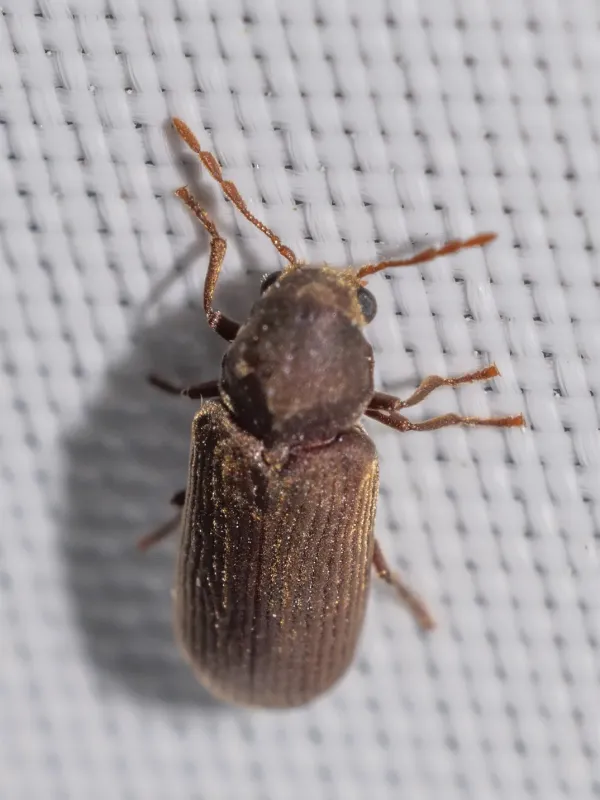
The Common furniture beetle (Anobium punctatum) is a member of the Ptinidae family (formerly Anobiidae). Adult beetles are small, ranging from 3 to 5 mm in length, with a cylindrical, dark brown body.
The pronotum, or the segment covering the head, resembles a hood, giving the insect a distinct appearance when viewed from above. The wing cases feature rows of fine punctures.
The larvae are typically white, C-shaped, and possess a soft, fleshy body with a hard-toothed head capsule capable of boring into dry, seasoned timber.
The life cycle varies significantly based on environmental conditions, typically spanning from one to three years, comprising the egg, larval, pupal, and adult stages.
Females lay eggs in small cracks, pores, or previously used exit holes, ensuring the offspring have immediate access to a food source upon hatching.
##damage##This pest primarily attacks seasoned, dry wood of both hardwood and softwood species. It is a notorious destroyer of furniture, flooring, and structural timbers.
The larvae are the destructive stage, tunneling deep into the wood and leaving a network of intricate galleries filled with powdery frass.
Structural damage can be severe, leading to significant weakening of floor joists, support beams, and antique furniture, potentially causing total failure of the items.
Beyond structural wood, they also infest museum artifacts, wooden carvings, and stored timber, causing irreparable damage to cultural heritage items.
If left unchecked, the accumulation of larval activity eventually turns the internal section of the timber into a fragile, hollowed structure.
When it appears
Adult emergence typically occurs during the warmer summer months, generally spanning from late May to mid-August, when temperatures reach optimal levels.
In centrally heated homes or buildings, the life cycle may be accelerated, allowing for emergence to occur outside of the standard summer window.
Mating occurs shortly after the adults emerge from the wood, and the cycle continues as the next generation of eggs is deposited in suitable timber.
During the winter months, larvae remain embedded within the wood, continuing their feeding and tunnel expansion if ambient temperatures remain conducive.
Monitoring for emergence holes is most successful during the summer, as new, clean holes are a primary indicator of active infestations.
Signs of infestation
The most recognizable sign is the presence of small, circular exit holes, typically 1 to 2 mm in diameter, on the surface of the infested wood.
Small piles of powdery dust, known as frass, often accumulate beneath these exit holes, indicating recent activity by emerging beetles or larvae.
In highly infested areas, one may hear a faint ticking sound, often referred to as the "death watch" sound, produced by beetles during courtship.
Affected wood often sounds hollow when tapped, which indicates significant internal tunneling and loss of structural integrity.
Visible surface cracking or crumbling wood under minor physical pressure is a classic sign of long-term or advanced infestation.
Control measures
Maintaining low humidity levels, preferably below 12% moisture content, is the most effective way to make wood unattractive to this pest.
Small-scale infestations can be managed by injecting liquid insecticide formulations directly into the exit holes using a fine-tipped applicator.
Surface treatments with wood preservatives and insecticides can provide a protective barrier against future egg-laying and larval entry.
- Professional fumigation for severe, structural-wide infestations.
- Heat treatment to kill all life stages within the timber.
- Replacing heavily damaged timbers with pre-treated, durable materials.
Consistent vigilance and regular inspection of susceptible woodwork are essential for early detection and mitigation of the damage caused by these beetles.
Taxonomy
- Latin name
- Anobium punctatum
- Order
- Coleoptera (beetles)
- Family
- Anobiidae
- EPPO code
- ANOBPU
Discussion
No discussions yet — be the first.