
Arabian spider mite
Tetranychus arabicus
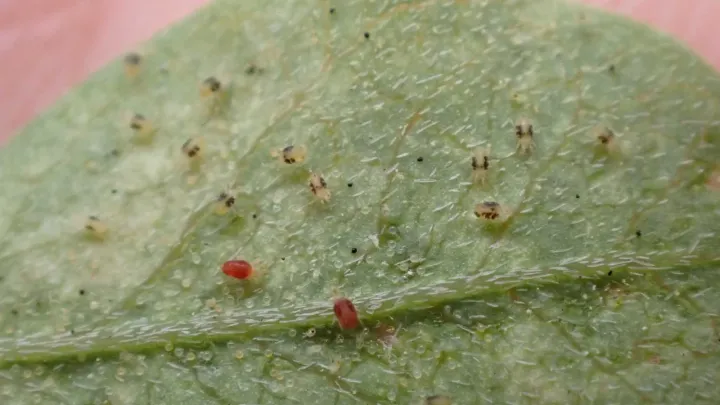
Description
How to identify
The Arabian spider mite (Tetranychus arabicus) is a member of the Tetranychidae family. It is a microscopic arachnid, measuring approximately 0.4 to 0.5 mm in length, making it difficult to detect with the naked eye.
Adult females are generally oval-shaped and can vary in color from pale green to brownish-red depending on their host plant and nutritional status. Dark spots are often visible on the sides of the abdomen.
The life cycle comprises the egg, larva, protonymph, deutonymph, and adult stages. This species is known for its rapid development rate, which is highly dependent on ambient temperature.
These mites inhabit the undersides of leaves, where they spin delicate silk webbing that serves as a protective barrier and a mechanism for dispersal.
The species reproduces sexually, and its populations can grow exponentially under favorable conditions, quickly colonizing the host plant.
What it damages
This mite is a highly polyphagous pest, capable of feeding on a wide variety of agricultural crops, particularly in warm climates and greenhouse environments.
Major crops affected include tomatoes, cucumbers, eggplants, peppers, and various ornamental plants. It also impacts legumes and cotton in many regions.
Mites use their specialized mouthparts to pierce plant tissues and extract cellular sap, which results in chlorophyll loss and cellular damage.
Large-scale infestations can cause severe physiological stress to the plant, significantly reducing the photosynthetic capacity and hindering normal growth.
In cases of heavy infestation, the cumulative damage leads to plant desiccation, premature leaf drop, and substantial losses in yield and fruit quality.
When it appears
In greenhouse settings, the Arabian spider mite can be active year-round, provided the temperature remains consistently above 20°C.
In outdoor conditions, activity typically begins in late spring, as temperatures rise, and continues through the warm summer months until autumn.
Hot, dry weather is the primary driver of rapid population growth, often shortening the complete life cycle of the mite to just over a week.
As temperatures decline in the autumn, fertilized females may enter a state of diapause, seeking shelter in soil debris or greenhouse structures to survive the winter.
Periods of extreme heat combined with low humidity are particularly favorable for outbreaks, as these conditions inhibit the development of natural predators.
Signs of infestation
The earliest symptom is the appearance of tiny chlorotic spots on the upper leaf surface, which correspond to feeding punctures on the underside.
As the infestation progresses, these spots coalesce, giving the leaves a stippled, mottled appearance. Eventually, leaves turn yellow, wilt, and dry up.
- Fine webbing observed on the undersides of leaves and between petioles.
- Loss of leaf turgor and overall plant vigor.
- Distortion and curling of leaves followed by premature abscission.
- Visible colonies of mites, eggs, and cast-off skins on the leaf surface under magnification.
Systemic damage often results in stunted plant growth and a significant reduction in the weight and marketability of the harvested crop.
Control measures
Integrated Pest Management (IPM) is essential for effective control, starting with strict field sanitation to remove weeds that harbor mite populations.
Biological control, utilizing predatory mites such as Phytoseiulus persimilis, has proven highly effective in greenhouse environments to keep mite numbers below economic injury levels.
Chemical control involves the use of specific acaricides. To prevent the development of pesticide resistance, it is crucial to rotate products with different modes of action.
Modifying the microclimate by increasing relative humidity to 70% or higher can discourage mite reproduction and create better conditions for natural enemies.
Regular scouting and early detection are critical. Targeted spot treatments can prevent small clusters of mites from becoming widespread, field-wide infestations.
Discussion
No discussions yet — be the first.