
Scymnus
Scymnus pullus
Description
How to identify
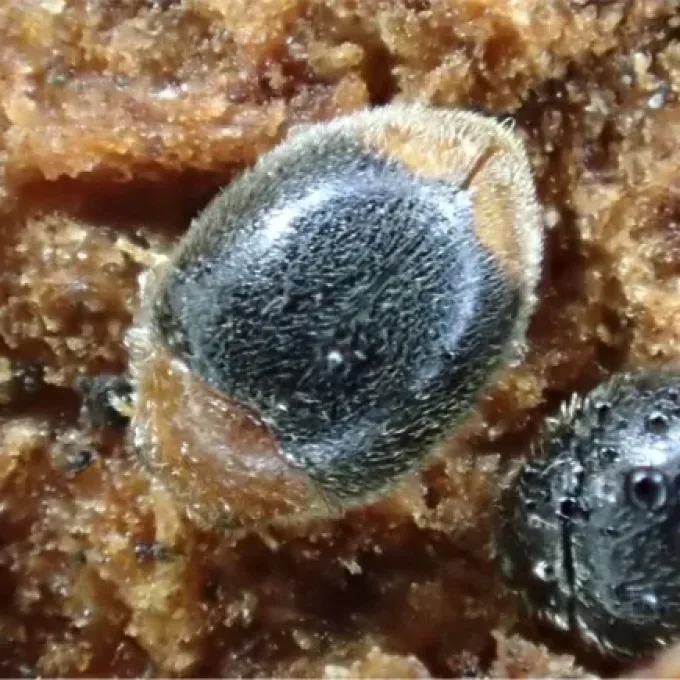
Scymnus pullus (Latin: Scymnus pullus) belongs to the ladybird beetle family (Coccinellidae), order Coleoptera. Unlike its larger predatory relatives, adult individuals of this species are very small, usually not exceeding 2–3 mm in length.
The body of the beetle is oval, convex, and covered with thick light hairs, giving it a grayish or brownish hue. The color of the elytra varies from dark brown to black.
Scymnus larvae are also distinguished by their miniature size. They have an elongated body shape and are covered with a white waxy coating, which often makes them visually resemble mealybugs, their typical prey.
The life cycle of the insect includes complete metamorphosis: egg, larva, pupa, and imago. Females lay eggs near colonies of potential victims, ensuring that larvae have immediate access to food after hatching.
Despite being systematic predators, under certain agricultural conditions or ecological imbalances, species of the genus Scymnus may exhibit non-typical feeding behavior or serve as an indicator of pest overpopulation.
What it damages
The main food source for Scymnus pullus consists of various species of aphids, coccids, and mealybugs. They are most commonly found on fruit trees, berry bushes, and greenhouse vegetable crops.
During mass outbreaks of the pests that Scymnus feeds on, females lay eggs directly in the clusters of their prey. Scymnus larvae are characterized by high voracity and can destroy a significant portion of an aphid colony.
However, the agronomic problem arises when, due to a sharp decline in the population of natural prey, the Scymnus beetle may change its habitat, switching to feeding on young plant shoots.
Damage manifests as injury to the epidermis of leaves and young buds, leading to deformation of leaf blades and slowing down the overall growth of the culture.
A particular danger is posed by damage to seedlings and young saplings in the early spring, when the scarcity of a natural food base forces the beetles to feed on plant tissues.
When it appears
The active development period of the insect begins with the establishment of stable positive temperatures, typically in late April or May.
Throughout one growing season, Scymnus can produce several generations, which directly depends on the regional temperature regime and the availability of food.
The peak activity of the imago occurs in the first half of summer when the concentration of aphids on vegetable and fruit crops is at its highest.
Adults overwinter primarily in litter, fallen leaves, tree bark, or in the topsoil layer, emerging from diapause during the first warm days.
Late generations of Scymnus enter hibernation when daily average temperatures drop below 10 degrees Celsius, hiding in shelters until the following spring.
Signs of infestation
The presence of insects can be noticed by the specific waxy secretions of the larvae on the underside of leaves, which are often mistaken for mealybug activity.
An indirect sign is the presence of characteristic small notches on the leaf edges, which differ from the damage caused by leaf-eating caterpillars.
With careful examination under a magnifying glass, miniature dark-colored beetles can be found on plant stems, actively moving in search of food.
The presence of Scymnus is also indicated by damaged apical buds, which begin to curl without visible signs of infectious diseases.
- Damage to the edges of leaf blades.
- Curling of young shoots.
- Presence of waxy coating on stems.
- Traces of excrement on the leaf surface.
Control measures
To prevent damage, the use of an integrated pest management (IPM) system aimed at maintaining the natural balance of entomophages is recommended.
If the economic threshold is exceeded, biological preparations based on bacterial cultures should be used, as they are less toxic to beneficial insects.
Chemical treatments should be carried out with caution; it is preferable to use selective insecticides that target specific pests.
An important element of control is the removal of weeds around fields or orchards, as they serve as reservoirs for the reproduction of various harmful organisms.
In greenhouse conditions, monitoring using pheromone or sticky traps is an effective method for the early detection of the population.
Discussion
No discussions yet — be the first.