
Caucasian ground beetle
Procerus gigas
Description
How to identify
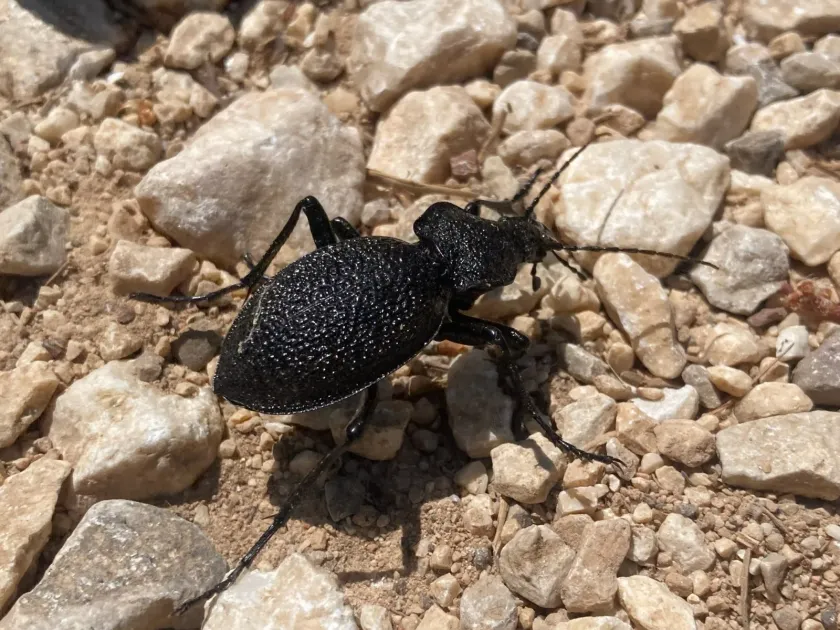
The Caucasian ground beetle (Latin Procerus gigas) belongs to the Carabidae family of the Coleoptera order. It is one of the largest beetle species in Europe, with adults reaching 50–55 mm in length.
Physically, the beetle has a massive body, typically black or dark blue, featuring a distinct granular texture on its elytra. They possess powerful mandibles and long legs, enabling them to move rapidly across the soil.
Larvae have elongated, slightly flattened bodies covered with dark chitinous plates. They lead a secretive lifestyle, primarily residing in the upper layers of moist soil or under leaf litter.
It is important to note that this species is considered rare and protected in many regions. It is often classified as a beneficial insect rather than a pest, as its primary food source is terrestrial mollusks.
Adult beetles are nocturnal and crepuscular, spending the daylight hours hiding under stones, in dense vegetation, or deep soil crevices, which makes monitoring their population quite challenging.
What it damages
The Caucasian ground beetle feeds primarily on terrestrial mollusks, including snails and slugs. Because of this, they serve as a crucial natural regulator of mollusk populations in gardens and forests.
However, when their natural prey is scarce, these beetles may consume plant material. They can occasionally cause minor damage to young seedlings or tender vegetative parts of garden plants.
Berries, such as strawberries, are most commonly targeted when prey is insufficient. Beetles may gnaw on the fruit, consuming the pulp, which often leads to the subsequent rotting of the berries.
Damage to ornamental flowers with delicate petals or succulent stems has also been reported, usually occurring as the beetles search for moisture or alternative food sources during drought periods.
In general, the damage caused by this species is considered negligible compared to specialized agricultural pests, and incidents of significant harm are typically localized and infrequent.
When it appears
The active period for the Caucasian ground beetle begins in early spring, as soon as the snow melts and the soil warms up, triggering the activity of their primary prey, the mollusks.
Peak adult activity occurs during May and June, coinciding with their mating and reproductive cycles. During this time, they are most visible in damp and shaded areas of the field or garden.
By mid-to-late summer, their activity levels decline. They tend to hide in deeper soil layers or under heavy mulch to survive dry periods and high temperatures.
In autumn, adults prepare for hibernation. They overwinter in the adult stage, burying themselves 20–30 cm deep into the soil or seeking refuge in natural cavities under logs, stones, or dense vegetation.
The beetle has a prolonged life cycle. Larvae pass through several developmental stages before pupating in the soil by early autumn, remaining there until they emerge as adults the following spring.
Signs of infestation
The primary sign of ground beetle presence is the appearance of distinct, irregular feeding marks on soft fruits or berries, often appearing as deep, ragged depressions in the pulp.
The presence of numerous empty snail shells near damaged plants is a strong indicator that a population of these predatory beetles is active, effectively hunting for mollusks in the area.
Beetles can often be spotted during night inspections using a flashlight or by checking the traps originally intended to capture slugs in the evening hours.
On the soil surface, one might observe the movement tracks of large insects, especially in loose, moist soil after a rainfall, which serves as a secondary indicator of their activity.
A notable reduction in the local slug population is often a clear sign that beneficial predatory insects, such as the Caucasian ground beetle, are successfully performing their role in the ecosystem.
Control measures
Given that the Caucasian ground beetle acts as a natural predator of slugs and snails, the use of broad-spectrum insecticides is strongly discouraged as it disrupts the natural balance.
The best management approach involves agrotechnical methods: keeping the area free of excess debris and weeds to reduce the favorable habitat for mollusks, which in turn reduces the need for the beetles to seek alternative food.
Installing physical barriers like gravel mulch or protective netting around highly susceptible berry crops can prevent the beetles from reaching the fruit without harming the insect population.
Managing irrigation to prevent excessive soil moisture in the root zone helps reduce the attractiveness of the garden to moisture-loving pests, including both slugs and large ground beetles.
If damage reaches an unacceptable level, targeted trapping or manual removal is preferred over chemical interventions to preserve the beneficial ecological role of these large predatory beetles.
Discussion
No discussions yet — be the first.