
Plautia lunulata
Plautia lunulata
Description
How to identify
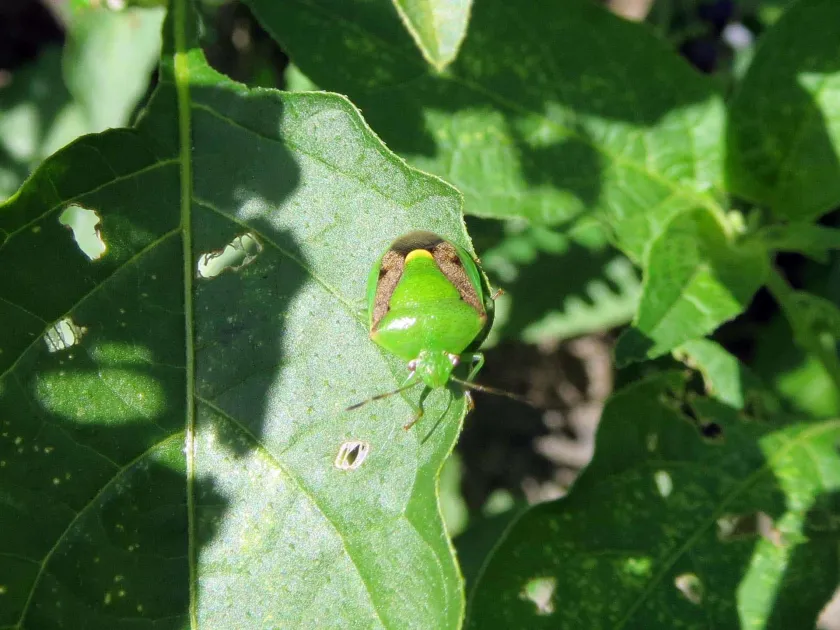
Plautia lunulata belongs to the family Pentatomidae, order Hemiptera. Adult specimens have a characteristic shield-like body shape typical of their family, reaching a length of about 10-12 millimeters.
The insect's coloration ranges from greenish to brownish-tan, allowing it to camouflage effectively on plant vegetation. The head is relatively small with prominent compound eyes on the sides.
A distinctive feature of this species is a clear, often yellowish or cream-colored spot on the apex of the scutellum, which serves as a primary diagnostic trait for identifying this insect.
The shield bug's antennae consist of several segments and serve as vital sensory organs, helping the insect locate host plants and mating partners within dense foliage.
Nymphs resemble smaller versions of the adults but lack fully developed wings and have a more rounded body shape, changing color as they progress through developmental instars.
What it damages
This pest is a polyphage, meaning it can feed on a wide range of agricultural and wild crops, causing significant economic losses in the agricultural sector.
Fruit crops, including apples, pears, and peaches, are among the most frequently affected, as the insect pierces the fruit skin to extract juices.
In addition to fruit trees, the pest damages legumes, affecting both young shoots and developing seeds within the pods, which leads to a sharp decline in crop quality.
Significant damage is also observed in berry patches, such as raspberries and blackberries, where the bug sucks juices from immature berries, causing deformation and subsequent rot due to pathogen introduction.
On large plantations, Plautia lunulata can spread rapidly by flying between plants, making control measures complex and requiring continuous field monitoring.
When it appears
The active life cycle of the shield bug begins in the spring when average daily air temperatures exceed the thresholds necessary for the insects to emerge from overwintering sites.
The mating and egg-laying period occurs during the early summer months when plants have the most succulent green mass, providing essential nutrients for developing offspring.
The pest goes through several generations over the summer, so population numbers can reach peak levels in the second half of the season, coinciding with the ripening period of major crops.
As autumn approaches and daylight hours decrease, adults enter a state of diapause, seeking overwintering spots in forest litter or beneath fallen leaves.
The number of generations per season depends directly on regional climatic conditions; in warmer zones, up to three generations can develop, significantly increasing the species' overall harmfulness.
Signs of infestation
The first sign of a shield bug infestation is the presence of specific puncture marks on the surface of leaves and fruit, which eventually turn into small necrotic spots.
At puncture sites, the fruit skin may deform, losing its marketability, while deep damage to the flesh can lead to rot or bacterial infection inside the fruit.
A characteristic indicator of the bug's presence is the specific unpleasant odor released by the insects when disturbed or mechanically irritated, especially in large aggregations.
On stems of infested plants, one can often see traces of "weeping" — the discharge of sap from punctures made by the insect's mouthparts, which dries quickly upon contact with air.
- Deformation of young fruits and berries.
- Appearance of yellow spots on leaves.
- Reduced seed viability due to damage to the embryo part.
- Presence of nymphs of different ages on the undersides of leaves.
Control measures
The fundamental method of controlling the pest is strict adherence to agronomic practices, including the removal of weeds in aisles that serve as temporary reservoirs for the bugs.
For small-scale farms, regular manual collection of adults and nymphs during the morning hours is recommended, as the insects are least active due to lower temperatures.
The use of biological control agents, such as entomophagous insects or fungus-based preparations, helps reduce shield bug populations without accumulating toxins in the fruit.
In cases of mass infestation, the application of systemic insecticides that target insects through sap feeding is justified, provided that usage strictly follows pre-harvest interval regulations.
An important element of an integrated pest management system is monitoring using pheromone traps, which allow for the early detection of the pest's migration into the field.
Discussion
No discussions yet — be the first.